

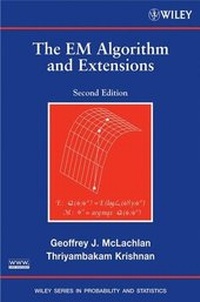
The EM Algorithm and Extensions
Description

Reviews / Votes
"The EM Algorithm and Extension, Second Edition, serves as an excellent text for graduate-level statistics students and is also a comprehensive resource for theoreticians, practioners, and researchers in the social and physical sciences who would like to extend their knowledge of the EM algorithm." (Mathematical Review, Issue 2009e)More details
Other editions
Additional editions
Persons
Content
Preface to the First Edition.
List of Examples.
1. General Introduction.
1.1 Introduction.
1.2 Maximum Likelihood Estimation.
1.3 Newton-Type Methods.
1.4 Introductory Examples.
1.5 Formulation of the EM Algorithm.
1.6 EM Algorithm for MAP and MPL Estimation.
1.7 Brief Summary of the Properties of EM Algorithm.
1.8 History of the EM Algorithm.
1.9 Overview of the Book.
1.10 Notations.
2. Examples of the EM Algorithm.
2.1 Introduction.
2.2 Multivariate Data with Missing Values.
2.3 Least Square with the Missing Data.
2.4 Example 2.4: Multinomial with Complex Cell Structure.
2.5 Example 2.5: Analysis of PET and SPECT Data.
2.6 Example 2.6: Multivariate t-Distribution (Known D.F.).
2.7 Finite Normal Mixtures.
2.8 Example 2.9: Grouped and Truncated Data.
2.9 Example 2.10: A Hidden Markov AR(1) Model.
3. Basic Theory of the EM Algorithm.
3.1 Introduction.
3.2 Monotonicity of a Generalized EM Algorithm.
3.3 Monotonicity of a Generalized EM Algorithm.
3.4 Convergence of an EM Sequence to a Stationary Value.
3.5 Convergence of an EM Sequence of Iterates.
3.6 Examples of Nontypical Behavior of an EM (GEM) Sequence.
3.7 Score Statistic.
3.8 Missing Information.
3.9 Rate of Convergence of the EM Algorithm.
4. Standard Errors and Speeding up Convergence.
4.1 Introduction.
4.2 Observed Information Matrix.
4.3 Approximations to Observed Information Matrix: i.i.d. Case.
4.4 Observed Information Matrix for Grouped Data.
4.5 Supplemented EM Algorithm.
4.6 Bookstrap Approach to Standard Error Approximation.
4.7 Baker's, Louis', and Oakes' Methods for Standard Error Computation.
4.8 Acceleration of the EM Algorithm via Aitken's Method.
4.9 An Aitken Acceleration-Based Stopping Criterion.
4.10 conjugate Gradient Acceleration of EM Algorithm.
4.11 Hybrid Methods for Finding the MLE.
4.12 A GEM Algorithm Based on One Newton-Raphson Algorithm.
4.13 EM gradient Algorithm.
4.14 A Quasi-Newton Acceleration of the EM Algorithm.
4.15 Ikeda Acceleration.
5. Extension of the EM Algorithm.
5.1 Introduction.
5.2 ECM Algorithm.
5.3 Multicycle ECM Algorithm.
5.4 Example 5.2: Normal Mixtures with Equal Correlations.
5.5 Example 5.3: Mixture Models for Survival Data.
5.6 Example 5.4: Contingency Tables with Incomplete Data.
5.7 ECME Algorithm.
5.8 Example 5.5: MLE of t-Distribution with the Unknown D.F.
5.9 Example 5.6: Variance Components.
5.10 Linear Mixed Models.
5.11 Example 5.8: Factor Analysis.
5.12 Efficient Data Augmentation.
5.13 Alternating ECM Algorithm.
5.14 Example 5.9: Mixtures of Factor Analyzers.
5.15 Parameter-Expanded EM (PX-EM) Algorithm.
5.16 EMS Algorithm.
5.17 One-Step-Late Algorithm.
5.18 Variance Estimation for Penalized EM and OSL Algorithms.
5.19 Incremental EM.
5.20 Linear Inverse problems.
6. Monte Carlo Versions of the EM Algorithm.
6.1 Introduction.
6.2 Monte Carlo Techniques.
6.3 Monte Carlo EM.
6.4 Data Augmentation.
6.5 Bayesian EM.
6.6 I.I.D. Monte Carlo Algorithm.
6.7 Markov Chain Monte Carlo Algorithms.
6.8 Gibbs Sampling.
6.9 Examples of MCMC Algorithms.
6.10 Relationship of EM to Gibbs Sampling.
6.11 Data Augmentation and Gibbs Sampling.
6.12 Empirical Bayes and EM.
6.13 Multiple Imputation.
6.14 Missing-Data Mechanism, Ignorability, and EM Algorithm.
7. Some Generalization of the EM Algorithm.
7.1 Introduction.
7.2 Estimating Equations and Estimating Functions.
7.3 Quasi-Score and the Projection-Solution Algorithm.
7.4 Expectation-Solution (ES) Algorithm.
7.5 Other Generalization.
7.6 Variational Bayesian EM Algorithm.
7.7 MM Algorithm.
7.8 Lower Bound Maximization.
7.9 Interval EM Algorithm.
7.10 Competing Methods and Some Comparisons with EM.
7.11 The Delta Algorithm.
7.12 Image Space Reconstruction Algorithm.
8. Further Applications of the EM Algorithm.
8.1 Introduction.
8.2 Hidden Markov Models.
8.3 AIDS Epidemiology.
8.4 Neural Networks.
8.5 Data Mining.
8.6 Bioinformatics.
References.
Author Index.
Subject Index.
