

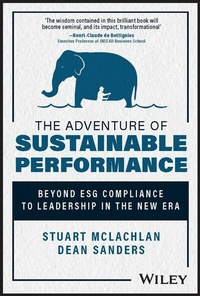
The Adventure of Sustainable Performance
Description

The Adventure of Sustainable Performance seeks out bold pioneers or forgotten pioneers who need reinvigorating and to be inspired with renewed purpose. Leaders who want more than just modest incremental efficiency gains, who want to create value, to deliver positive impact and meaningful change, should welcome this book. In a time of disruption like never before, boundaries will need revisiting, systems need reimagining, and assets need repurposing through wise stewardship.
The authors share their many years of experience serving clients and driving performance as the world transitions to a net zero carbon future. A future that uses resources sustainably and that seeks social justice. Through storytelling and interviews from many international leaders in business and sustainability, and by anchoring practical advice with evidence and truth, you will find:
* The avalanche of new regulations and changes to the compliance landscape
* The opportunity for value creation beyond compliance box ticking
* Inspirational stories on how ambitions can be reset
* A destination that supports ongoing prosperity for humanity from sustainable performance models
* How purpose driven brands generate superior value
* The role of 'Total Value Systems' as we move from shareholder to stakeholder capitalism models.
* The relationship between sustainability, talent and customer attraction
* How digital will play an increasingly important role as the world pivots in response to the climate crisis
Be in no doubt, The Adventure of Sustainable Performance describes an adventurous journey, uncomfortable at times, where a new and cold reality is dawning. But, in a period when the world will continue to play at denial or talk more of ruins, this book helps leaders to instead see foundations. Foundations upon which the new era will be built, and new systems of value will be realised.
Perfect for executives, managers, directors, and other business leaders, The Adventure of Sustainable Performance is an actionable guidebook for the implementation of value-add sustainability programmes.
More details
Other editions
Additional editions
Persons
DEAN SANDERS is Chief Enterprise Officer at Anthesis. He started his career at Jacobs Suchard in brand marketing before setting up GoodBrand in 1997. He has 25 years of experience in building sustainable performance strategies for some of the world's leading multinational consumer brand companies. Dean serves as an Honorary Fellow at Durham University Business School.
In 1997 Dean Sanders gave up his job leading the marketing team of a multinational food company to launch himself into a new adventure as the founder of one of the earliest advisory firms in sustainability, GoodBrand. In 2013, Stuart McLachlan, with his co-founders, took the step to move from his 17-year career in a large UK based PLC, to start a company designed to move the market from talk to action in sustainability, ESG and climate transition. In 2019, these two entrepreneurs and pioneers merged their enterprises. In The Adventure of Sustainable Performance, the authors share their insights and visions of the future for business, drawing on interviews with leaders working out how to take their organisations beyond the compliance agenda and on to the journey towards impact and performance.
Content
Prologue: Encounters with Elephants xix
Introduction xxv
PART I 'DAY 1': THE CHARGE 1
1 Reality Today, Tomorrow, and the Peril of Business as Usual 3
2 Strongholds The Fantasy of the Status Quo 23
3 Disruptions Change as Never Before 51
PART II THE CAMPFIRE 75
4 Reflections The Insufficiency of Compliance 77
5 Pivot Mindsets, Models, and Honouring Planetary Boundaries 105
6 Leadership Leaders, Organisational Will, and Guides 131
PART III 'DAY 2': THE REAPPROACH 161
7 Natives How Some Enterprises Are Built for Total Value 163
8 Journeyers How Established Enterprises Reconfigure for Day 2 179
9 Value A Reapproach to Defining and Creating Total Value 201
Conclusion 223
Appendix 1: The Anthesis Activator Journey 231
Appendix 2: Building Organisational Will and Operational Capabilities 233
Appendix 3: Classic Value Chain Compared with the Total Value System 235
Index 243
1
Reality: Today, Tomorrow, and the Peril of Business as Usual
The world is changing. We are in a liminal space and, as much as we might try to resist it, business as usual is no longer an option for the long term. The social and economic foundations that we have come to rely upon are being undermined and nature is becoming recognised as an unpredictable yet 'essential partner', if we are to continue to thrive.
At the same time, however, this 'essential partner' is showing signs of stress and even collapse as years of exploitation take their toll on fragile ecosystem balances we assumed would be ever unchanging. Due in part to these seismic changes, the external landscape affecting businesses is shifting, bringing with it questions without clear answers and a lot of uncertainty. In short, we have come to the end of the current era, and change now is inevitable, not optional.
The Size of the Challenge
Prior to 1946, when a group of surrendered German scientists strapped a camera to a V-2 ballistic missile, we hadn't yet seen the Earth from space. It was a fuzzy first, a black and white image, and remarkable, but it isn't the one most of us think about. We tend to remember the incredible globe shot, from the Apollo 8 mission, which was taken almost 20 years later, captured by Bill Anders as Frank Borman came round the moon for the fourth time.
Known as 'The Earth Rising' it changed the way we view ourselves forever; it's what Ron Garan, an astronaut from more recent times, describes as 'the orbital perspective' and what others have called the overview effect. Those lucky to see it for real from space often describe the moment as one when your awareness shifts to a profound and deeply felt understanding, that the Earth is a single organism floating in nothing and that all our actions as individuals are acutely and intimately connected and have collective consequences we should all take responsibility for.
The reason why this is important is because 'whole Earth thinking' or systemic understanding was not affirmed in the minds of leaders when they made their business and organisational decisions in 1760. From then until very recently, decisions were made through a mechanistic lens: establishing or creating a need, designing a product or service, extracting resources to create, before sale and distribution. From spices, to coffee, to cars, to computers; from entertainment, to finance, to app stores and virtual art - everything we have consumed since 1760 has had an impact on our Earth system.
Throughout the Industrial Revolution to recent times, business and government were working under the illusion of an infinite planet. There was an endless cornucopia of resources to uncover and transform into products, and along with them the services to get them made and sold. People built fortunes, and economies thrived.
The results from this rapacious and highly successful industrial momentum have been variously brilliant, uplifting, destructive, and depleting. However, as we haven't really created that many rules or guardrails for this growth, we now live inside the consequences of that uncontrol. With every extraction comes an externality, and externalities have piled up around us, in heaps of slag or plastic waste, in measurable molecules throughout our water and air, in social realities of cultural decline and inequity.
The impacts grew as the economy grew, through waves of feast and famine, literally and metaphorically, and as growth continued apace, the consequences of our collective actions increased alongside it. Year-by-year, the unmeasured negative outputs from the industrial engine at the heart of the Western drive for growth increased to the point of visible and measurable change. But in the last century, people started to question whether the endless growth was really sensible and as we became more connected and globalised the impacts became more apparent.
What started as a few powerful, pioneering voices at the beginning of the second part of the twentieth century turned into a 'green' movement and then a sustainable one. As scientific improvement and the computing revolution dovetailed into incredible capability, the truth of the industrial experiment became ever more apparent.
That truth is now unarguable - even in a post-truth world.
Every day, we have at our fingertips trillions of data points. They crunch through machine-learning algorithms, fed by off-planet satellites and on-planet sensors, all analysed by some of the smartest scientists we have. Together they represent a movement of understanding that means we now know what we are doing, that it is affecting the whole Earth system, and with a level of detail unfathomable in 1760.
So, we now know what's going on, we have the knowledge but not yet the action. The 'why' we aren't making decisions based on this understanding will be unpacked in other chapters, but the driver for the transition is clear: the whole Earth system has been pushed beyond its limits by an old era industrial revolution that has reached its natural end point.
What comes next, and is already transitioning, is the move to a fully sustainable system as part of the Fourth Industrial Revolution. The first three transitioned through different base energy supplies - coal to oil and gas, then to nuclear, and now in the fourth we have renewables. Along with the rise of our technological capability we have all we need to become fully sustainable, but as with all change, the incumbent and existing powers are struggling to release their grip, with all the impact that has on our world.
The Speed of the Change
Alongside the size of the challenge is the need to act at a speed in line with the challenges; that means acting now and learning how to move fast. Just as it is difficult for humans to comprehend the size of the whole Earth challenge, it is equally difficult to understand the speed at which the whole Earth is changing. In just 262 years we have, as a species, taken our world from one of relative balance, into one of rapid extinction.
Let's delve into that for a moment - try to stop and really think about what fast actually means in this context. Unless you are Marty McFly from the 1980s Back to the Future movies, when we think of time, we base our understanding on our experience of what time is - this means a human perspective, grounded in our 80 years or so, if we're lucky.
It is almost impossible to step out of this into 'longer time', where we try to wrap our heads around how things like entire forest systems, oceans, and atmospheres are supposed to change.
These are huge complex webs with multiple forces acting upon them, that should heat, cool, move, and change over long spans of time so that the living organisms within them can adapt, to evolve, and to survive. But if those changes happen so fast that we don't have that time, then the reverse of those three things happens: we don't adapt, we don't evolve, and we don't survive.
In the last 30 years, we have pushed our Earth survival systems into that space. We should be adapting, evolving, and learning to survive (and thrive) at the speed the changes are happening. But we aren't.
In fact, when you step back and look at just those 262 years, it's only in the last few decades of that time that the size of the impact has become clear, which has allowed us to understand the speed. And in response to that, we might as well be standing still.
This is not meant to create an emotional response of fear and inaction in the face of the danger, but there is no point in talking about drivers without them containing the truth.
As leaders, many have moved through the ranks of businesses or started them up and grown to size inside the principles of endless growth: profit at all costs, destructive competition, an irresponsible approach to externalities, and a myopic focus. The drivers for success in business did not contain sustainability, and it is only just starting to influence core decision making. This means the huge behemoths are hard to change and the humans that have benefited have very little motivation to do so. In their situation, why would change seem so pressing and why would they feel the need to move at speed?
The truth is they haven't. So, nothing has moved fast. There were PR-creating reduction strategies, covering the reduction of waste, water use, and carbon, but only at the tinkering edge. There is a reason that, despite the sustainability movement being around for a few decades, all the indicators of change have still been going in the wrong direction. The necessary speed of solutions has yet to be activated.
The other truth we need to face as leaders is that everyone has to act and now. The speed of change has outstripped our ability to adapt alongside it. We failed to act as a collective. Whether by governments creating policy levers, businesses making bold choices, consumers demanding change; none of these have happened at the speed we need. As a result, we are now left with a world system - the Earth model, the economy, and us - all wrapped up in an extinction-level speed shift without the required response.
Given we now have the data and many of the solutions to these problems, the challenge is how do we catch up? How do we accelerate the changes...
