

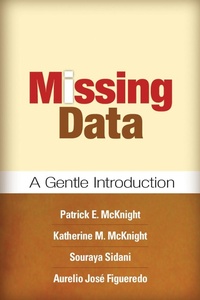
Missing Data
A Gentle Introduction
Published on 28. March 2007
251 pages
978-1-60623-820-2 (ISBN)
Description

Students and researchers in psychology, education, sociology, management, public health, nursing, and other behavioral and social science disciplines. Serves as a supplemental text in graduate-level courses on quantitative analysis, survey research, experimental design, or research methods, or as a primary text in a specialized course on missing data.
More details
Other editions
Additional editions
Book
05/2007
1st Edition
Guilford Publications
€45.00
Shipment within 15-20 days
Persons
Patrick E. McKnight, PhD, is Assistant Professor in the Department of Psychology at George Mason University, Fairfax, Virginia. The majority of his work focuses on health services outcomes and, in particular, on measuring those outcomes to make them readily interpretable. He has worked and published in the health-related areas of asthma, arthritis, cancer, speech, pain, low vision, and rehabilitation. Dr. McKnight is an active member of the American Evaluation Association, serving as co-chair of the quantitative methods topical interest group for the past 4 years. Katherine M. McKnight, PhD, teaches statistics at George Mason University, Fairfax, Virginia, and is Director of Evaluation for LessonLab Research Institute, part of Pearson Achievement Solutions. She has published numerous articles reflecting a wide range of interests, with the common underlying framework of the thoughtful use of research methods, measurement, and data analysis for addressing research and evaluation questions. She is a member of the American Evaluation Association and the Association for Psychological Science. Souraya Sidani, PhD, RN, is Canada Research Chair, Tier One, in Health Interventions Design and Evaluation at Toronto Metropolitan University. Aurelio José Figueredo, PhD, is Professor of Psychology at the University of Arizona. He is the director of the graduate program in Ethology and Evolutionary Psychology (EEP), a cross-disciplinary program integrating the studies of comparative psychology, ethology, sociobiology, and behavioral ecology, genetics, and development. His major areas of research interest are the evolutionary psychology and behavioral development of life-history strategy and sex and violence in human and nonhuman animals, and the quantitative ethology and social development of insects, birds, and primates. In the EEP he regularly teaches the graduate year-long course in Statistical Methods in Psychological Research.
Content
1. A Gentle Introduction to Missing Data
1.1. The Concept of Missing Data
1.2. The Prevalence of Missing Data
1.3. Why Data Might Be Missing
1.4. The Impact of Missing Data
1.5. What's Missing in the Missing Data Literature?
1.6. A Cost-Benefit Approach to Missing Data
1.7. Missing Data--Not Just for Statisticians Anymore
2. Consequences of Missing Data
2.1. Three General Consequences of Missing Data
2.2. Consequences of Missing Data on Construct Validity
2.3. Consequences of Missing Data on Internal Validity
2.4. Consequences on Causal Generalization
2.5. Summary
3. Classifying Missing Data
3.1. "The Silence That Betokens"
3.2. The Current Classification System: Mechanisms of Missing Data
3.3. Expanding the Classification System
3.4. Summary
4. Preventing Missing Data by Design
4.1. Overall Study Design
4.2. Characteristics of the Target Population and the Sample
4.3. Data Collection and Measurement
4.4. Treatment Implementation
4.5. Data Entry Process
4.6. Summary
5. Diagnostic Procedures
5.1. Traditional Diagnostics
5.2. Dummy Coding Missing Data
5.3. Numerical Diagnostic Procedures
5.4. Graphical Diagnostic Procedures
5.5. Summary
6. The Selection of Data Analytic Procedures
6.1. Preliminary Steps
6.2. Decision Making
6.3. Summary
7. Data Deletion Methods for Handling Missing Data
7.1. Data Sets
7.2. Complete Case Method
7.3. Available Case Method
7.4. Available Item Method
7.5. Individual Growth Curve Analysis
7.6. Multisample Analyses
7.7. Summary
8. Data Augmentation Procedures8.1. Model-Based Procedures
8.2. Markov Chain Monte Carlo
8.3. Adjustment Methods
8.4. Summary
9. Single Imputation Procedures
9.1. Constant Replacement Methods
9.2. Random Value Imputation
9.3. Nonrandom Value Imputation: Single Condition
9.4. Nonrandom Value Imputation: Multiple Conditions
9.5. Summary
10. Multiple Imputation
10.1. The MI Process
10.2. Summary
11. Reporting Missing Data and Results
11.1. APA Task Force Recommendations
11.2. Missing Data and Study Stages
11.3. TFSI Recommendations and Missing Data
11.4. Reporting Format
11.5. Summary
12. Epilogue
1.1. The Concept of Missing Data
1.2. The Prevalence of Missing Data
1.3. Why Data Might Be Missing
1.4. The Impact of Missing Data
1.5. What's Missing in the Missing Data Literature?
1.6. A Cost-Benefit Approach to Missing Data
1.7. Missing Data--Not Just for Statisticians Anymore
2. Consequences of Missing Data
2.1. Three General Consequences of Missing Data
2.2. Consequences of Missing Data on Construct Validity
2.3. Consequences of Missing Data on Internal Validity
2.4. Consequences on Causal Generalization
2.5. Summary
3. Classifying Missing Data
3.1. "The Silence That Betokens"
3.2. The Current Classification System: Mechanisms of Missing Data
3.3. Expanding the Classification System
3.4. Summary
4. Preventing Missing Data by Design
4.1. Overall Study Design
4.2. Characteristics of the Target Population and the Sample
4.3. Data Collection and Measurement
4.4. Treatment Implementation
4.5. Data Entry Process
4.6. Summary
5. Diagnostic Procedures
5.1. Traditional Diagnostics
5.2. Dummy Coding Missing Data
5.3. Numerical Diagnostic Procedures
5.4. Graphical Diagnostic Procedures
5.5. Summary
6. The Selection of Data Analytic Procedures
6.1. Preliminary Steps
6.2. Decision Making
6.3. Summary
7. Data Deletion Methods for Handling Missing Data
7.1. Data Sets
7.2. Complete Case Method
7.3. Available Case Method
7.4. Available Item Method
7.5. Individual Growth Curve Analysis
7.6. Multisample Analyses
7.7. Summary
8. Data Augmentation Procedures8.1. Model-Based Procedures
8.2. Markov Chain Monte Carlo
8.3. Adjustment Methods
8.4. Summary
9. Single Imputation Procedures
9.1. Constant Replacement Methods
9.2. Random Value Imputation
9.3. Nonrandom Value Imputation: Single Condition
9.4. Nonrandom Value Imputation: Multiple Conditions
9.5. Summary
10. Multiple Imputation
10.1. The MI Process
10.2. Summary
11. Reporting Missing Data and Results
11.1. APA Task Force Recommendations
11.2. Missing Data and Study Stages
11.3. TFSI Recommendations and Missing Data
11.4. Reporting Format
11.5. Summary
12. Epilogue
