

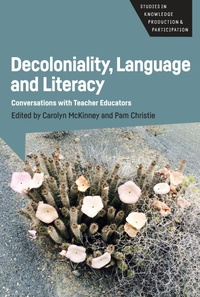
Decoloniality, Language and Literacy
Conversations with Teacher Educators
Published on 20. December 2021
240 pages
978-1-78892-926-4 (ISBN)
Description

Through a range of unconventional genres, representations of data, and dialogic, reflective narratives alongside more traditional academic genres, this book engages with contexts of decoloniality and border thinking in the Global South. It addresses processes of knowledge production and participation in the highly divided and unequal schooling and higher education system in South Africa, and highlights the consequences of the monolingual myth in post-colonial education, demonstrating opportunities for learning provided by translanguaging. It explores both embodied, multimodal and multilingual instances of knowledge-making in teaching and teacher education that take place outside but alongside formal classroom, lecture and seminar modes, and the positionality and learning experiences of teacher educators in science, literacy and language across the curriculum. The book is not only transdisciplinary but also captures the learning that takes place beyond the borders of disciplines and formal classroom spaces.
Reviews / Votes
Courageously following Harraway's injunction to 'stay with the trouble', this important edited collection confronts the complex and complicit nature of teaching language and literacy in contexts of coloniality, while simultaneously providing possibilities for rethinking practice. * Hilary Janks, Professor Emerita, Wits University, South Africa * Each chapter of this exceptional book offers a brave and uncompromising account of what universities must do to recognize the knowledge of marginalized multilingual students. Initially located in student protest in South Africa, the book quickly expands to address us all. It is an ethical call to action. * Angela Creese, University of Stirling, UK * McKinney and Christie have drawn on a wealth of experience to edit a compelling text on the relationship between decoloniality, language, and literacy. By identifying leading scholars who share their interest in language and power, the editors promote rich conversations on teacher education, multilingualism, coloniality, racism, poverty, and gender violence. Such conversations have profound relevance for teachers, researchers, and policymakers in contemporary education. * Bonny Norton, University of British Columbia, Canada * I don't have space in a review to do full justice to the various innovative ways this book will make you more aware not only of its immediate topic and context, but how it also challenges all of us to be more reflective aboutour own EAL contexts and reflect on our complicity in coloniality and our responsibility as educators to challenge it, within ourselves, our settings, and our system more generally. -- Frank Monaghan, The Open University, UK * EAL Journal, Spring 2022 * [The book] contributes to the expanding body of work on decolonising practices in teacher education that will interest not only teacher educators and teachers working in post-colonial settings, but also those preparing teachers for socially just schooling. * Indika Liyanage, Beijing Normal University, Hong Kong Baptist University, China, Comparative Education 59:1 * Apart from the rich data represented in the chapters, there are also instances of poetry and reflective pieces that offer another view to language inequality in formal education and demonstrate personal accounts of authors' own language experiences. The book is thus constructed as a cause for language activism and social justice in education in South Africa and promotes the possibility for 'third' space learning in engaging with the decolonial challenges of thinking within rather than about complex power relations of border conditions. * Amy Hiss, University of The Western Cape, South Africa, Multilingual Margins 2022, 9(2) *
More details
Series
Language
English
Place of publication
Bristol
United Kingdom
Target group
College/higher education
Product notice
Reflowable
ISBN-13
978-1-78892-926-4 (9781788929264)
Copyright in bibliographic data and cover images is held by Nielsen Book Services Limited or by the publishers or by their respective licensors: all rights reserved.
Schweitzer Classification
Other editions
Additional editions
Carolyn McKinney | Pam Christie
Decoloniality, Language and Literacy
Conversations with Teacher Educators
Book
12/2021
Multilingual Matters
€48.30
Shipment within 3-4 weeks
Persons
Carolyn McKinney is Associate Professor of Language Education in the School of Education, University of Cape Town, South Africa. She is the author of Language and Power in Post-Colonial Schooling: Ideologies in Practice (2017, Routledge).
Pam Christie is Emeritus Professor of Education, University of Cape Town, South Africa and Honorary Professor, The University of Queensland, Australia. She is the author of Decolonising Schooling in South Africa: The Impossible Dream? (2020, Routledge).
Pam Christie is Emeritus Professor of Education, University of Cape Town, South Africa and Honorary Professor, The University of Queensland, Australia. She is the author of Decolonising Schooling in South Africa: The Impossible Dream? (2020, Routledge).
Content
Acknowledgements
Contributors
Prologue
Chapter 1. Carolyn McKinney and Pam Christie: Introduction: Conversations with Teacher Educators in Coloniality
Part 1: De/coloniality in Schooling
Harry Garuba: Leaving Home at 10
Chapter 2. Xolisa Guzula: De/coloniality in South African Language in Education Policy: Resisting the Marginalisation of African Language Speaking Children
Chapter 3. Pinky Makoe: Navigating Hegemonic Knowledge and Ideologies at School: Children's Oral Storytelling as Acts of Agency and Positioning
Chapter 4. Robyn Tyler: Identity Meshing in Learning Science Bilingually: Tales of a 'Coconuty Nerd'
Part 2: Delinking from Coloniality in Teacher Education
Chapter 5. Kate Angier, Carolyn McKinney and Catherine Kell: Visual Essay: Teaching and Learning beyond the Classroom: What Can We Learn from Participating in Struggle with our Students?
Chapter 6. Annemarie Hattingh: Learning Science from umaGogo: The Value of Teaching Practice in Semi-rural School Contexts
Chapter 7. Rochelle Kapp: Engaging Deficit: Pre-service Teachers' Reflections on Negotiation of Working-class Schools
Chapter 8. Soraya Abdulatief: Thirdspace Thinking: Expanding the Paradigm of Academic Literacies to Reposition Multilingual Pre-service Science Teachers
Chapter 9. Carolyn McKinney: Delinking from Coloniality and Increasing Participation in Early Literacy Teacher Education
Chapter 10. Catherine Kell in conversation with Xolisa Guzula and Carolyn McKinney: Reinventing Literacy: Literacy Teacher Education in Contexts of Coloniality
Part 3: Conversations with Teacher Educators in Brazil, Canada and Chile
Chapter 11. Cloris Porto Torquato: Teacher Education amid Centralising/Colonial and Decentralising/Decolonial Forces
Chapter 12. Vanessa Andreotti and Sharon Stein: Education for Depth: An Invitation to Engage with the Complexities and Challenges of Decolonizing Work
Chapter 13. Natalia Avila Reyes: Transnational Connections in the Global South: A Reflection on this Book's Reception
Index
Contributors
Prologue
Chapter 1. Carolyn McKinney and Pam Christie: Introduction: Conversations with Teacher Educators in Coloniality
Part 1: De/coloniality in Schooling
Harry Garuba: Leaving Home at 10
Chapter 2. Xolisa Guzula: De/coloniality in South African Language in Education Policy: Resisting the Marginalisation of African Language Speaking Children
Chapter 3. Pinky Makoe: Navigating Hegemonic Knowledge and Ideologies at School: Children's Oral Storytelling as Acts of Agency and Positioning
Chapter 4. Robyn Tyler: Identity Meshing in Learning Science Bilingually: Tales of a 'Coconuty Nerd'
Part 2: Delinking from Coloniality in Teacher Education
Chapter 5. Kate Angier, Carolyn McKinney and Catherine Kell: Visual Essay: Teaching and Learning beyond the Classroom: What Can We Learn from Participating in Struggle with our Students?
Chapter 6. Annemarie Hattingh: Learning Science from umaGogo: The Value of Teaching Practice in Semi-rural School Contexts
Chapter 7. Rochelle Kapp: Engaging Deficit: Pre-service Teachers' Reflections on Negotiation of Working-class Schools
Chapter 8. Soraya Abdulatief: Thirdspace Thinking: Expanding the Paradigm of Academic Literacies to Reposition Multilingual Pre-service Science Teachers
Chapter 9. Carolyn McKinney: Delinking from Coloniality and Increasing Participation in Early Literacy Teacher Education
Chapter 10. Catherine Kell in conversation with Xolisa Guzula and Carolyn McKinney: Reinventing Literacy: Literacy Teacher Education in Contexts of Coloniality
Part 3: Conversations with Teacher Educators in Brazil, Canada and Chile
Chapter 11. Cloris Porto Torquato: Teacher Education amid Centralising/Colonial and Decentralising/Decolonial Forces
Chapter 12. Vanessa Andreotti and Sharon Stein: Education for Depth: An Invitation to Engage with the Complexities and Challenges of Decolonizing Work
Chapter 13. Natalia Avila Reyes: Transnational Connections in the Global South: A Reflection on this Book's Reception
Index
