

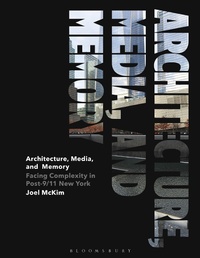
Architecture, Media, and Memory
Facing Complexity in Post-9/11 New York
1st Edition
Published on 13. December 2018
176 pages
978-1-350-03763-2 (ISBN)
Description

Architecture, Media and Memory examines the wide range of urban sites impacted by September 11 and its aftermath - from the spontaneous memorials that emerged in Union Square in the hours after the attacks, to the reconstruction at Ground Zero, to vast ongoing landscape urbanism projects beyond.
Yet this is not simply a book about post-9/11 architecture. It instead presents 9/11 as a multifaceted case study to explore a discourse on memory and its representation in the built environment. It argues that the reconstruction of New York must be considered in relation to larger issues of urban development, ongoing global conflicts, the rise of digital media, and the culture, philosophy and aesthetics of memory. It shows how understanding architecture in New York post-9/11 requires bringing memory into contact with a complex array of political, economic and social forces.
Demonstrating an ability to explain complex philosophical ideas in language that will be accessible to students and researchers alike in architecture, urban studies, cultural studies and memory studies, this book serves as a thought-provoking account of the intertwining of contemporary architecture, media and memory.
Yet this is not simply a book about post-9/11 architecture. It instead presents 9/11 as a multifaceted case study to explore a discourse on memory and its representation in the built environment. It argues that the reconstruction of New York must be considered in relation to larger issues of urban development, ongoing global conflicts, the rise of digital media, and the culture, philosophy and aesthetics of memory. It shows how understanding architecture in New York post-9/11 requires bringing memory into contact with a complex array of political, economic and social forces.
Demonstrating an ability to explain complex philosophical ideas in language that will be accessible to students and researchers alike in architecture, urban studies, cultural studies and memory studies, this book serves as a thought-provoking account of the intertwining of contemporary architecture, media and memory.
More details
Edition
1. Auflage
Language
English
Place of publication
London
United Kingdom
Publishing group
Bloomsbury Publishing PLC
Target group
College/higher education
Illustrations
17 bw illus
ISBN-13
978-1-350-03763-2 (9781350037632)
Copyright in bibliographic data and cover images is held by Nielsen Book Services Limited or by the publishers or by their respective licensors: all rights reserved.
Schweitzer Classification
Other editions
Additional editions
Book
12/2019
Bloomsbury Visual Arts
€62.08
Shipment within 15-20 days
Book
12/2018
Bloomsbury Visual Arts
€163.42
Shipment within 15-20 days
Person
Dr Joel McKim is director of the Vasari Research Centre in Art and Technology and co-director of the BA programme in Media and Culture at Birkbeck, University of London, UK.
Content
Introduction
Chapter One: Mourning and Protest: The Spontaneous Memorials at Union Square
Chapter Two: Absence and Plenitude: The National September 11 Memorial and Museum
Chapter Three: Creative Recall: Digital Design, Architecture and the Challenge of Memory
Chapter Four: Algorithmic Remembrance: The Interaction Designs of Local Projects
Chapter Five: False Targets and Social Media: Confronting Conspiracy Theories
Chapter Six: Landfills and Lifescapes: The Transformation of New York's Fresh Kills
Bibliography
Index
Chapter One: Mourning and Protest: The Spontaneous Memorials at Union Square
Chapter Two: Absence and Plenitude: The National September 11 Memorial and Museum
Chapter Three: Creative Recall: Digital Design, Architecture and the Challenge of Memory
Chapter Four: Algorithmic Remembrance: The Interaction Designs of Local Projects
Chapter Five: False Targets and Social Media: Confronting Conspiracy Theories
Chapter Six: Landfills and Lifescapes: The Transformation of New York's Fresh Kills
Bibliography
Index
