

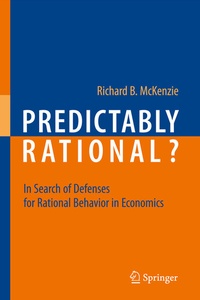
Predictably Rational?
Description

Mainstream economists everywhere exhibit an "irrational passion for dispassionate rationality." Behavioral economists, and long-time critic of mainstream economics suggests that people in mainstrean economic models "can think like Albert Einstein, store as much memory as IBM's Big Blue, and exercise the will power of Mahatma Gandhi," suggesting that such a view of real world modern homo sapiens is simply wrongheaded. Indeed, Thaler and other behavioral economists and psychology have documented a variety of ways in which real-world people fall far short of mainstream economists' idealized economic actor, perfectly rational homo economicus. Behavioral economist Daniel Ariely has concluded that real-world people not only exhibit an array of decision-making frailties and biases, they are "predictably irrational," a position now shared by so many behavioral economists, psychologists, sociologists, and evolutionary biologists that a defense of the core rationality premise of modedrn economics is demanded.
Reviews / Votes
From the reviews:
One reviewer (Nobel Laureate in Economics) described the book as a "massise effort," because of the breadth of the inquiry, covering from the intellectual history of the rationality premise (from Adam Smith to modern economists) to the evolutionary biology of the concept to the neurobiology/economics of the concept to the behavioral economics/psychology of the criticisms.
"McKenzie (Univ. of California, Irvine) defends homo economicus, the perfectly rational maximizer of self-interest, assumed in Chicago-style economics as the conceptual basis of efficient markets, rational expectations, and the efficacy of free market capitalism. . Summing Up: Recommended. Upper-division undergraduate through faculty and research collections." (R. S. Hewett, Choice, Vol. 47 (11), July, 2010)
More details
Other editions
Additional editions
Person
Richard McKenzie is the Walter B. Gerken Professor of Enterprise and Society in the Paul Merage School of Business at the University of California, Irvine. Widely published in academic journals and general audience publications, his two most recent books are In Defense of Monopoly: How Market Power Fosters Creative Production (University of Michigan Press, 2008) and Why Popcorn Costs so Much at the Movies, And Other Pricing Puzzles (Springer, 2008) (www.merage.uci.edu/~mckenzie)
