

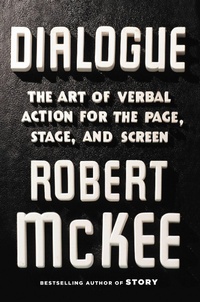
Dialogue
The Art of Verbal Action for Page, Stage, and Screen
Published on 12. July 2016
352 pages
978-1-4555-9192-3 (ISBN)
Description

The long-awaited follow-up to the perennially bestselling writers' guide Story, from the most sought-after expert in the art of storytelling.
"Dialogue is a masterwork. There's nothing harder to teach. Now this book exists. McKee has written an essential book akin to The Elements of Style for all writers." -Margaret Nagle, winner of the Writer's Guild Award, Emmy, NAACP, Golden Globe, and Pen
Robert McKee's popular writing workshops have earned him an international reputation. The list of alumni with Oscars runs off the page. The cornerstone of his program is his singular book, Story, which has defined how we talk about the art of story creation.
Now, in Dialogue, McKee offers the same in-depth analysis for how characters speak on the screen, on the stage, and on the page in believable and engaging ways. From Macbeth to Breaking Bad, McKee deconstructs key scenes to illustrate the strategies and techniques of dialogue. Dialogue applies a framework of incisive thinking to instruct the prospective writer on how to craft artful, impactful speech.
"Dialogue is a masterwork. There's nothing harder to teach. Now this book exists. McKee has written an essential book akin to The Elements of Style for all writers." -Margaret Nagle, winner of the Writer's Guild Award, Emmy, NAACP, Golden Globe, and Pen
Robert McKee's popular writing workshops have earned him an international reputation. The list of alumni with Oscars runs off the page. The cornerstone of his program is his singular book, Story, which has defined how we talk about the art of story creation.
Now, in Dialogue, McKee offers the same in-depth analysis for how characters speak on the screen, on the stage, and on the page in believable and engaging ways. From Macbeth to Breaking Bad, McKee deconstructs key scenes to illustrate the strategies and techniques of dialogue. Dialogue applies a framework of incisive thinking to instruct the prospective writer on how to craft artful, impactful speech.
More details
Other editions

Content
- Intro
- Title Page
- Welcome
- Dedication
- Acknowledgments
- Preface: In Praise of Dialogue
- Introduction
- PART ONE: THE ART OF DIALOGUE
- Chapter One: The Full Definition of Dialogue
- Dramatized Dialogue
- Narratized Dialogue
- Dialogue and the Major Media
- Dialogue Onstage
- Dialogue Onscreen
- Dialogue on Page
- Indirect Dialogue
- Chapter Two: The Three Functions of Dialogue
- Exposition
- Narrative Drive
- Exposition as Ammunition
- Revelations
- Direct Telling
- Forced Exposition
- Characterization
- Action
- Chapter Three: Expressivity I: Content
- The Said
- The Unsaid
- The Unsayable
- Action versus Activity
- Text and Subtext
- Chapter Four: Expressivity II: Form
- The Conflict Complex
- Dialogue Onstage
- Dialogue in Film
- Dialogue on Television
- Dialogue in Prose
- Chapter Five: Expressivity III: Technique
- Figurative Language
- Paralanguage
- Mixed Techniques
- Line Design
- Economy
- The Pause
- The Case for Silence
- PART TWO: FLAWS AND FIXES
- Introduction: Six Dialogue Tasks
- Chapter Six: Credibility Flaws
- Incredibility
- Empty Talk
- Overly Emotive Talk
- Overly Knowing Talk
- Overly Perceptive Talk
- Excuses Mistaken for Motivation
- Melodrama
- Chapter Seven: Language Flaws
- Clichés
- Character-Neutral Language
- Ostentatious Language
- Arid Language
- Prefer the Concrete to the Abstract
- Prefer the Familiar to the Exotic
- Prefer Short Words to Long Words
- Prefer Direct Phrases to Circumlocution
- Prefer an Active to a Passive Voice
- Prefer Short Speeches to Long
- Prefer Expressive Language to Mimicry
- Eliminate Clutter
- Chapter Eight: Content Flaws
- Writing On-the-Nose
- The Monologue Fallacy
- The Duelogue
- The Trialogue
- Chapter Nine: Design Flaws
- Repetition
- Misshapen Lines
- Misshapen Scenes
- Splintered Scenes
- The Paraphrasing Trap
- PART THREE: CREATING DIALOGUE
- Chapter Ten: Character-Specific Dialogue
- The Two Talents
- Vocabulary and Characterization
- The Principle of Creative Limitation
- Locution and Characterization
- Principle of Character-Specific Dialogue
- Culture and Characterization
- Chapter Eleven: Four Case Studies
- The Tragedy of Julius Caesar
- Out of Sight
- 30 ROCK
- SIDEWAYS
- PART FOUR: DIALOGUE DESIGN
- Chapter Twelve: Story/Scene/Dialogue
- Inciting Incident
- Story Values
- The Complex of Desire
- Forces of Antagonism
- Spine of Action
- Story Progression
- Turning Points
- Scene Progression
- The Beat
- Five Steps of Behavior
- Introduction to Seven Case Studies
- Chapter Thirteen: Balanced Conflict (THE SOPRANOS)
- Chapter Fourteen: Comic Conflict (FRASIER)
- Chapter Fifteen: Asymmetric Conflict (A Raisin in the Sun)
- Chapter Sixteen: Indirect Conflict (The Great Gatsby)
- Chapter Seventeen: Reflexive Conflict (Fräulein Else and The Museum of Innocence)
- Chapter Eighteen: Minimal Conflict (LOST IN TRANSLATION)
- Chapter Nineteen: Mastering the Craft
- About the Author
- Also by Robert McKee
- Mission Statement
- Notes
- Newsletters
- Table of Contents
- Copyright
