

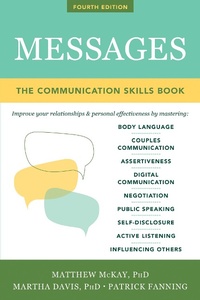
Messages
Description

Many people assume that good communicators possess an intrinsic talent for speaking and listening to others, a gift that can't be learned or improved. The reality is that communication skills are developed with deliberate effort and practice, and learning to understand others and communicate your ideas more clearly will improve every facet of your life.
Messages has already helped thousands of people build communication skills and cultivate better relationships with friends, family members, coworkers, and partners. With this fully revised and updated fourth edition, you'll discover new skills to help you communicate your ideas more effectively and become a better listener. Learn how to:
- Read body language
- Develop skills for couples communication
- Negotiate and resolve conflicts
- Communicate with family members
- Handle group interactions
- Talk to children
- Master public speaking
- Prepare for job interviews
This new edition features a much-needed chapter on digital communication. Effective communication can easily be compromised when you're not able to read your conversation partner's body language, facial expression, or vocal tone. This chapter teaches you how to express yourself well via phone, email, texting, and video-all the skills you need to thrive in the digital age.
More details
Other editions
Additional editions
Content
- Intro
- _GoBack
- Contents
- Introduction
- PART I: Basic Skills
- 1: Listening
- Real vs. Pseudo Listening
- Blocks to Listening
- Assessing Your Listening Blocks
- Four Steps to Effective Listening
- Total Listening
- 2: Self-Disclosure
- Rewards of Self-Disclosure
- Blocks to Self-Disclosure
- Optimal Levels of Self-Disclosure
- Assessing Your Self-Disclosure
- Practice in Self-Disclosure
- 3: Expressing
- Observations
- Thoughts
- Feelings
- Needs
- Whole Messages
- Contaminated Messages
- Preparing Your Message
- Practicing Whole Messages
- Rules for Effective Expression
- PART II: Advanced Skills
- 4: Body Language
- Body Movements
- Spatial Relationships
- Advanced Skills
- 5: Paralanguage and Metamessages
- The Elements of Paralanguage
- Changing Your Paralanguage
- Metamessages
- Coping with Metamessages
- 6: Hidden Agendas
- The Eight Agendas
- Purpose of the Agendas
- 7: Transactional Analysis
- Parent, Child, and Adult Messages
- Analyzing Your Communications
- Kinds of Transactions
- Keeping Your Communications Clean
- 8: Clarifying Language
- Understanding a Model
- Challenging the Limits of a Model
- Challenging Distortions in a Model
- Some Final Clarifications
- PART III: Conflict Skills
- 9: Assertiveness Training
- Your Legitimate Rights
- Three Communication Styles
- Your Assertiveness Goals
- Assertive Expression
- Assertive Listening
- Combining Assertive Expression and Listening
- Responding to Criticism
- Special Assertive Strategies
- 10: Validation Strategies
- What Is Validation?
- How Does Validation Work?
- Components of Validation
- 11: Negotiation
- Four Stages of Negotiation
- Dealing with Conflict
- Rules of Principled Negotiation
- When the Going Gets Tough
- PART IV: Social Skills
- 12: Forming Accurate First Impressions
- Prejudgment Traps
- Approval and Disapproval in Prejudgment
- Correcting Parataxic Distortions
- Perpetuating Illusions
- Clarifying First Impressions
- 13: Making Contact
- Fear of Strangers
- Guidelines for Making Contact
- The Art of Conversation
- Putting It All Together
- 14: Digital Communication
- Texting
- Voice Mail
- Social Media
- Video Communication
- PART V: Family Skills
- 15: Couples Skills
- Schemas
- Couples Systems
- Keeping Your Relationship Strong
- 16: Communicating with Children
- Listening
- Expressing
- Joint Problem Solving
- When to Let Go
- When You Have to Say No
- The Point Is .
- 17: Family Communications
- Family Communication Disorders
- Family Pathology
- Family Systems
- How to Keep Family Communications Healthy
- PART VI: Public Skills
- 18: Influencing Others
- Ineffective Strategies for Influencing Change
- Effective Strategies for Influencing Others
- A Plan for Influencing Change
- 19: Public Speaking
- Planning Your Talk
- Organizing Your Talk
- Audience Analysis
- Style
- Supporting Materials
- The Outline
- Delivery
- Dealing with Stage Fright
- 20: Interviewing
- Clarifying What You Want
- When You Are the Interviewer
- If You Are the Interviewee
- Conclusion
- Recommended Reading
- References
