

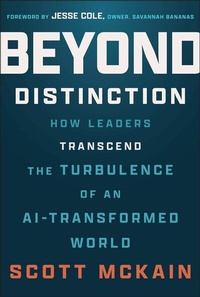
Beyond Distinction
Description

Sustainably transform your company into a long-term authority in its industry
In Beyond Distinction: How Leaders Create Organizations That Transcend the Turbulent AI-Driven Marketplace, leadership expert Scott McKain delivers an exciting and practical discussion of how organizations and leaders can move past short-term differentiation from competitors and realize sustainable transformation in a fast, evolving, AI-driven world. The author offers a comprehensive, long-term alternative to short-term business "strategy."
Beyond Distinction demonstrates how to stop differentiation decline, master new AI tools, and stay relevant even during rapid technological change. You'll discover how to connect deeply with customers and build real relationships, as well as how to attract (and retain) top talent even as other companies do their best to poach your best people.
Inside the book:
- Effective techniques for overcoming competitor copying
- Strategies to make distinction part of your company's core identity
- Key metrics to create and track so you can measure the impact of your newfound focus on distinction
Perfect for executives and business leaders interested in future-proofing their organizations and building a sustainable competitive advantage, Beyond Distinction contains a values-driven framework that will quickly become required reading for all professionals in leadership positions.
More details
Other editions
Additional editions
Person
SCOTT MCKAIN is a pioneer whose work has redefined how leaders transcend disruption to achieve enduring significance. He is a Hall of Fame speaker, the "In Residence Expert on Distinction and Relevance" at High Point University, and recognized business advisor for many of the world's iconic organizations.
Content
Foreword ix
Introduction-Beyond Distinction: The Power of Transcendence in a Turbulent World xiii
Chapter 1 Turbulence and the Need to Transcend It 1
Chapter 2 The Case for Transcendence 27
Chapter 3 Cornerstone One: Visionary Clarity-Your Strategic Compass 43
Chapter 4 Cornerstone Two: Adaptive Creativity-Innovation That Evolves 63
Chapter 5 Cornerstone Three: Transformative Communication-Beyond Information to Connection 87
Chapter 6 Cornerstone Four: Proactive Customer Evolution 115
Chapter 7 Transcendent Leadership in Times of Turbulence 139
Chapter 8 Transcendence in Crisis: Thriving When the Unexpected Happens 153
Chapter 9 The Transcendent Organization: Building Culture for Sustainable Excellence 163
Chapter 10 Beyond Distinction: Your Path to Transcendence 193
Notes 201
Acknowledgments 211
About the Author 215
Index 217
Introduction
Beyond Distinction: The Power of Transcendence in a Turbulent World
Stuck: Why Standing Out Is No Longer Enough
There was a time when standing out was the path to success. Being unique-creating distinction-meant you could capture attention, build loyalty, and drive results. It worked, and for a while, it worked extraordinarily well.
But that time has passed. Many professionals tell me that they and their organizations feel stuck.
In today's world, differentiation has become diluted. Everyone is trying to stand out. Businesses are refining their branding, embracing emerging technologies, and exploring new platforms. Professionals are updating their LinkedIn profiles, pursuing certifications, and chasing trends. Yet despite all this activity, many are still stuck.
- Stuck in the sameness
- Stuck in the noise
- Stuck in the cycles of incremental improvements that never lead to breakthrough performance
In this new era of relentless disruption, surface-level changes aren't enough. What once made you different is now expected. Yesterday's innovations are today's standards. And the pursuit of being "better" has left too many organizations and leaders exhausted and stuck, feeling as if they are falling behind.
Standing out isn't wrong. It's just not enough anymore.
To succeed now, you must go beyond distinction and transcend the previous limitations of your culture and customer experience. This isn't about merely refining what already exists. It's about rising above the turbulence, breaking free from stagnation, and embracing a deeper, more transformative path forward.
What Was Change Is Now Turbulence
We have heard the phrase that "change is constant" so often it has become a platitude. My pal Joe Calloway has joked that a speaker could walk into a conference without knowing the company holding the event or having any information about the roles of the professionals in the meeting, simply look at the audience, and proclaim, "My Lord-you folks have been through so much change, I don't know how you do it!"
People in the crowd would at once wipe tears from their eyes and say to one another, "Wow-he really understands us!"
The truth is that the pace of change today is anything but constant. It is accelerating, dramatically and relentlessly, which makes today's business landscape so turbulent. We are no longer dealing with gradual, predictable shifts in how the world works. Instead, just as an airplane can encounter severe and unpredictable turbulence, we are grappling with waves of disruption that appear without warning, reshape entire industries, and often leave leaders scrambling to catch up. We will address the turbulence issue thoroughly in the first two chapters.
Consider this: In 1958, the average lifespan of a company on the S&P 500 was 61 years. It was 25 years in 1980. Today, it's less than 18. By 2027, Innosight projects it will fall to under 12 years.1
That is a seismic shift in longevity, underscoring the reality we now encounter: Change is happening so fast that it is fundamentally redefining what it means to lead an organization.
Why This Book as Your Guide?
When I am a reader of leadership, business advice, or self-help books-particularly those written by authors with whom I'm unfamiliar-I must admit that I usually start with a bit of a chip on my shoulder. I often think, "Why should I listen to her?" Or "What gives him the right to tell me what I should do or how I can get unstuck?" I understand why you would ask these questions, too. Maybe you're the same way and have a similar approach to what you are reading right now.
In all candor, it is unlikely that any author would open their latest book with a list of all the erroneous concepts they have advocated. (You will not find me doing that here, either!)
However, when I started working on this manuscript, I realized that since I will make some provocative points later, it is perhaps appropriate to begin by reviewing the high points of my track record to establish a bit of credibility with you.
Twenty-five years ago, my first business book proposed something that many then believed was outlandish, outrageous, or even incorrect: ALL Business is Show Business.
Many reviewers dismissed it, arguing that business was not entertainment and customers did not want to be "wowed"-they just wanted good products and decent service. I wish I had collected a dollar from every businessperson who told me something like, "We are not in show business, for goodness' sake. We make and sell (insert their product or service name here)"!
But fast-forward to today, and that very concept is now so deeply embedded in the DNA of successful companies that it is hard to imagine anyone doing business without acknowledging the need to involve, captivate, and create an experience for their customers.
From local retailers to global giants, the idea that businesses must engage with customers on a compelling and appealing level-creating memorable experiences, connecting emotionally, and delivering beyond expectations like a hit movie or television series-has become the norm. It was a bold idea at the time, but looking back, I realize today that it was not just a forecast. I failed to understand that my concept reflected something much larger: the evolution of business itself.
The Evolution of Experience
Twenty years ago, in my book, What Customers REALLY Want, I suggested a shift from customer service to customer experience. I even obtained the federally registered trademark on the term "Ultimate Customer Experience®"-which our business still holds.
At the time, most businesses believed that "service" was the fundamental element of retention. They thought a smile and a speedy checkout were all it took to keep customers returning. I argued that service, while essential, was merely a baseline. The future would belong to those who could deliver experiences-something more immersive, something that created emotional connections and lasting memories.
Back then, this was a radical concept. Today, it is a business fundamental. Think about it: Oft-cited companies like Disney and Apple do not just provide products or services; they create experiences that transcend the transactional. And yet, even as experience has now become central to organizational success, the business world is once again on the cusp of a profound transformation.
Fifteen years ago, I wrote, "In order to achieve lasting success, businesses must not just be good at what they do-they must stand out. They must create distinction."
Once again, critics said I was being overly idealistic. But look around: The companies that thrive today have found a way to differentiate themselves in a crowded marketplace. It is not enough to simply provide value. You must provide unique, meaningful value that stands out from the customer's perspective-that is the essence of distinction.
When I first wrote The Collapse of Distinction, I had recently experienced a profound personal tragedy that almost tanked my small business. When I could not find a roadmap to create the competitive advantage my little company required to survive, I started researching and writing about what it took to create distinction. The result was the philosophy of distinction and subsequent books.
Now, a myriad of consultants, authors, and speakers proclaim it to the point that it is no longer an idea that sets businesses apart-it is a prerequisite for survival.
But here is the thing: Encouraging "standing out" has now become almost commonplace.
Everyone is trying to stand out. I attended a recent convention of the National Speakers Association. I counted over 30 speakers at that meeting alone who market that they deliver presentations on topics related to "how to stand out."
I would argue that "distinction" has a unique and added value beyond simply "standing out." For example, as I've often said, slapping every customer in the face would make me "stand out" from the competition. However, the point that struck me (pardon the pun) was that, as much as it sounds like an oxymoron, standing out has become commoditized.
Undoubtedly, the rapid advancements in AI and the ever-increasing pace of change have made the goal of merely "standing out" insufficient.
So, once again, we find ourselves at the edge of a new frontier.
Standing Out Is No Longer Enough
In the same way that differentiation became the new standard 15 years ago, my research and experience have convinced me that transcending the limitations of today's business environment, which often leaves companies stuck in a competitive quagmire, will be the hallmark of tomorrow's success stories. Simply being "different" is no longer enough. We must even move beyond distinction. You must become transcendent.
The future belongs to those who can transcend the current business landscape and rise above the noise, disruption, and rapid changes driven by technology, most notably...
