

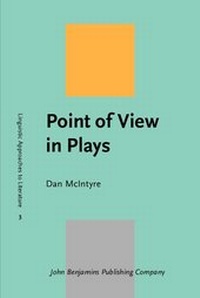
Point of View in Plays
A cognitive stylistic approach to viewpoint in drama and other text-types
1st Edition
Published on 12. September 2006
XII, 203 pages
978-90-272-9333-6 (ISBN)
Description

This is the first book-length study of how point of view is manifested linguistically in dramatic texts. It examines such issues as how readers process the shifts in viewpoint that can occur within such texts. Using insights from cognitive linguistics, the book aims to explain how the analysis of point of view in drama can be undertaken, and how this is fruitful for understanding textual and discoursal effects in this genre. Following on from a consideration of existing frameworks for the analysis of point of view, a cognitive approach to deixis is suggested as being particularly profitable for explaining the viewpoint effects that can arise in dramatic texts. To expand on the large number of examples discussed throughout the book, the penultimate chapter consists of an extended analysis of a single play. This book is relevant to scholars in a range of areas, including linguistics, literary studies and cognitive science.
More details
Other editions
Additional editions
Dan McIntyre
Point of View in Plays
A cognitive stylistic approach to viewpoint in drama and other text-types
Book
09/2006
John Benjamins Publishing Co
€104.94
Shipment within 10-15 days
Person
Content
- Point of View in Plays
- Editorial page
- Title page
- LCC data
- Table of contents
- Acknowledgements
- Preface
- Point of view and plays
- 1.1. Introduction
- 1.2. Aims of the book
- 1.3. Prototypical and non-prototypical dramatic texts
- 1.4. The prototypical discourse structure of drama
- 1.5. Alan Bennett's The Lady in the Van
- 1.6. The discourse structure of The Lady in the Van
- 1.7. Text and performance
- 1.8. Stage plays, screenplays, readers and audiences
- 1.9. Outline of the book
- Narratives, narration and point of view in prose
- 2.1. Introduction
- 2.2. Defining 'narratives' and 'narration'
- 2.2.1. Formalist distinctions in narrative structure
- 2.3. Narrative connections
- 2.4. Types of narrators
- 2.4.1. Internal and external narration
- 2.4.2. Fowler's taxonomy of narration
- 2.4.3. Simpson's development of Fowler's work
- 2.5. Point of view in prose narration
- 2.5.1. Focalization
- 2.5.2. Point of view on the Uspenskian planes
- 2.5.3. Fowler's development of Uspensky's taxonomy
- 2.5.4. Chatman's work on point of view
- 2.5.5. Short's checklist of linguistic indicators of viewpoint
- 2.5.6. Additional linguistic indicators of viewpoint
- 2.5.7. Summary
- 2.6. Conclusion
- Perspectives on point of view in drama
- 3.1. Introduction
- 3.2. Mimesis and diegesis
- 3.3. Existing work on point of view in stage drama
- 3.3.1. Narration, dreams and the inner life
- 3.3.2. Richardson's categories of narration
- 3.3.3. Applying Chatman's taxonomy to dramatic texts
- 3.3.4. Stage and screen directions in drama
- 3.4. Point of view in film
- 3.4.1. Narration in light
- 3.4.2. Objective and subjective shots
- 3.5. Conclusion
- Deictic shifts in dramatic texts
- 4.1. Introduction
- 4.2. Deictic shift theory - a brief overview
- 4.3. The concept of the deictic centre
- 4.4. Traditional categories of deixis
- 4.4.1. Place deixis
- 4.4.2. Temporal deixis
- 4.4.3. Person deixis
- 4.4.4. Social deixis
- 4.4.5. Empathetic deixis
- 4.5. Deictic shift theory and reader involvement
- 4.5.1. Deictic fields, PUSHes and POPs
- 4.5.2. Edgework
- 4.5.3. Deictic fields revisited
- 4.5.4. Deictic decay
- 4.5.5. Problems with PUSHes and POPs
- 4.6. Modifying deictic shift theory
- 4.6.1. Contextual frame theory
- 4.6.2. Binding and priming in deictic shift theory
- 4.7. Deictic fields and point of view in Our Town
- 4.8. Conclusion
- Possible worlds, possible viewpoints
- 5.1. Introduction
- 5.2. The development of possible worlds theory
- 5.2.1. Limitations of truth conditional semantics
- 5.3. Ryan's typology of possible worlds
- 5.3.1. Alternative possible worlds
- 5.3.2. Fantasy universes
- 5.3.3. The principle of minimal departure
- 5.4. Mapping deictic shifts and possible worlds
- 5.4.1. Recentering
- 5.4.2. Increasing and decreasing the prominence of possible worlds
- 5.5. Conclusion
- Logic, reality and mind style
- 6.1. Introduction
- 6.2. Defining mind style
- 6.2.1. World view, ideological point of view and mind style
- 6.3. Logic and mind style
- 6.3.1. Deductive and inductive logic
- 6.3.2. Logic, mind style and Miss Shepherd
- 6.4. Mind style and paradigms of reality
- 6.4.1. Miss Shepherd's reality paradigm and its effect on her mind style
- 6.5. Conclusion
- Point of view in The Lady in the Van
- 7.1. Introduction
- 7.2. Alan Bennett 1 meets Miss Shepherd (Act One, turns 1 to 109)
- 7.3. Miss Shepherd's confession (Act Two, turns 651 to 673)
- 7.4. The mysteries surrounding Miss Shepherd (Act Two, turns 732 to 798)
- 7.5. The truth about Miss Shepherd (Act Two, turns 900 to 976)
- 7.6. Conclusion
- Conclusion
- 8.1. Summary
- 8.2. Concluding remarks
- References
- Index
