

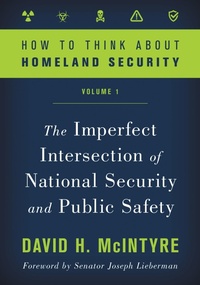
How to Think about Homeland Security
The Imperfect Intersection of National Security and Public Safety, Volume 1
1st Edition
Published on 3. May 2019
224 pages
979-8-7651-7130-1 (ISBN)
Description

Volume 1:The Imperfect Intersection of National Security and Public Safetyexplains homeland security as a struggle to meet new national security threats with traditional public safety practitioners. It offers a new solution that reaches beyond training and equipment to change practitioner culture through education. This first volume represents a major new contribution to the literature by recognizing that homeland security is not based on theories of nuclear response or countering terrorism, but on making bureaucracy work.
The next evolution in improving homeland security is to analyze and evaluate various theories of bureaucratic change against the national-level catastrophic threats we are most likely to face. This synthesis provides the bridge between volume 1 (understanding homeland security) and the next in the series (understanding the risk and threats to domestic security). All four volumes could be used in an introductory course at the graduate or undergraduate level. Volumes 2 and 3 are most likely to be adopted in a risk management (RM) course which generally focus on threats, vulnerabilities, and consequences, while volume 4 will get picked up in courses on emergency management (EM).
The next evolution in improving homeland security is to analyze and evaluate various theories of bureaucratic change against the national-level catastrophic threats we are most likely to face. This synthesis provides the bridge between volume 1 (understanding homeland security) and the next in the series (understanding the risk and threats to domestic security). All four volumes could be used in an introductory course at the graduate or undergraduate level. Volumes 2 and 3 are most likely to be adopted in a risk management (RM) course which generally focus on threats, vulnerabilities, and consequences, while volume 4 will get picked up in courses on emergency management (EM).
More details
Other editions
Additional editions
David H. McIntyre
How to Think about Homeland Security
The Imperfect Intersection of National Security and Public Safety, Volume 1
Book
05/2019
Rowman & Littlefield Publishers
€38.70
Shipment within 3-4 weeks
Person
Dr. David H. McIntyre has been writing, teaching, and presenting on National Security and Homeland Security issues for 30 years. He has taught for 20 semesters at the Bush School of Government and Public Service at Texas A&M University. Before that he was Deputy Director of the ANSER Institute for Homeland Security in Washington, DC (the first think tank focused on HS). Colonel McIntyre (USA, Retired) began those duties after a 30 year career in the United States Army, where he served in airborne and armored cavalry units, wrote and taught strategy and retired as the Dean of Faculty and Academics at the National War College.
Content
Part I: The Concept of National Security
1.What is a Nation?
2.What is Security?
3.What is National Security?
4.National Security Begins with Academics, Inquiry and Theory
5.Conflicting Ways to Think About Security
6.Conflicting Beliefs about Security (the Nature of Man)
Part II: The Emergence of National Security Strategy
7.From Thought and Belief to Security Theory and Practice
8.What is Strategy?
9.What is a National Security Strategy?
10.What is THE US National Security Strategy?
Part III: The Emergence of Homeland Security
11.What is Homeland Security and Why Does It Exist?
12.Building a Systemic Solution for a New Domestic Defense
13.Systemic Challenge #1: Tensions
14.Systemic Challenge #2: Perspectives
15.Systemic Challenge #3: Theories (or lack thereof)
Part IV: Imperfect Intersection
16.How to Think About Homeland Security: Go Ask Your MOMs
1.What is a Nation?
2.What is Security?
3.What is National Security?
4.National Security Begins with Academics, Inquiry and Theory
5.Conflicting Ways to Think About Security
6.Conflicting Beliefs about Security (the Nature of Man)
Part II: The Emergence of National Security Strategy
7.From Thought and Belief to Security Theory and Practice
8.What is Strategy?
9.What is a National Security Strategy?
10.What is THE US National Security Strategy?
Part III: The Emergence of Homeland Security
11.What is Homeland Security and Why Does It Exist?
12.Building a Systemic Solution for a New Domestic Defense
13.Systemic Challenge #1: Tensions
14.Systemic Challenge #2: Perspectives
15.Systemic Challenge #3: Theories (or lack thereof)
Part IV: Imperfect Intersection
16.How to Think About Homeland Security: Go Ask Your MOMs
