
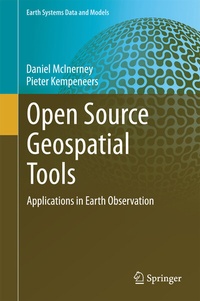
Open Source Geospatial Tools
Description
Alles über E-Books | Antworten auf Fragen rund um E-Books, Kopierschutz und Dateiformate finden Sie in unserem Info- & Hilfebereich.
This book focuses on the use of open source software for geospatial analysis. It demonstrates the effectiveness of the command line interface for handling both vector, raster and 3D geospatial data. Appropriate open-source tools for data processing are clearly explained and discusses how they can be used to solve everyday tasks.
A series of fully worked case studies are presented including vector spatial analysis, remote sensing data analysis, landcover classification and LiDAR processing. A hands-on introduction to the application programming interface (API) of GDAL/OGR in Python/C++ is provided for readers who want to extend existing tools and/or develop their own software.
More details
Other editions
Additional editions
Content
Introduction.- Vector data processing.- Raster data explained.- Introduction to GDAL utilities.- Manipulating raster data.- Indexed color images.- Image overviews, tiling and pyramids.- Image (re-)projections and merging.- Raster meets vector data.- Raster meets point data.- Virtual rasters and raster calculations.- Pktools.- Orfeo Toolbox.- Write your own geospatial utilities.- 3D point cloud data processing.- Case study on Vector Spatial analysis.- Multispectral land cover classification.- Case study on point data.- Conclusions and future outlook.

System requirements
File format: PDF
Copy protection: Watermark-DRM (Digital Rights Management)
System requirements:
- Computer (Windows; MacOS X; Linux): Use the free software Adobe Reader, Adobe Digital Editions, or any other PDF viewer of your choice (see eBook Help).
- Tablet/Smartphone (Android; iOS): Install the free app Adobe Digital Editions or another reading app for eBooks, e.g., PocketBook (see eBook Help).
- E-reader: Bookeen, Kobo, Pocketbook, Sony, Tolino and many more (only limited: Kindle).
The file format PDF always displays a book page identically on any hardware. This makes PDF suitable for complex layouts such as those used in textbooks and reference books (images, tables, columns, footnotes). Unfortunately, on the small screens of e-readers or smartphones, PDFs are rather annoying, requiring too much scrolling.
This eBook uses Watermark-DRM, a „soft” copy protection. This means that there are no technical restrictions to prevent illegal distribution. However, there is a personalised watermark embedded in the eBook that can be used to identify the purchaser of the eBook in the event of misuse and to provide evidence for legal purposes.
For more information, see our eBook Help page.