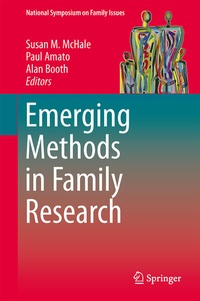
Emerging Methods in Family Research
Description

The family can be a model of loving support, a crucible of pathology, or some blend of the two. Across disciplines, it is also the basic unit for studying human relationships, patterns of behavior, and influence on individuals and society. As family structures evolve and challenge previous societal norms, new means are required for understanding their dynamics, and for improving family interventions and policies.
Emerging Methods in Family Research details innovative approaches designed to keep researchers apace with the diversity and complexities of today's families. This versatile idea-book offers meaningful new ways to represent multiple forms of diversity in family structure and process, cutting-edge updates to family systems models and measurement methods, and guidance on the research process, from designing projects to analyzing findings. These chapters provide not only new frameworks for basic research on families, but also prime examples of their practical use in intervention and policy studies. Contributors also consider the similarities and differences between the study of individuals and the study of family relationships and systems. Included in the coverage:
Use of nonlinear dynamic models to study families as coordinated symbiotic systems.
- Use of network models for understanding change and diversity in the formal structure of American families.
- Representing trends and moment-to-moment variability in dyadic and family processes using state-space modeling techniques.
- Why qualitative and ethnographic methods are essential for understanding family life.
- Methods in multi-site trials of family-based interventions.
- Implementing the Multiphase Optimization Strategy (MOST) to analyze the effects of family interventions.
Researchers in human development, family studies, clinical and developmental psychology, social psychology, sociology, anthropology, and social welfareas well as public policy researchers will welcome Emerging Methods in Family Research as a resource to inspire novel approaches to studying families.
More details
Other editions
Additional editions