

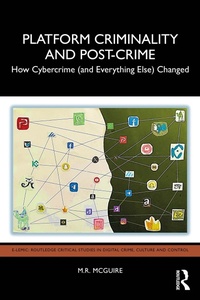
Platform Criminality and Post-Crime
How Cybercrime (and Everything Else) Changed
1st Edition
Published on 17. April 2026
414 pages
978-1-040-71663-2 (ISBN)
Description

This book explores how digital crime/cybercrime has been decisively reshaped by the emergence of the digital platform.
Online platforms now constitute so significant a mode of wealth production that many argue a new kind of economic order - 'platform capitalism' has emerged. But the platform vehicle has also provided a new organisational dynamic for criminal entrepreneurs, one that significantly adds to other advantages of digital technology exploited by earlier (cyber) criminals such as hyperconnection and capacity augmentation. The book traces the emergence of a shadow digital crime economy which both feeds off and contributes to the way digital societies now produce wealth and explores the role of the platform in underpinning this. It sets out three modalities of platform criminality; the emergence of criminal platforms; the targeting of commercial platforms and the misuse of platform by key institutional agents such as tech companies and the state. By exploring the reciprocal relations between legitimate and illegitimate platforms it suggests how platforms have not only changed the practice and organisation of cybercrime but have been instrumental in unravelling key elements of civil society, not least the legal consensus upon which democracy depends. It argues that 'post-truth' and the crisis of objectivity in which platforms are implicated lead directly into a 'post-crime' world, one where the boundaries between the legal and the criminal are becoming increasingly blurred.
This book will be of interest to students and scholars of criminology, cybersecurity, technology ethics, and digital economies. It will also appeal to professionals and policymakers engaged with these fields.
Online platforms now constitute so significant a mode of wealth production that many argue a new kind of economic order - 'platform capitalism' has emerged. But the platform vehicle has also provided a new organisational dynamic for criminal entrepreneurs, one that significantly adds to other advantages of digital technology exploited by earlier (cyber) criminals such as hyperconnection and capacity augmentation. The book traces the emergence of a shadow digital crime economy which both feeds off and contributes to the way digital societies now produce wealth and explores the role of the platform in underpinning this. It sets out three modalities of platform criminality; the emergence of criminal platforms; the targeting of commercial platforms and the misuse of platform by key institutional agents such as tech companies and the state. By exploring the reciprocal relations between legitimate and illegitimate platforms it suggests how platforms have not only changed the practice and organisation of cybercrime but have been instrumental in unravelling key elements of civil society, not least the legal consensus upon which democracy depends. It argues that 'post-truth' and the crisis of objectivity in which platforms are implicated lead directly into a 'post-crime' world, one where the boundaries between the legal and the criminal are becoming increasingly blurred.
This book will be of interest to students and scholars of criminology, cybersecurity, technology ethics, and digital economies. It will also appeal to professionals and policymakers engaged with these fields.
Reviews / Votes
Once again, Michael McGuire anticipates everyone else in capturing the criminality and harms that define our digital societies. Platform Criminality and Post-Crime offers a bold and incisive analysis of how the platform economy has transformed both crime and legality themselves-a landmark work in contemporary criminology.Fernando Miro-Llinares, Professor of Criminal Law and Criminology, Crimina, Miguel Hernandez University, Spain
One of the most provocative and grounded perspectives on how digital platforms are not just shaping our society - but redefining crime itself and the boundaries between legality and illegality.
Marc Schuilenburg, Professor Digital Surveillance, Erasmus University Rotterdam, Netherlands
Michael McGuire has long been one of the most insightful and theoretically inventive thinkers when it comes to matters relating to cybercrime and digital criminology. In his latest work, Platform Criminality and Post-Crime, he takes us on an essential exploration of the profound transformation wrought by digital platforms, showing how they've amplified criminal opportunities while blurring the boundaries between legitimate business and criminality itself.'
Keith Hayward, Professor of Criminology, University of Copenhagen, Denmark
As cybercrime continues to evolve and exploit new opportunities arising from the constant transformation of the digital ecosystem, criminology must adapt its theoretical toolbox to remain relevant. In this book, Michael McGuire accomplishes a remarkable tour de force by revealing how digital platforms are supercharging criminal activity and profits, redefining how we understand crime in the platform age.
Benoit Dupont, Professor of Criminology, Canada Research Chair in Cyber-resilience, Universite de Montreal, Canada
Cybercrime circa 2025 may be only a quarter of a century away from Cybercrime circa 2000, yet the difference between the two periods could be measured in light years in terms of its impact on society. In Platform Criminality and Post-Crime, Mike Mcquire provides a very accessible, useful and informative analysis of changes in the cybercrime landscape.
David S. Wall, Professor of Criminology, University of Leeds, UK
Platform criminality moves readers away from a more static representation of 'cybercrime' and offers a theoretically and historically informed reconceptualization of shifts in the ways in which platforms are exploited by wholly and occasionally criminal outsiders, Big Tech and States to commit a range of crimes and social harms.
Michael Levi, Professor of Criminology, Cardiff University, UK
More details
Series
Edition
1. Auflage
Language
English
Place of publication
London
United Kingdom
Publishing group
Taylor & Francis Ltd
Target group
College/higher education
Product notice
Reflowable
Illustrations
16 Tables, black and white; 2 Line drawings, black and white; 25 Halftones, black and white; 27 Illustrations, black and white
File size
4,40 MB
ISBN-13
978-1-040-71663-2 (9781040716632)
Copyright in bibliographic data and cover images is held by Nielsen Book Services Limited or by the publishers or by their respective licensors: all rights reserved.
Schweitzer Classification
Other editions
Additional editions

Book
04/2026
1st Edition
Routledge
€191.89
Shipment within 15-20 days
Book
04/2026
1st Edition
Routledge
€52.50
Shipment within 15-20 days
Person
M.R. McGuire has written extensively on issues around technology and technology crime. He has pioneered the development of critical approaches to cybercrime and is the author of Hypercrime: the New Geometry of Harm; Technology, Crime & Justice and is the editor of The Routledge Handbook of Technology, Crime & Justice. He is currently Senior Lecturer in Criminology at the University of Surrey.
Content
1 How Cybercrime Changed: From Tools to Platforms 2 The Digital Crime Economy 3 Platform Criminality 4 First Order Platform Crime: Invisibility and Independence 5 Second Order Platform Crime: Cuckooing and Parasitism, Harvesting and Targeting 6 Platform Criminality and the Platform State: Digital Crime and a New World Order 7 Post-Crime
