

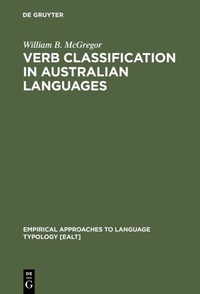
Verb Classification in Australian Languages
1st Edition
Published on 10. June 2013
XXV, 531 pages
978-3-11-087087-9 (ISBN)
Description

This book deals with systems of verb classification in Australian Aboriginal languages, with particular focus on languages of the north-west. It proposes a typology of the systems according to their main formal and semantic characteristics. It also makes some proposals concerning the historical origins and grammaticisation of these systems, and suggestions regarding the grammatical relations involved. In addition, an attempt is made to situate the phenomenon of verb classification within the context of related verbal phenomena such as serial verb constructions, nominal incorporation, and complex predicates.
More details
Series
Edition
Reprint 2013
Language
English
Place of publication
Berlin/Boston
Germany
Publishing group
de Gruyter Mouton
Target group
Professional and scholarly
US School Grade: College Graduate Student
Illustrations
6 Ktn., 35 s/w Tabellen, 27 s/w Abbildungen
27 b/w ill., 35 b/w tbl., 6 maps
File size
12,98 MB
ISBN-13
978-3-11-087087-9 (9783110870879)
Schweitzer Classification
Other editions
Additional editions
William B. McGregor
Verb Classification in Australian Languages
Book
03/2002
1st Edition
De Gruyter Mouton
€169.95
Shipment within 7-9 days
William B. McGregor
Verb Classification in Australian Languages
Book
01/2002
1st Edition
De Gruyter Mouton
€239.00
Article exhausted; check different version
Person
William McGregor, Aarhus University, Denmark.
Content
- Intro
- Preface
- List of Figures
- List of Maps
- List of Tables
- Abbreviations and Conventions
- 1. Introduction
- 1.1. What is verb classification?
- 1.2. Towards a typology of classification
- 1.2.1. Superclassification and subclassification
- 1.2.2. Classes and categories
- 1.2.3. Classifiers and classifying constructions
- 1.2.4. Concluding remarks
- 1.3. Understanding grammatical superclassification
- 1.3.1. A conceptual model
- 1.3.2. Distributional criteria for grammatical superclassification
- 1.3.3. An example: the Kija noun class system
- 1.4. Verb superclassification Australian style
- 1.5. Semantic basis of verb superclassification
- 1.5.1. Fundamental parameters
- 1.5.2. On class, category, and classification meaning
- 1.5.3. Prediction and explanation
- 1.6. Aims and organisation
- 2. The Gooniyandi verb classifier system
- 2.1. Structure of the verbal complex
- 2.2. The X morphemes as category markers
- 2.3. The semantics of Gooniyandi verb classifiers
- 2.3.1. Extendible classifiers
- 2.3.2. Accomplishment classifiers 64 2.3.2.1. Monovalent classifiers
- 2.3.3. Parallelisms between extendible and accomplishment classifiers?
- 2.3.4. Exceptions
- 2.3.5. Concluding remarks
- 2.4. Two special cases
- 2.4.1. Classification of the most frequent verb roots
- 2.4.2. Classification of English borrowings
- 2.5. Remarks on verb classification in Bunuba
- 3. CVC-based verb category systems
- 3.1. Formal properties of CVCs
- 3.2. Nyulnyulanlanguages
- 3.3. Worrorran (Northern Kimberley) languages
- 3.4. Jarrakan languages
- 3.5. Jaminjungan languages
- 3.6. Wagiman
- 3.7. Daly River languages
- 3.8. Maran languages
- 3.9. Mangarrayi
- 3.10. Pama-Nyungan languages
- 3.11. Concluding remarks
- 4. Comparison of verb category systems
- 4.1. Degrees of grammaticisation
- 4.2. IVs recurrent in CVC-based category systems
- 4.2.1. Speech
- avalent
- 4.2.2. Stance
- monovalent
- 4.2.3. Motion
- monovalent
- 4.2.4. Induced motion
- bivalent
- 4.2.5. Acquisition
- bivalent
- 4.2.6. Violence
- bivalent
- 4.2.7. Perception
- bivalent
- 4.2.8. Concluding remarks
- 4.3. Gooniyandi and Nyulnyul systems in contrast
- 4.3.1. Formal characteristics
- 4.3.2. System level comparison
- 4.3.3. Individual categories compared and contrasted
- 4.3.4. Categorisation of vocalisation/communication events
- 4.3.5. Categorisation of motion events
- 4.3.6. Conclusion
- 5. Verb class systems: conjugations
- 5.1. Pama-Nyungan conjugation classes
- 5.2. Non-Pama-Nyungan conjugation classes
- 5.2.1. Nyulnyulan languages
- 5.2.2. Worrorran languages
- 5.2.3. Mindi languages
- 5.2.4. Wagiman and Wardaman
- 5.2.5. Gunwinjguan languages
- 5.2.6. Maran languages
- 5.2.7. Nunggubuyu
- 5.2.8. Anindilyakwa
- 5.3. Overlapping conjugation class membership
- 5.4. Other types of verb class system
- 6. The grammar of verb superclassifying constructions
- 6.1. Overview of approaches to verb classification
- 6.1.1. Conjugation by auxiliary
- 6.1.2. Compounding analysis
- 6.1.3. Semantic bleaching
- 6.1.4. Classifying analyses
- 6.1.5. Fusion and union analyses
- 6.1.6. CVCs as complex predicates
- 6.1.7. Grammatical relations in conjugation classes?
- 6.2. Grammatical relations in CVCs
- 6.3. Valency and transitivity in Nyulnyul CVCs
- 7. Related grammatical phenomena
- 7.1. Verb classification in a wider perspective
- 7.1.1. Non-CVC compound verb classifying constructions
- 7.1.2. Categorisation by prefixes
- 7.1.3. Categorisation with quantification
- 7.1.4. Other verbal constructions
- 7.1.5. Concluding observations
- 7.2. Other types of compound verb construction
- 7.3. Other double-unit verb constructions
- 7.3.1. Auxiliary constructions
- 7.3.2. Serial verb constructions
- 7.3.3. Associated motion constructions
- 7.3.4. Final remark
- 7.4. Marking of diathesis alternations
- 7.5. Concluding remarks
- 8. Evolution of verb classification in Australia
- 8.1. Ideophone origins of UVs
- 8.1.1. Distinctive phonotactic features
- 8.1.2. Phonaesthesia
- 8.1.3. Use of UVs as expressives
- 8.1.4. Limited morphological modification
- 8.1.5. Syntactic properties
- 8.1.6. Comparison with recurrent features of ideophones
- 8.1.7. Motivations for historical change from ideophone to UV
- 8.2. Origins and historical development of the CVC
- 8.3. Origins of Pama-Nyungan conjugation markers
- 8.4. Evolution of meaning
- 8.5. Australia as a verb classification Sprachbund
- 9. Verb classification in discourse: a preliminary investigation
- 9.1. Category distribution in Gooniyandi narratives
- 9.2. A textual investigation
- 9.3. Interpretation and explanation
- 10. Conclusions
- 10.1. Overview
- 10.2. Comparatison of noun and verb classification
- 10.3. Directions for future research
- Appendix 1. Basic information on Australian languages mentioned in this book
- Appendix 2. Australian phonologies and orthographies
- Notes
- References
- Index of authors
- Index of languages
- Index of subjects
