

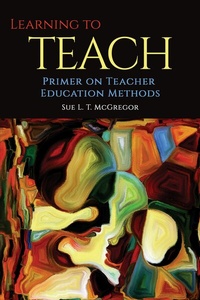
Learning to Teach
Primer on Teacher Education Methods
1st Edition
Published on 1. January 2023
139 pages
979-8-88730-412-0 (ISBN)
Description

This primer is about learning how to teach. As its name suggests, it provides a basic introduction to what is involved in becoming an effective, efficient, and efficacious educator. The targeted audiences are (a) preservice teachers (PST) (i.e., nonprofessional student teachers enrolled in a university Bachelor of Education degree), (b) early-career (novice) inservice teachers (c) or any educator for that matter who wants to build or bolster their essential foundation for teaching. The primer is unabashedly oriented to a synthesis of the technical (how-to) aspects of teaching because without prowess in these skills, even the most dedicated and committed teacher may not be effective and efficient let alone efficacious. Although teaching is both a science and an art, this primer is about the science of teaching. Other books focus on teaching as inquiry, thinking educators, reflective educators, and the sociocultural/political aspects of teaching.The book adopts a before-during-after class approach. It addresses how to (a) prepare lessons before a class (learning styles, learning objectives, lesson planning, and learning environments); (b) deliver lessons during a class (instructional strategies, questioning strategies, and classroom management); and (c) evaluate learning after the class (student assessment and evaluation strategies, and teacher self-reflection). This basic tool kit is further underscored with details about the larger constructs of (d) developing courses, modules, and units from which daily lessons emerge. Higher level notions of (e) educational philosophies, (f) curriculum theories and (g) curriculum development approaches are also included to illustrate how they, as the educational context, shape teachers' pedagogies.
More details
Other editions
Additional editions
Book
10/2023
Information Age Publishing
€55.60
Shipment within 10-20 days
Content
- Cover
- Learning to Teach: Primer on Teacher Education Methods
- Learning to Teach: Primer on Teacher Education Methods
- Copyright
- Contents
- Preface
- 1. Educational Context: Philosophical and Theoretical
- EDUCATIONAL PHILOSOPHIES
- Teacher-Centered
- Student-Centered
- Macro-Centered
- CURRICULUM THEORIES
- Structure-Oriented Curriculum Theories
- Content-Oriented Curriculum Theories
- Child-Centered
- Knowledge-Centered
- ociety-Centered
- Values-Oriented Curriculum Theories
- Process-Oriented Curriculum Theories
- CURRICULUM DEVELOPMENT APPROACHES
- Top-Down Technical Implementation
- Measurable Learning Outcomes
- Scope and Sequence
- Bottom-Up, Nontechnical Enactment
- Kinds of Curriculum
- PREPARING AN EDUCATIONAL PHILOSOPHICAL STATEMENT
- 2. Developing Course Outlines, Modules, and Units
- DEVELOPING COURSE OUTLINES
- Build Course Outline From Scratch
- Course Rationale
- Course Aims, Goals, and Objectives
- Course Organizational Logic
- Update or Adapt an Existing Course Outline
- Update Course Taught Before
- Adapt an Inherited or Imposed Course Outline
- DEVELOPING COURSE MODULES AND UNITS
- 3. Before Class: Learning Styles, Learning Objectives, Lesson Plans, and Learning Environments
- STUDENTS' LEARNING STYLES AND LEARNING PREFERENCES
- Gardner's Multiple Intelligences
- Kolb's Learning Styles
- Concrete Experience (CE)
- Reflective Observers (RO)
- Abstract Conceptualizers (AC)
- Active Experimenters (AE)
- Gregorc's Learning Styles
- McCarthy's Learning Styles
- Imaginative Learner (Why?)
- Analytical Learner (What?)
- Common Sense Learner (How?)
- Dynamic Learner (What If...?)
- Dunn and Dunn's Learning Preferences
- WRITING LEARNING OBJECTIVES
- Bloom's Domains of Learning
- Additional Learning Domains and Perceptions
- Perceptual Learning Domain
- Participatory Domain of Learning
- Proprioceptive Processing
- Learning Goals Versus Learning Objectives
- Learning Goals
- Learning Objectives
- Writing Effective Learning Objectives
- Behavior
- Conditions
- Criteria
- PREPARING LESSON PLANS
- Lesson Plan Development Model
- Lesson Rationale
- Student Accommodation
- Curricular Connections
- Personal Self-Reflection on Each Lesson
- CREATING LEARNING ENVIRONMENTS
- 4. During Class: Teaching Strategies, Questioning Strategies, and Classroom Management
- SET, PACE, PRACTICE, CHECK, AND CLOSURE
- TEACHING (INSTRUCTIONAL) STRATEGIES
- Lectures
- Discussions
- Projects
- Laboratories
- QUESTIONING STRATEGIES
- Purpose of Questioning
- Types of Questions
- Developing and Asking Questions
- Discerning Effectiveness of Questioning Strategy
- CLASSROOM MANAGEMENT
- Authentic Classroom Management
- Transformative Classroom Management
- 5. After Class: Assessing and Evaluating Student Learning
- TYPES OF ASSESSMENT
- Conventional Assessment
- Alternative Assessment
- Performance Assessment
- Face and Content Validity of Assessment and Evaluation Tools
- Conventional Objective Assessment Tools
- True/False
- Multiple Choice
- Fill in the Blank
- Matching
- Conventional Subjective Assessment Tools
- Short Answer
- Essay
- Restricted and Extended Response Essays
- Alternative, Authentic Assessment Tools
- Portfolios
- Project-Based Learning
- Service Learning
- Performance Assessment Tools
- TYPES OF EVALUATION
- Norm-Referenced Standard
- Alpha, Numeric, and Grade Point Average (GPA)
- Self-Referenced Standard
- MARKING AND GRADING
- Answer Keys for Objective Tests
- Analytical Scoring
- Holistic Scoring
- Rubrics for Marking and Grading Essays
- TEACHER'S SELF-REFLECTION
- References
- About the Author
