

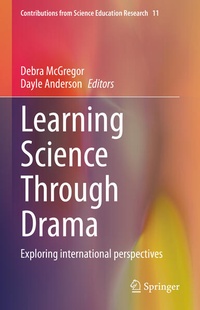
Learning Science Through Drama
Description

This book presents a wide range of international perspectives that explore the different ways the diverse forms of drama supports learning in science. It illustrates how learning science by adopting and adapting theatrical techniques can offer more inclusive ways for students to relate to scientific ideas and concepts. The theatrical processes by which subject matter can be introduced, thought about, discussed, transformed, enacted and disseminated are shown to be endless. The first section of the book considers different ways of theorising and applying drama in classrooms. The second section provides a range of case studies illustrating how role play, performance, embodiment and enquiry approaches can be utilised for learning in primary, secondary and tertiary education contexts. The third section demonstrates how different research methods from questionnaires, particular kinds of tests and even the theatrical conventions themselves can provide rich data that informs how drama impacts on learning science.
More details
Other editions
Additional editions
Persons
Professor Debra (Deb) McGregor works at Oxford Brookes University. She has also worked in a variety of science education positions in primary, secondary and higher education. She has worked in teacher education for over 25 years in Connecticut, USA; Keele University and as Assistant Director of the Centre for Development and Research in Wolverhampton, UK. Her passion for creativity is brought into being through an aspect of her research and development work with teachers on the ways drama can support active and participatory learning in science classrooms.
Dr Dayle Anderson an Adjunct Research Fellow at Ako Pai o Te Herenga Waka, the Faculty of Education at Victoria University of Wellington, New Zealand. She has worked as a scientist, primary teacher, deputy principal, and for many years as a teacher educator and researcher in the field of primary science education. Her focus is on supporting primary teachers to develop science programmes that involve students in learning that builds capabilities for confident and competent engagement with science as citizens.
