

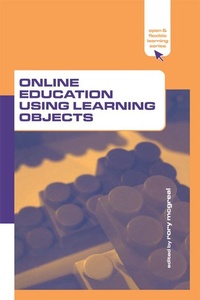
Online Education Using Learning Objects
2nd Edition
Published on 10. September 2012
392 pages
978-1-134-11680-5 (ISBN)
Description

'E-learning is integral to on-site education institutions worldwide, and the rapid explosion of interest in the subject means that this timely, cutting-edge book will be an instant and indispensable resource. Among educators, the development of reusable learning objects made accessible via the internet is ever more important to teaching and learning.
This book provides a comprehensive look at a state-of-the-art online education, and presents advice on the creation, adaptation and implementation of learning objects and metadata. Including articles written by some of the leading innovators in the field, this book takes the reader through:
designing effective learning objects;
creating learning objects;
transforming existing content into reusable learning objects;
building a metadata management system.
This book will be essential reference material for learning technologists, course developers at learning institutions, postgraduate students, teachers and learners in the field of e-learning.'
This book provides a comprehensive look at a state-of-the-art online education, and presents advice on the creation, adaptation and implementation of learning objects and metadata. Including articles written by some of the leading innovators in the field, this book takes the reader through:
designing effective learning objects;
creating learning objects;
transforming existing content into reusable learning objects;
building a metadata management system.
This book will be essential reference material for learning technologists, course developers at learning institutions, postgraduate students, teachers and learners in the field of e-learning.'
More details
Series
Edition
2nd edition
Language
English
Place of publication
London
United Kingdom
Publishing group
Taylor & Francis Ltd
Target group
College/higher education
Edition type
New edition
Illustrations
13 Tables, black and white; 72 Line drawings, black and white
File size
22,38 MB
ISBN-13
978-1-134-11680-5 (9781134116805)
Copyright in bibliographic data and cover images is held by Nielsen Book Services Limited or by the publishers or by their respective licensors: all rights reserved.
Schweitzer Classification
Other editions
Additional editions
Rory McGreal
Online Education Using Learning Objects
Book
04/2007
Routledge
€57.13
Article exhausted; check different version
Person
Rory McGreal
Content
Part 1: Learning Objects and Metadata
1. Learning Objects: Resources for Learning Worldwide S. Downes
2. A First Step Towards a Theory of Learning Objects M. Sosteric and S. Hesemeier
3. Modeling Units of Learning from a Pedagogical Perspective R. Koper & R. van Es
4. Some Objections to Learning Objects N. Friesen
5. Learning Objects Revisited E. Duval and W. Hodgins
Part 2: Creating Learning Objects
6. Designing Effective Learning Objects M. Ally
7. Creating Learning Objects S. Downes
8. Signs and Objects: Modeling Learning Objects on Peirce's Theory of Signs P. Polsani
9. Transforming Existing Content into Resable Learning Objects M. Doorten, B Giesbers, J. Janssen, J. Daniels & R. Koper
10. The Language of Flexible Reuse: Reuse, Portability and Interoperability of Learning Objects Or Why Learning Design P. Sloep
11. Collaborative Evaluation of Learning Objects J. Nesbit, K. Belfer
Part 3: Contextualization of Learning Objects
12. Context and the Role of Standards in Increasing the Value Of Learning Objects R. Robson
13. Context and Metadata for Learning, Education and Training J. Mason
14. Contextualised Models and Metadata for Learning Repositories H. Allert, C. Richter, H. Dhraief and W. Nejdl
15. Moving Further in E-Learning Standardization: Towards a Reference Architecture L. Anido
16. Reusable Learning Resources: Building a Metadata Management System Supporting Interoperable Learning Object Repositories D. Sampson and P. Karampiperis
Part 4: Learning Object Profiles, Applications and Models
17. CanCore: Guidelines for Learning Object Metadata N. Friesen, S. Hesemeier and A. Roberts
18. The Evolution of Learning Object Repository Technologies: Portals for On-Line Objects for Learning G. Richards, M. Hatala and R. McGreal
19. The Edutella P2P Network: Supporting Democratic E-Learning and Communities of Practice M. Nilsson
20. The Explor@2 Learning Object Manager G. Paquette, A. Miara, L. Guerette and K. Lundgren-Cayrol
21. The MERLOT Model and the Scholarship of Teaching N. Kestner
Part 5: The Semantic Web, Intelligent Agents and the Future
22. The Semantic Web and Metadata Decentralization S. Palmer
23. Beyond Educational Objects to Education Modeling Languages T. Anderson and A. Petrinjak
24. Semantic Cobblestones: An Interoperability Mechanism for Learning Object Repositories G. Richards and M. Hatala
25. Knowledge Modeling for Developing Course Design Agents F. Lin
26. Educational Modeling Languages, from an Instructional Engineering Perspective G. Paquette
1. Learning Objects: Resources for Learning Worldwide S. Downes
2. A First Step Towards a Theory of Learning Objects M. Sosteric and S. Hesemeier
3. Modeling Units of Learning from a Pedagogical Perspective R. Koper & R. van Es
4. Some Objections to Learning Objects N. Friesen
5. Learning Objects Revisited E. Duval and W. Hodgins
Part 2: Creating Learning Objects
6. Designing Effective Learning Objects M. Ally
7. Creating Learning Objects S. Downes
8. Signs and Objects: Modeling Learning Objects on Peirce's Theory of Signs P. Polsani
9. Transforming Existing Content into Resable Learning Objects M. Doorten, B Giesbers, J. Janssen, J. Daniels & R. Koper
10. The Language of Flexible Reuse: Reuse, Portability and Interoperability of Learning Objects Or Why Learning Design P. Sloep
11. Collaborative Evaluation of Learning Objects J. Nesbit, K. Belfer
Part 3: Contextualization of Learning Objects
12. Context and the Role of Standards in Increasing the Value Of Learning Objects R. Robson
13. Context and Metadata for Learning, Education and Training J. Mason
14. Contextualised Models and Metadata for Learning Repositories H. Allert, C. Richter, H. Dhraief and W. Nejdl
15. Moving Further in E-Learning Standardization: Towards a Reference Architecture L. Anido
16. Reusable Learning Resources: Building a Metadata Management System Supporting Interoperable Learning Object Repositories D. Sampson and P. Karampiperis
Part 4: Learning Object Profiles, Applications and Models
17. CanCore: Guidelines for Learning Object Metadata N. Friesen, S. Hesemeier and A. Roberts
18. The Evolution of Learning Object Repository Technologies: Portals for On-Line Objects for Learning G. Richards, M. Hatala and R. McGreal
19. The Edutella P2P Network: Supporting Democratic E-Learning and Communities of Practice M. Nilsson
20. The Explor@2 Learning Object Manager G. Paquette, A. Miara, L. Guerette and K. Lundgren-Cayrol
21. The MERLOT Model and the Scholarship of Teaching N. Kestner
Part 5: The Semantic Web, Intelligent Agents and the Future
22. The Semantic Web and Metadata Decentralization S. Palmer
23. Beyond Educational Objects to Education Modeling Languages T. Anderson and A. Petrinjak
24. Semantic Cobblestones: An Interoperability Mechanism for Learning Object Repositories G. Richards and M. Hatala
25. Knowledge Modeling for Developing Course Design Agents F. Lin
26. Educational Modeling Languages, from an Instructional Engineering Perspective G. Paquette
