

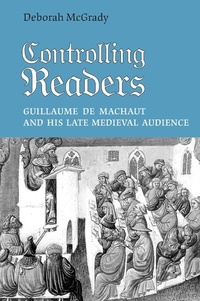
Controlling Readers
Guillaume De Machaut and His Late Medieval Audience
1st Edition
Published on 11. March 2013
368 pages
978-1-4426-6815-7 (ISBN)
Description

Guillaume de Machaut (1300-1377) was the master poet of fourteenth-century France. He established models for much of the vernacular poetry written by subsequent generations, and he was instrumental in institutionalizing the lay reader. In particular, his longest and most important work, the Voir dit, calls attention to the coexistence of public and private reading practices through its intensely hybrid form: sixty-three poems and ten songs invite an oral performance, while forty-six private prose letters as well as elaborate illustration and references to it's own materiality promote a physical encounter with the book.
In Controlling Readers, Deborah McGrady uses Machaut's corpus as a case study to explore the impact of lay literacy on the culture of late-medieval Europe. Arguing that Machaut and his bookmakers were responding to contemporary debates surrounding literacy, McGrady first accounts for the formal invention of the lay reader in medieval art and literature, then analyses Machaut and his bookmakers' innovative use of both narrative and bibliographical devices to try to control the responses of his readers and promote intimate and sensual reading practices in place of the more common public performances of court culture. McGrady's erudite and exhaustive study is key to understanding Machaut, his works, and his influence on the history of reading in the fourteenth century and beyond.
In Controlling Readers, Deborah McGrady uses Machaut's corpus as a case study to explore the impact of lay literacy on the culture of late-medieval Europe. Arguing that Machaut and his bookmakers were responding to contemporary debates surrounding literacy, McGrady first accounts for the formal invention of the lay reader in medieval art and literature, then analyses Machaut and his bookmakers' innovative use of both narrative and bibliographical devices to try to control the responses of his readers and promote intimate and sensual reading practices in place of the more common public performances of court culture. McGrady's erudite and exhaustive study is key to understanding Machaut, his works, and his influence on the history of reading in the fourteenth century and beyond.
More details
Language
English
Place of publication
Toronto
Canada
Target group
Professional and scholarly
Edition type
Digital original
File size
4,14 MB
ISBN-13
978-1-4426-6815-7 (9781442668157)
Copyright in bibliographic data and cover images is held by Nielsen Book Services Limited or by the publishers or by their respective licensors: all rights reserved.
Schweitzer Classification
Other editions
Additional editions
Book
12/2006
University of Toronto Press
€83.07
No shipping information available
Person
Deborah McGrady is an associate professor of French at the University of Virginia.
