

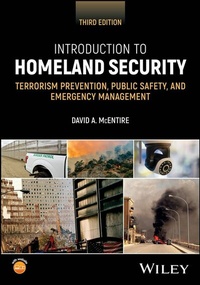
Introduction to Homeland Security
Description

Explore the growing concerns about security with this vital book
Homeland Security has never been a more important part of the American social and political fabric. Risk assessment, attack prediction and prevention, preparedness measures, response to terrorist activity, and natural disaster management all fall under the purview of homeland security. It is a key focus of the US security state, which has expanded massively in recent decades.
Introduction to Homeland Security provides an overview of this subject for professors, students, and practitioners in the field. Drawing upon a rich foundation of scholarship and academic literature, it focuses principally on terrorism prevention and protection, and offers new content related to novel threats and security concerns. Its practitioner-centered approach and attention to both governmental and non-governmental stakeholders make it an indispensable introduction to the subject.
Readers will also find:
- Coverage of the four traditional phases of emergency management
- New and additional treatment of border control, drug trafficking, organized crime, mass shootings, protests, riots, pandemics, and climate change
- Companion websites including extensive pedagogical materials, student self-assessment tests, and an image gallery
Introduction to Homeland Security is ideal for professors and students in homeland security and emergency management programs, as well as practitioners involved in this important profession.
More details
Other editions
Additional editions
Person
David A. McEntire, PhD, is a Professor in the Emergency Services and Criminal Justice Departments at Utah Valley University, Utah, USA. He has received grants from, among others, the Natural Hazards Center and the National Science Foundation to pursue research into emergency management theory, vulnerability reduction, response coordination, terrorism prevention, and related subjects.
Content
1 Understanding a Global Priority 1
Introduction 2
1.1 Diverse Threats and Terrorism are the New Normal 2
Self-Check 8
1.2 A Growing Risk 9
Self-Check 14
1.3 9/11: A Wake-Up Call 14
Self-Check 16
1.4 The Nature of Homeland Security 17
Self-Check 22
1.5 Disciplines Involved in Homeland Security and the Emergency Management Profession 22
Self-Check 31
Summary 31
Assess Your Understanding 32
Summary Questions 32
Applying This Chapter 33
Be a Homeland Security Professional 34
Key Terms 34
References 35
2 Identifying Terrorism 38
Introduction 39
2.1 Defining Terrorism 39
Self-Check 42
2.2 Common Characteristics of Terrorism 42
Self-Check 43
2.3 Types of Terrorism 43
Self-Check 46
2.4 Relation of Terrorism to Other Disasters 46
Self-Check 49
Summary 49
Assess Your Understanding 50
Summary Questions 50
Applying This Chapter 51
Be a Homeland Security Professional 51
Key Terms 52
References 52
3 Recognizing the Causes of Terrorism 54
Introduction 55
3.1 Frequently Mentioned Causes of Terrorism 55
Self-Check 58
3.2 Political Causes 58
Self-Check 63
3.3 Cultural and Religious Causes 63
Self-Check 67
3.4 Ideology 68
Self-Check 70
Summary 70
Assess Your Understanding 71
Summary Questions 71
Applying This Chapter 72
Be a Homeland Security Professional 72
Key Terms 73
References 74
4 Comprehending Terrorists and their Behavior 76
Introduction 77
4.1 Terrorists and Terrorist Organizations 77
Self-Check 81
4.2 Personal Characteristics 82
Self-Check 84
4.3 The Behavior and Tactics of Terrorists 84
Self-Check 95
Summary 95
Assess Your Understanding 96
Summary Questions 96
Applying This Chapter 97
Be a Homeland Security Professional 97
Key Terms 98
References 99
5 Uncovering the Dynamic Nature of Terrorism 101
Introduction 102
5.1 The Appearance of Terrorism 102
Self-Check 103
5.2 The Evolution of Terrorism Abroad 103
Self-Check 108
5.3 Terrorism and The United States 108
Self-Check 112
5.4 Terrorism Today 113
Self-Check 116
Summary 116
Assess Your Understanding 117
Summary Questions 117
Applying This Chapter 118
Be a Homeland Security Professional 118
Key Terms 119
References 120
6 Evaluating a Major Dilemma 121
Introduction 122
6.1 Changes in The Media Over Time 122
Self-Check 123
6.2 Terrorists and The Media 123
Self-Check 126
6.3 The Media and Terrorism 126
Self-Check 129
6.4 Government and The Media 130
Self-Check 134
6.5 Censorship and Self-Censorship 134
Self-Check 136
Summary 137
Assess Your Understanding 137
Summary Questions 137
Applying This Chapter 138
Be a Homeland Security Professional 138
Key Terms 139
References 139
7 Contemplating a Quandary 141
Introduction 142
7.1 War, Terrorism, and Law 142
Self-Check 145
7.2 Security and Liberty 145
Self-Check 149
7.3 Cases and Considerations 149
Self-Check 155
Summary 156
Assess Your Understanding 156
Summary Questions 156
Applying This Chapter 157
Be a Homeland Security Professional 157
Key Terms 158
References 158
8 Preventing Terrorist Attacks 160
Introduction 161
8.1 Addressing Root Causes 161
Self-Check 163
8.2 Policy and Legislation 163
Self-Check 167
8.3 Intelligence 167
Self-Check 174
8.4 Counterterrorism 174
Self-Check 181
Summary 181
Assess Your Understanding 181
Summary Questions 182
Applying This Chapter 183
Be a Homeland Security Professional 183
Key Terms 183
References 185
9 Securing the Nation 186
Introduction 187
9.1 Border Control 187
Self-Check 195
9.2 Protecting Air Transportation 195
Self-Check 198
9.3 Rail Transportation Security 198
Self-Check 202
9.4 Protection of Sea Ports and Maritime Transportation 203
Self-Check 206
9.5 Protection of Petrochemical Facilities 206
Self-Check 208
Summary 208
Assess Your Understanding 209
Summary Questions 209
Applying This Chapter 210
Be a Homeland Security Professional 210
Key Terms 211
References 212
10 Protecting Against Potential Attacks 213
Introduction 214
10.1 Threat Assessment 214
Self-Check 222
10.2 Structural and Nonstructural Mitigation 223
Self-Check 227
Summary 228
Assess Your Understanding 228
Summary Questions 228
Applying This Chapter 229
Be a Homeland Security Professional 230
Key Terms 230
References 231
11 Preparing for the Unthinkable 232
Introduction 233
11.1 The Importance and Nature of Preparedness 233
Self-Check 240
11.2 Foundations of Local Preparedness 240
Self-Check 245
11.3 Planning 245
Self-Check 248
11.4 Other Measures 248
Self-Check 254
Summary 254
Assess Your Understanding 255
Summary Questions 255
Applying This Chapter 256
Be a Homeland Security Professional 256
Key Terms 257
References 258
12 Responding to Attacks 260
Introduction 261
12.1 Investigation and Apprehension 261
Self-Check 272
12.2 Other Crucial Functions 272
Self-Check 276
12.3 Coordination Mechanisms 277
Self-Check 282
Summary 283
Assess Your Understanding 283
Summary Questions 283
Applying This Chapter 284
Be a Homeland Security Professional 285
Key Terms 285
References 287
13 Recovering From Impacts 288
Introduction 289
13.1 Initial Recovery Steps 289
Self-Check 293
13.2 Key Recovery Functions 293
Self-Check 299
13.3 The Importance of Disaster Assistance 299
Self-Check 305
Summary 305
Assess Your Understanding 305
Summary Questions 306
Applying This Chapter 307
Be a Homeland Security Professional 307
Key Terms 308
References 309
14 Assessing Significant Threats 311
Introduction 312
14.1 The Future of Terrorism and WMD 312
Self-Check 316
14.2 Radiological Weapons 316
Self-Check 320
14.3 Nuclear Weapons 320
Self-Check 323
14.4 Biological Weapons 324
Self-Check 327
14.5 Chemical Weapons 328
Self-Check 331
14.6 Cyberterrorism 331
Self-Check 335
Summary 336
Assess Your Understanding 336
Summary Questions 336
Applying This Chapter 337
Be a Homeland Security Professional 338
Key Terms 338
References 339
15 Evaluating Other Pressing Problems 341
Introduction 342
15.1 Criminal Activity 342
Self-Check 352
15.2 Social Disturbances 353
Self-Check 360
15.3 Epidemics and Pandemics 360
Self-Check 364
15.4 Global Warming and Climate Change 364
Self-Check 368
Summary 369
Assess Your Understanding 369
Summary Questions 369
Applying This Chapter 371
Be a Homeland Security Professional 371
Key Terms 372
References 373
16 Looking Toward the Future 378
Introduction 379
16.1 The Lessons of This Book 379
Self-Check 383
16.2 Accountability in Homeland Security 383
Self-Check 386
16.3 Clarification of Homeland Security Policy 386
Self-Check 390
16.4 Research Needs and Recommendations for the Future 390
Self-Check 396
Summary 397
Assess Your Understanding 397
Summary Questions 397
Applying This Chapter 398
Be a Homeland Security Professional 399
Key Terms 399
References 399
Glossary 401
Index 415
Preface
U.S. policy regarding international affairs, terrorism, and disasters has witnessed ongoing tension between the security and emergency management points of view. Since the late 1940s, there has been recurring disagreement about the priority given to conflict disasters versus other types of hazards. Several events elevated the stakes in this debate and created additional urgency to find some sort of consensus about future priorities.
First, the 9/11 attacks and the recent Hamas violence in Israel underscore the fact that the threat of terrorism needs to be taken seriously by disaster scholars and emergency managers. No one should pretend that the world is the way it once used to be.
Second, Hurricane Katrina and a plethora of other disasters remind homeland security officials that they must not disregard human vulnerability to natural hazards. The frequency of natural, technological, and anthropogenic disasters is simply too great to ignore. In addition, the consequences of compound interactions are getting worse over time.
With these observations in mind, it is the opinion of this author that both homeland security and emergency management functions need to be addressed concomitantly in the future. Terrorist attacks are increasing in frequency, and their negative outcomes are widespread. While the possibility of terrorism involving weapons of mass destruction or cyberterrorism is uncertain, the impact of such attacks would indeed be overwhelming. More resources will be needed to address every type of threat.
However, government attention and resource distribution should also take into account the broad aspects of homeland security. Terrorism has been given the lion's share of public support in recent years, but this attention should not be allowed to overshadow the essential functions and contributions of emergency management.
Unfortunately, policy makers unintentionally created a substantial divide between the homeland security and disaster communities. Politicians may have overreacted to 9/11, and their decisions initially diminished the existing emergency management system of the 1990s. This has caused some ill feelings among emergency managers toward the military and the law enforcement communities, which is not a good situation when one considers the fact that terrorists have vowed to kill Americans everywhere (including at home).
Added to this ongoing discussion is the fact that additional risks have become more prevalent in recent years. This includes a rise in various types of crime, the occurrence of riots, the global COVID-19 pandemic, and concerns about climate change. Thus, those involved in homeland security and emergency management must also work collaboratively with other public safety, public health, and environmental agencies and officials to address the challenges of our day.
This book, Introduction to Homeland Security: Terrorism Prevention, Public Safety and Emergency Management, Third Edition, aims to provide a foundation that could assist in spanning the chasm between the disaster and terrorism communities. Its focus on terrorism may help to educate those who do not yet understand the need to prepare for this expanding threat. Its concentration on emergency management will remind homeland security officials that reinventing of the wheel is not only unnecessary but problematic. In addition, the book educates homeland security and emergency management professionals about other important considerations pertaining to unabated crime, social discord, physical well-being, and our precious natural resources.
Of course, taking this approach could result in increased antagonism between the different parties. It is also possible that the author has not adequately portrayed the specific details pertinent to all of the actors involved in the broad and interdisciplinary array of homeland security, emergency management, public safety, public health, and environmental protection activities. Nevertheless, it is the author's hope that this work will educate those working in each area and help promote a synergy of effort.
Chapter 1, "Understanding a Global Priority: Diverse Threats, Terrorism, Homeland Security, and Emergency Management," examines the significant impacts of 9/11, the Hamas attacks in Israel, and other events in world history. It also defines homeland security and supplements homeland security with an emergency management perspective, thereby offering a broader view of how to deal with terrorist attacks.
Chapter 2, "Identifying Terrorism: Ideologically Motivated Acts of Violence and Their Relation to Disasters," identifies the numerous definitions and perspectives of terrorism, comparing how these are both alike and dissimilar. This chapter also looks at the connections between terrorism and other types of disasters.
Chapter 3, "Recognizing the Causes of Terrorism: Differing Perspectives and the Role of Ideology," explores what motivates people to participate in terrorism, paying special attention to how historical conflicts, mistakes in foreign policy, and extreme levels of poverty may impel some to engage in terrorist attacks.
Chapter 4, "Comprehending Terrorists and Their Behavior: Who They Are and What They Do," assesses the nature of individual terrorists and those associated with groups and states and identifies how they finance operations, communicate with secret codes, and carry out attacks.
Chapter 5, "Uncovering the Dynamic Nature of Terrorism: History of Violence and Change over Time," explores why terrorism initially emerged, how it evolved in other nations, and the ways it has manifested in the United States.
Chapter 6, "Evaluating a Major Dilemma: Terrorism, the Media, and Censorship," looks at the difficult relationship between terrorism and the media, how to predict how reporters view terrorism, and the drawbacks and limitations of censorship.
In Chapter 7, "Contemplating a Quandary: Terrorism, Security, and Liberty," you learn why, as a participant in homeland security, it is imperative that you assess the tradeoffs between security and rights and why terrorism exploits the tension between them.
Chapter 8, "Preventing Terrorist Attacks: Root Causes, Law, Intelligence, and Counterterrorism," addresses the root causes of terrorism and explores primary ways of preventing attacks, like promoting laws that prohibit terrorism and punish those who support it, protecting all points of entry into the United States, and relying on human and other sources of intelligence to apprehend terrorists before they strike.
In Chapter 9, "Securing the Nation: Border Control and Sector Safety," the permeability of the U.S. border is mentioned along with measures to prevent the infiltration of terrorists onto American soil. It also discusses the vulnerability of various economic sectors and describes ways to secure railways, air transportation, sea ports, and chemical facilities.
Chapter 10, "Protecting Against Potential Attacks: Threat Assessment, Mitigation, and Other Measures," looks at the benefits of mitigation practices, such as working with others to assess threats posed to critical infrastructure, key assets, and soft targets, as well as differentiating between structural and nonstructural mitigation methods.
In Chapter 11, "Preparing for the Unthinkable: Efforts for Readiness," it is revealed that preparing for terrorism is one of the central responsibilities of homeland security. To help your community prepare for possible terrorist attacks, you will need to be familiar with the executive orders and legislation issued by the president and congress and set the foundation for preparedness by creating an advisory council, passing ordinances, acquiring monetary resources, and establishing an EOC.
Chapter 12, "Responding to Attacks: Important Functions and Coordination Mechanisms," examines effective ways to react to terrorist attacks, including the numerous functions involved, such as investigation, the protection of first responders, and the treatment of the victims of terrorist attacks.
Chapter 13, "Recovering from Impacts: Short- and Long-term Measures," addresses the variety of recovery measures that need to be performed after a terrorist attack takes place, including declaring a disaster or state of emergency, addressing mass fatality issues, disposing debris, and providing emotional support for those who have been emotionally impacted by the event.
Chapter 14, "Assessing Significant Threats: WMD and Cyberterorrism," assesses the probability that terrorists will launch more unique and devastating attacks. It identifies the threat of radiological, nuclear, biological, and chemical weapons along with numerous recommendations to counter such assaults. The chapter also describes the risk of cyberterrorism and mentions the measures being taken to increase preparedness in this area.
Chapter 15, "Evaluating Other Pressing Problems: Criminal Activity, Social Disturbances, Pandemics, and Climate Change," explores additional risks that must be taken into consideration today by both homeland security and emergency management professionals. These risks include a variety of problems relating to organized crime, illegal drugs, human trafficking, protests, riots, COVID-19, and global warming.
In Chapter 16, "Looking Toward the Future: Challenges and...
