

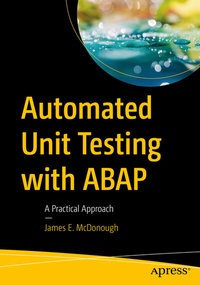
Automated Unit Testing with ABAP
Description

Automated Unit Testing with ABAP: A Practical Approach offers hope and salvation to ABAP programmers who continue to toil with antiquated manual unit testing processes, taking them by the hand and lifting them out of that dungeon of despair with a modern and proven alternative. It begins by explaining how the xUnit family of automated testing frameworks provides a quick and effective means of insuring high-quality software. It then focuses on the ABAP Unit Testing Facility, the xUnit framework applicable specifically to the ABAP language, showing how it can be used to bring ABAP applications underautomated testing control, from old legacy applications to those newly written.
Whereas xUnit testing has been widely accepted with developers writing in many other programming languages, it is an unfortunate fact in the ABAP community that many programmers still are unfamiliar with xUnit concepts and do not know how to begin implementing automated unit testing into their development process. This book demonstrates how to refactor programs so they become designed for testability, showing how to use process encapsulation and test isolation to facilitate automated testing, including a thorough explanation of test-driven development and the use of test doubles. The book:
- Shows how to write automated unit tests for ABAP
- Instills ABAP programmers with the confidence to refactor poorly written code
- Explains how an automated testing harness facilitates rapid software development
- Teaches how to utilize test-driven development (TDD) withABAP
- Offers advice and tips on the best ways to write automated unit tests
What You Will Learn
- Become familiar with the xUnit approach to testing
- Know the ABAP statements that interfere with running automated unit tests and how to accommodate them
- Understand what it means to isolate code for testing and how this is achieved
- Gain the confidence to refactor poorly written code
- Make ABAP programs designed for testability
- Reap the benefits of spending less time manually unit testing ABAP programs
- Use test-driven development (TDD) with ABAP programming
- Use configurable test doubles in ABAP
Who This Book Is For
More details
Other editions
Additional editions
Person
Content
Chapter 1: Introduction.- Chapter 2: Preparing to Take the First Step.- Chapter 3: Software Quality.- Chapter 4: The Origins of Automated Unit Testing.- Chapter 5: Automated Unit Testing with ABAP.- Chapter 6: Rudiments.- Chapter 7: Design for Testability.- Chapter 8: Test Doubles.- Chapter 9: Service Locator.- Chapter 10: Leveraging the Service Locator.- Chapter 11: Test-Driven Development.- Chapter 12: Configurable Test Doubles.- Chapter 13: Obtaining Code Coverage Information Through ABAP Unit Testing.- Chapter 14: Cultivating Good Test Writing Skills.- Chapter 15: Welcome to Autropolis.- Appendix A: Requirements Documentation and ABAP Exercise Programs.- Appendix B: Answers to Chapter Quizzes.- Appendix C: Concepts Associated with Defining Local Test Classes.-
