

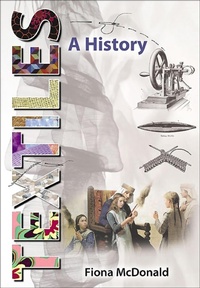
Textiles
A History
Published on 31. January 2020
304 pages
978-1-78159-952-5 (ISBN)
Description

A fascinating and accessible history of textiles, including the key personalities and inventions which revolutionized the industry, together with the East End workshops and the creation of artificial materials such as rayon. Textile expert, Fiona McDonald, includes tips on the care and repair of materials and advice on whats worth collecting and the best materials to wear, as well as safe cleaning, tips on collecting.In addition to a handy glossary of textile terms, there is an A-Z of different textiles, full of interesting facts did you know that velvet was originally made from silk and its name derives from the Latin word, vellus, meaning fleece, or that cabbage was the term used in the rag trade to refer to the extra outfits clever cutters created and sold off the books by careful placement of the pattern. A fascinating and often surprising subject area explored at an accessible but informative level.Did you know? Peau de Soie is a heavy satin which was used for wedding dresses at the turn of the last century. The word satin is derived from Zaytoun, an area of China where it was first made We have lost many evocative names for colors over the years, including bouffon (darker than eau de nil) cendre de rose (gray with pink nuances), dust of Paris (ecru), esterhazy (silver-gray), flys wing (graphite) and terre dEgypt (rust)
More details
Other editions
Additional editions
Book
02/2012
Remember When
€37.50
Shipment within 10-20 days
Content
- Intro
- Dedication
- Title Page
- Copyright Page
- Table of Contents
- Introduction
- Timeline
- PART I - The Raw Materials
- CHAPTER ONE - Plant Fibres
- Flax in China
- Egyptian linen
- Pliny the Elder
- Processing flax
- Flax on the move
- Flax and hemp facts at a glance
- Sisal
- Jute
- Hemp
- Nettle
- Note
- CHAPTER TWO - Plant Fibres
- Cotton in two continents
- The Indus Valley
- Cotton in Egypt
- The Greeks
- Cotton arrives in Europe
- Meanwhile, across the Atlantic .
- South America
- Cotton in Britain
- Cotton in America
- Eli Whitney's Cotton Gin
- Slave labour leads to American Civil War
- Going back in time to the English Invasion of India .
- England buys American cotton
- Cotton mills of England
- Back in America
- Back in Britain .
- Egyptian Cotton
- What happened to cotton in India?
- Cotton in the Twentieth Century
- But what is cotton?
- Properties of Cotton
- Processing of Cotton
- Cotton's worst nightmare
- Notes
- CHAPTER THREE - Animal Fibres
- Prehistoric wool
- The wool industry in England
- Flanders enters the field
- Here come the Italians
- Flanders is squeezed out of the market
- Florence as master cloth makers
- Merchants, merchants everywhere: foreign merchants in England
- Italian finance
- Guilds
- Organisation of medieval mercantile guilds
- Decay of the guilds
- Merchants of the Staple
- Hanseatic League
- Wool in the Time of Chaucer
- Wool in Tudor times
- Weaver makes good
- The Merchant Adventurers of London
- Friction between the Staples and the Adventurers
- The Domestic System
- Wool in Nineteenth Century
- Wool in the Twentieth Century
- Wool in Australia
- Shearing sheep
- Worsted processing
- Wool processing
- Some of the major sheep wool types
- Parasites and other problems
- Notes
- CHAPTER FOUR - Silk
- The Legend
- Discovery and early production of Chinese silk
- Silk follows the trade routes
- The secret is out
- Silk in Rome
- Chinese silk weavers in Persia
- Mechanisation in China
- Independent silk development outside of China
- Production of silk in the West
- Byzantine silk
- Silk production in Europe
- Silk in the colonies
- Silk weaving in Britain
- Espionage and murder
- Silk in Ireland
- The Queen wears mauve silk and then black
- Thai silk
- Cultivated Silk Process
- Life cycle of Bombyx mori
- Spinning the cocoon
- What happens next
- Waste silk
- Wild silk
- Wild silk moth types
- Glossary specifically for silk, including imitation silk
- PART TWO - Processing
- CHAPTER FIVE - Spinning
- The first twisted thread
- The spindle
- Spindle whorls
- Make it yourself
- The distaff
- Evidence of plying
- The Great Wheel
- The Saxony Wheel
- Origin of the word spinster
- Origin of the word draper
- Industrial spinning
- John Kay - the flying shuttle
- James Hargreaves - the spinning jenny
- Richard Arkwright - the water frame
- Samuel Crompton - the spinning mule
- Edward Cartwright - the power loom
- What was happening in America?
- From cotton to guns
- Wool in America
- Ring-spinning frame
- James Watt and the steam engine
- CHAPTER SIX - Weaving
- Tapestry
- Note
- CHAPTER SEVEN - Felting
- How Felt is Made
- Felt Hats
- Try it yourself
- Needle Felting
- Felt as Art
- Note
- CHAPTER EIGHT - Knitting
- More early knitting
- Two Needle Knitting
- Two needles, more needles or one?
- Joseph's coat of many colours
- Sailors
- Men knitting in the Twentieth Century
- War
- Knitting for charity
- Knitting samples
- French knitting
- Finger knitting
- William Lee and the knitting machine
- Crochet
- Lace
- Note
- PART THREE - Surface Decoration
- CHAPTER NINE - Dyeing
- Yellow
- Red
- Orange
- Blue
- Green and Purple
- Natural Mordants
- Chemical dyes
- Ways of dyeing
- Tie-dyeing
- Batik
- CHAPTER TEN - Printing and Painting
- Woodblock
- Perrotine printing
- Engraved copperplate printing
- Roller printing, cylinder printing, or machine printing
- Stencil printing
- Screen printing
- Digital textile printing
- Preparation of cloth for printing
- Painting
- CHAPTER ELEVEN - Embroidery
- Quilting
- Canvas Work
- Embroidery Stitch Glossary
- PART FOUR - The Industrial Revolution
- CHAPTER TWELVE - The Industrial Revolution
- Before the revolution
- The Beginning of Mechanisation
- The Major Inventors
- The Factory System
- The Industrial Revolution
- Pollution
- Land Enclosure
- Women and children in the work force
- Real Reform?
- Fluff
- The Sewing Machine
- Isaac Singer
- Notes
- PART FIVE - Textiles in the Modern World
- CHAPTER THIRTEEN - Man-made Fibres
- Nylon
- Man-made Fibre Glossary
- CHAPTER FOURTEEN - Fibre Art
- Glenys Mann
- Lisa Lichtenfels
- Kaffe Fassett
- Brandon Mably
- Jan Garside
- Vicki Taylor
- Vanessa Taylor
- Helen Evans
- Judy Wilford
- Note
- CHAPTER FIFTEEN - Literary Textiles - Quotes, Metaphors etc.
- CHAPTER SIXTEEN - Care of Textiles
- Storage and Display
- Glossary
- Textile Places of Interest
- Bibliography
- Acknowledgements
- Index
