

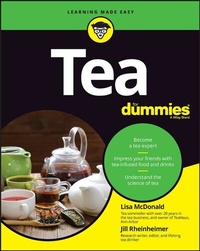
Tea For Dummies
Description

Tea For Dummies is your guide to enjoying the delicate flavors and health benefits of the world's second most popular beverage. This book helps novices and connoisseurs alike step confidently into the vast, versatile world of tea. Learn which teas are right for you and brew the perfect cup. We'll also look at the research on tea's benefits, including lower blood pressure, reduced stress, lessened risk of cancer and cognitive decline, and easier weight management. Where is tea grown? How is it processed? What's the best way of incorporating tea into a healthy lifestyle? How is tea enjoyed around the world? Dummies answers all your tea questions, so you can enjoy every sip.
* Learn the basics of tea production and preparation
* Discover the varieties of tea and get to know their effects
* Develop a deep knowledge of tea to enhance the experience of drinking or serving it
* Maximize the mental and physical health benefits of herbal and caffeinated teas
This compendium of tea wisdom is perfect for anyone looking for a deeper enjoyment and appreciation of tea. We'll help you figure out where to start with tea, and if you're already part of the tea fan club, we'll inspire and fascinate you even more.
More details
Other editions
Additional editions
Persons
Lisa McDonald is one of a handful of European-trained tea sommeliers in the U.S. and the owner of TeaHaus in Ann Arbor, MI (teahaus.com), an acclaimed tea shop where customers can find over 200 varieties of tea.
Jill Rheinheimer, an editor and graphic designer, writes a research-based blog about all things tea (ItsMoreThanTea.wordpress.com) as well as educational and marketing material for TeaHaus.
Content
Part 1: Getting Started with Tea 5
Chapter 1: It's Time for Tea 7
Chapter 2: Tea for You, Tea for Me 13
Chapter 3: From Garden to Cup 25
Part 2: Talking about Different Types of Tea 39
Chapter 4: Black Tea 41
Chapter 5: Green Tea 53
Chapter 6: Oolong (Wulong) Tea 63
Chapter 7: White Tea 69
Chapter 8: Other Teas 75
Chapter 9: Herbal Teas 83
Chapter 10: Drinking Tea Like an Expert 91
Part 3: Getting Curious about Caffeine 113
Chapter 11: Caffeine: Tempest in a Teacup? 115
Chapter 12: Less Is Not Always More -- Decaffeinated Tea 133
Part 4: Spilling the Tea about Health Benefits 139
Chapter 13: Tea and Its Powerful Antioxidants 141
Chapter 14: Investigating the Health Benefits of Tea 149
Chapter 15: Investigating the Health Benefits of Herbal Tea 167
Part 5: My Cup of Tea -- Around the World 183
Chapter 16: Exploring Tea-Producing Regions of the World 185
Chapter 17: Embracing Age-Old Traditions and Ceremonies 195
Chapter 18: Insight into the Tea Industry 207
Part 6: Let's Have Tea -- In the Kitchen, at the Bar 217
Chapter 19: Cooking and Baking with Tea 219
Chapter 20: Tea and Food Pairing 249
Chapter 21: Tea Mixology 257
Part 7: The Part of Tens 285
Chapter 22: Ten Plus Things to Do with Tea That You Don't Like 287
Chapter 23: More Than Ten Myths about Tea 291
Glossary 297
Index 305
Chapter 1
It's Time for Tea
IN THIS CHAPTER
Thinking about why tea is so popular
Figuring out which tea to try first
Deciding how much tea to buy
Learning how to properly store your tea
Did you know that tea is the second-most consumed beverage in the world? Most think of coffee or even beer before tea, but they are wrong. Tea is second only to water.
Throughout history, tea has played an important role in politics, economics, and society. Whether picked up in a gas station cooler or sipped in a fancy tearoom with friends, this drink's steeped in complexity. So, let's take a closer look at what has become one of the fastest-growing industries as well as the second-most popular drink around the globe.
In this chapter, we consider just what makes tea so enduring and loved. Is it just its flavor, or is there more to it? We briefly look at the benefits of drinking tea, and then we head into a few practical issues to get you started on your journey into the world of tea. About a gazillion teas are out there, but we offer some recommendations for where to begin, and then we supply a handy guide for how many cups of tea you can expect out of a bag of leaves. Finally, we offer a few tips on how to best store your leaves. Oh, and we do want to welcome you to the communi-tea!
Understanding the Popularity of Tea
It is safe to say that nations were built and economies were structured on tea. Today, nearly 4 billion cups of tea are enjoyed every day! That's more than 165 million cups an hour! Imagine how many leaves are picked daily to bring you this amazing elixir.
Meeting tea drinkers the world over
In the United States, tea is mostly consumed cold and quickly, but it is still an important part of our culture. Whether at a backyard barbeque, given to us for a sore throat or upset tummy, or served at a fancy tea party, we all have had a cup at some point in our lives - for some of us, multiple cups a day.
In many places in the world, tea is so woven into the culture that businesses and homes must welcome you with a cup of tea, while in other countries serving tea is a ceremony with deep traditions and meanings. People on every continent have made tea their own.
So, whether you're guzzling a refreshing iced tea while driving to your kid's soccer game, or someone across the ocean is getting all dressed up for a special tea party, or another person is attending a traditional tea ceremony, we are all enjoying the same drink.
Seeing why tea is so popular
Just why is tea so popular? For one, the world of tea is incredibly diverse. Although "tea" may conjure up an iced black tea, you can find tea to suit any taste. Bold or subtle, toasty or vegetal, bitter or sweet, smoky, fruity, floral, simple or complex, you get the picture. Some teas explode with flavor when iced, and others brace your spirits on a bone-chilling rainy night. Some pair amazingly well with food, whereas others are meant for thoughtful sipping.
Further, tea gives you what's often called a "calm alertness." Unlike the caffeine in coffee, which hits you quickly and sometimes hard, that same caffeine in tea is tempered by an amino acid that's unique to tea. In a cup of tea, you get the best of both worlds: that alertness of caffeine, coupled with a calm and relaxing focus.
On a deeper level, having tea together binds us socially. A boisterous night over tea cocktails fosters camaraderie among friends; a solemn tea ceremony may ground us. We offer comfort and support when we pour a cup of tea for a grieving friend. Simply holding a steaming cup of tea promotes well-being. When someone asks you if you want a cup of tea, they're extending hospitality and kindness at the very least. If someone you love asks you that same question, you know that cup symbolizes empathy, connectedness, and love.
Discovering some benefits of tea
There's a lot of media coverage these days about the health benefits of tea and why you should drink it. Although tea is a healthy alternative to high caloric drinks like soda or pop, it isn't a cure-all. Yes, tea can be an important part of a healthy diet and may indeed offer some benefits, but tangible physical effects are only now being defined and understood. However, preliminary results are exciting as we learn, for instance, how tea positively impacts our frame of mind, including outlook, mood, and our perception of others. There's hope that tea helps preserve cognition. In fact, so much research is being done that we dive deeper into the science in Chapters 13 and 14.
If you're an herbal tea fan, don't worry. We have you covered as well, with Chapter 15 devoted to current research on herbal teas.
Begin Your Tea Journey Here
Tea. It's as simple as boiling water, pouring it over leaves, taking a couple minutes to relax, and straining out the leaves. One cup of the perfect tea can hook you for a lifetime.
Tea knows no age
When I (Lisa) opened TeaHaus, my older son was two years old and my younger one was three days old - yes, I know, I'm crazy. They have both been drinking tea since, well, forever. I can remember giving my baby a little cooled ginger rooibos when his tummy was upset, and my older son would be so excited to get his favorite fruit tea in his sippy cup. On the other hand, my husband was forty-five before he started really enjoying tea. He remembers having it as a kid but only when he wasn't feeling well or when his grandma was visiting.
Meanwhile, Jill has finally gotten her decades-long-coffee-drinker husband into tea. Granted, he drinks only two black teas, one fruity black tea, and absolutely no green teas, but he really likes those three teas.
Tea can be enjoyed by anyone at any age. Sure, some teas are better suited for kids (caffeine free), and sometimes it takes finding the one that you personally love, but tea is to be had by all.
Teas to try first
If you are trying to get into tea, you'll probably want to hold off on some teas. Lapsang souchong, Japanese green teas like sencha or matcha, and white teas may not be what you are expecting. You may want to ease into these teas after you're more accustomed to tea and its various flavors.
So then, where do you begin?
For many, their journey into the world of tea starts with something more familiar, like earl grey or a teabag from a box. Although teabags have gotten better throughout the years, they will never be what tea is meant to be. In this book, we focus on loose-leaf tea.
At our store, we have seven different versions of loose-leaf earl grey, one of which is our number-one-selling tea. In fact, three of our best-selling teas come from our earl grey collection, and they generally rank within the top ten teas every year, which speaks to their enduring popularity. Once you have a cup of high-quality loose-leaf earl grey, you will never teabag again.
Another commonly known tea is chai. This spiced and often sweetened tea is a popular starting point in coffee shops and cafes. Fruity flavored teas are another great entry tea, especially iced. Even as a tea sommelier, I never judge if someone's favorite is a pineapple-mango tea or a sweetened caramel tea. I like to look at these teas as gateway teas. You should always drink what you enjoy the most and then branch out every so often. You might find a new favorite.
Things to consider when picking a black tea is how strong and bold you want it, how much astringency (that dry feeling in your mouth) you want, whether you prefer a tea that is simply strong versus something that has layers of flavor, and whether you like earthy or smoky notes.
For a less intense black tea, there are plenty of options. Ceylon teas are full-bodied and brisk, but not overly so, and they have just the right amount of astringency. They are what many people think of when they envision black tea. Ceylon is great iced and works well with lemon, sugar, milk, and so on. Assam teas pair particularly well with food, so they can be nice with a snack or meal, and they hold up to a little cream and sugar.
If, however, you want a strong tea, breakfast teas are a good match - and you have a lot to choose from: Irish, Scottish, English, Russian, and East Frisian blends, among others. Every tea blender will use a different ratio of teas, so you may find that you prefer some breakfast blends over others. Yet, all of them are robust enough to stand up to milk and sugar. Just take care in brewing these teas so that they don't become bitter.
For coffee lovers who are used to deep and complex flavors, consider an Assam from India or the many pu-erh and Yunnan teas from China. Some wild-grown teas would also make this list. Although these aren't in-your-face bold like the breakfast blends, they are intriguingly full-bodied and multilayered in flavor.
Note that teas that have been processed by the cut-tear-curl (CTC) process (these teas are in tiny bits) will release caffeine more quickly than teas composed of intact or largely intact leaves, especially if those leaves have been tightly rolled. However, this isn't to say that you will get more caffeine overall. The caffeine issue is complicated, and we suggest you go to Chapter 11 for a comprehensive look at how it operates in tea.
To...
