

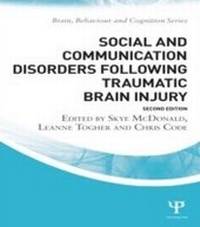
Social and Communication Disorders Following Traumatic Brain Injury
2nd Edition
Published on 4. December 2013
432 pages
978-1-136-76864-4 (ISBN)
Description

Traumatic brain injury (TBI) can seriously disrupt the social and communication skills that are basic requirements for everyday life. It is the loss of these interpersonal skills that can be the most devastating for people with TBI and their families. Although there are many books that focus upon TBI, none focus on communication and communication skills specifically. This book fills this important gap in the literature and provides information ranging from a broad overview of the nature of pathology following TBI and its effects on cognition and behaviour, through to the latest evidence about ways to assess and treat social and communication disorders.
Much has changed in the field of communication disorders and TBI since the first edition of this book was published in 1999. There have been advances in neuroimaging, providing more accurate understanding of how the brain is damaged in TBI and also insights into its repair. There has been a burgeoning interest in social cognition, and advances in how communication is conceptualized, with a particular focus on the role of how context facilitates or impedes communicative ability. Most importantly, much has changed in the arena of rehabilitation. There is now a growing evidence base of treatments aimed at improving communication problems following TBI, new resources for accessing this information and renewed interest in different kinds of methods for demonstrating treatment effects.
Bringing together a range of expert international researchers interested in understanding the nature and treatment of TBI this book covers topics from understanding how the brain damage occurs, how it affects social and communication skills and how these problems might be treated. As such it will be of great interest to clinicians, postgraduate and undergraduate students and researchers in neuropsychology, speech and language pathology.
Much has changed in the field of communication disorders and TBI since the first edition of this book was published in 1999. There have been advances in neuroimaging, providing more accurate understanding of how the brain is damaged in TBI and also insights into its repair. There has been a burgeoning interest in social cognition, and advances in how communication is conceptualized, with a particular focus on the role of how context facilitates or impedes communicative ability. Most importantly, much has changed in the arena of rehabilitation. There is now a growing evidence base of treatments aimed at improving communication problems following TBI, new resources for accessing this information and renewed interest in different kinds of methods for demonstrating treatment effects.
Bringing together a range of expert international researchers interested in understanding the nature and treatment of TBI this book covers topics from understanding how the brain damage occurs, how it affects social and communication skills and how these problems might be treated. As such it will be of great interest to clinicians, postgraduate and undergraduate students and researchers in neuropsychology, speech and language pathology.
More details
Series
Edition
2nd edition
Language
English
Place of publication
London
United Kingdom
Publishing group
Taylor & Francis Ltd
Target group
College/higher education
Edition type
Revised edition
Illustrations
10 s/w Abbildungen, 26 s/w Tabellen, 10 s/w Zeichnungen
26 Tables, black and white; 10 Line drawings, black and white; 10 Illustrations, black and white
File size
4,34 MB
ISBN-13
978-1-136-76864-4 (9781136768644)
Copyright in bibliographic data and cover images is held by Nielsen Book Services Limited or by the publishers or by their respective licensors: all rights reserved.
Schweitzer Classification
Other editions
Additional editions
Skye McDonald | Leanne Togher | Chris Code
Social and Communication Disorders Following Traumatic Brain Injury
Book
11/2013
2nd Edition
Psychology Press Ltd
€275.20
Shipment within 3-4 weeks
Skye McDonald | Leanne Togher | Chris Code
Social and Communication Disorders Following Traumatic Brain Injury
Book
11/2013
2nd Edition
Psychology Press Ltd
€95.00
Shipment within 3-4 weeks
Persons
Skye McDonald is Professor of Clinical Neuropsychology at the University of New South Wales. She is an experienced clinical neuropsychologist and a senior researcher specializing in disorders of communication, social cognition and emotion following traumatic brain injury. McDonald has over 100 peer reviewed research studies focusing on these topics. She leads a Centre of Research Excellence in psychosocial rehabilitation following traumatic brain injury and is Associate Editor of the Journal of the International Neuropsychological Society.
Leanne Togher is Professor of Communication Disorders following Traumatic Brain Injury, Senior Research Fellow of the National Health and Medical Research Council and Principal Research Fellow of the University of Sydney. Togher is widely known for her work characterizing discourse and communication disorders post-TBI. Togher has published over 80 peer reviewed journal articles, and serves on a number of editorial boards, includingthe Journal of Rehabilitation Medicine, Aphasiology, Brain Impairment and Brain Injury.
Chris Code is a Fellow of the Royal College of Speech and Language Therapists, and the British Psychological Society. He trained as a speech-language pathologist-therapist with degrees in psychology and linguistics. He is a Professorial Research Fellow in Psychology at theUniversity of Exeter, Foundation Professor of Communication Sciences and Disorders (Hon) at the University of Sydney and co-founding Editor of Aphasiology. Research interests include the neuropsychology of language and speech, psychosocial consequences, recovery and treatment of aphasia.
Leanne Togher is Professor of Communication Disorders following Traumatic Brain Injury, Senior Research Fellow of the National Health and Medical Research Council and Principal Research Fellow of the University of Sydney. Togher is widely known for her work characterizing discourse and communication disorders post-TBI. Togher has published over 80 peer reviewed journal articles, and serves on a number of editorial boards, includingthe Journal of Rehabilitation Medicine, Aphasiology, Brain Impairment and Brain Injury.
Chris Code is a Fellow of the Royal College of Speech and Language Therapists, and the British Psychological Society. He trained as a speech-language pathologist-therapist with degrees in psychology and linguistics. He is a Professorial Research Fellow in Psychology at theUniversity of Exeter, Foundation Professor of Communication Sciences and Disorders (Hon) at the University of Sydney and co-founding Editor of Aphasiology. Research interests include the neuropsychology of language and speech, psychosocial consequences, recovery and treatment of aphasia.
Content
1. Social and Communication disorders following traumatic brain injury. 2. Traumatic Brain Injury: Basic Features 3. The nature of cognitive deficits and psychosocial function following TBI 4. Cognitive communication disability following TBI: Examining discourse, pragmatics, behaviour and executive functioning 5. Disorders of social cognition and social behaviour following severe TBI 6. A theoretical approach to understanding social dysfunction in children and adolescents with TBI 7. Issues in the assessment and treatment of cognitive communication disorders in children with TBI 8. Dysarthria in children and adults with TBI 9. Higher-Level Cognitive-Communication Approaches in Chronic TBI to Harness Brain Plasticity 10. Evidence-based Practice and Cognitive Rehabilitation Therapy 11. Communication and Social Skills Training 12. Training communication partners of people with TBI: Communication really is a two way process 13. Using single-case methodology to treat social-pragmatic communication disorders.
.
.
