

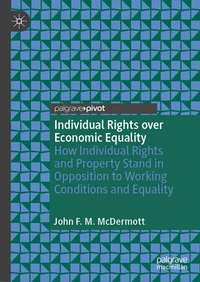
Individual Rights over Economic Equality
Description

Since the mid-1960s, citizens' rights in the United States have improved across many areas, including race, gender, sexuality, physical disabilities, age, consumption of goods, voting, and more. During this time, there has also been a degradation in economic rights, such as economic inequality. Is there a reason for this contradiction? Is it possible for American citizens to experience rights and equality?
At the center of natural rights theories lies the "inalienable" right to private property, and the concepts and practices of the accumulation of private property always defeat personal liberties. Modern political philosophers who espouse natural rights, including liberal John Rawls and conservative James M. Buchanan, share nearly identical premises and goals. The two sides do not often recognize that the free-standing individual at the center of mainstream theorizing in economics and politics simply does not exist. We are social animals, all embedded in (unequal) networks of social and economic relations, requiring very different explanatory frameworks from those given by individual rights theorizing.
This book explores the ways in which the foundational ideology of individual rights belies the actualities of economic inequality. It argues that "individual rights" philosophy offers the main ideological basis for the astronomical accumulation of wealth that produces this inequality. Investigating the defects of rights theory, the book examines key concepts related to social progress and economic stability. The resulting text presents and analyzes the networks of contemporary corporate, business, and financial power that structurally and systemically limit the lives and choices of citizens in the United States.
More details
Other editions
Additional editions
Persons
John F. M. McDermott (1932-2022) was Professor Emeritus of the State University of New York in Old Westbury, USA. He is the author of several books, including Economics in Real Time and Employers' Economics versus Employees' Economy .
Steven Colatrella taught sociology, international relations, and political theory at Bard College, The New School, the University of Padua, and the American University of Rome. Colatrella's most recent book is Looking Over the Abyss: The US and Europe Beyond Capitalism .
Frances A. Maher is Professor Emerita of Education at Wheaton College in Massachusetts, USA. Maher's most recent book is Privilege and Diversity in the Academy , which she coauthored with Mary Kay Thomson Tetreault.
Michael Meeropol is Professor Emeritus of Economics at Western New England University. He previously taught at John Jay College of Criminal Justice, part of the City University of New York. An economist, author, and activist, he has published several books. Alongside Howard J. Sherman and Paul D. Sherman, Meeropol co-authored Principles of Macroeconomics . He also co-authored We Are Your Sons: The Legacy of Ethel and Julius Rosenberg with Robert Meeropol and is the sole author of Surrender: How the Clinton Administration Completed the Reagan Revolution .
Content
Introduction: John McDermott's Body of Work.- Chapter 1 As Rights Expand Equality Declines.- Chapter 2 Ours is Not a "Liberal Society".- Chapter 3 Inalienable Rights and the Abortion Wars.- Chapter 4 Elements of a Theory of Social Rights.- Chapter 5 Looking at the Workplace.- Chapter 6 Interregnum.- Chapter 7 Afterword.
