

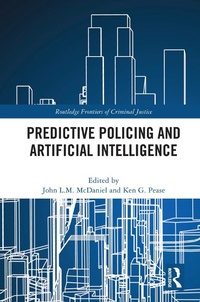
Predictive Policing and Artificial Intelligence
1st Edition
Published on 25. February 2021
330 pages
978-0-429-55591-6 (ISBN)
Description

This edited text draws together the insights of numerous worldwide eminent academics to evaluate the condition of predictive policing and artificial intelligence (AI) as interlocked policy areas. Predictive and AI technologies are growing in prominence and at an unprecedented rate. Powerful digital crime mapping tools are being used to identify crime hotspots in real-time, as pattern-matching and search algorithms are sorting through huge police databases populated by growing volumes of data in an eff ort to identify people liable to experience (or commit) crime, places likely to host it, and variables associated with its solvability. Facial and vehicle recognition cameras are locating criminals as they move, while police services develop strategies informed by machine learning and other kinds of predictive analytics. Many of these innovations are features of modern policing in the UK, the US and Australia, among other jurisdictions.
AI promises to reduce unnecessary labour, speed up various forms of police work, encourage police forces to more efficiently apportion their resources, and enable police officers to prevent crime and protect people from a variety of future harms. However, the promises of predictive and AI technologies and innovations do not always match reality. They often have significant weaknesses, come at a considerable cost and require challenging trade- off s to be made. Focusing on the UK, the US and Australia, this book explores themes of choice architecture, decision- making, human rights, accountability and the rule of law, as well as future uses of AI and predictive technologies in various policing contexts. The text contributes to ongoing debates on the benefits and biases of predictive algorithms, big data sets, machine learning systems, and broader policing strategies and challenges.
Written in a clear and direct style, this book will appeal to students and scholars of policing, criminology, crime science, sociology, computer science, cognitive psychology and all those interested in the emergence of AI as a feature of contemporary policing.
AI promises to reduce unnecessary labour, speed up various forms of police work, encourage police forces to more efficiently apportion their resources, and enable police officers to prevent crime and protect people from a variety of future harms. However, the promises of predictive and AI technologies and innovations do not always match reality. They often have significant weaknesses, come at a considerable cost and require challenging trade- off s to be made. Focusing on the UK, the US and Australia, this book explores themes of choice architecture, decision- making, human rights, accountability and the rule of law, as well as future uses of AI and predictive technologies in various policing contexts. The text contributes to ongoing debates on the benefits and biases of predictive algorithms, big data sets, machine learning systems, and broader policing strategies and challenges.
Written in a clear and direct style, this book will appeal to students and scholars of policing, criminology, crime science, sociology, computer science, cognitive psychology and all those interested in the emergence of AI as a feature of contemporary policing.
More details
Series
Edition
1. Auflage
Language
English
Place of publication
London
United Kingdom
Publishing group
Taylor & Francis Ltd
Target group
College/higher education
Illustrations
3 Tables, black and white; 6 Line drawings, black and white
ISBN-13
978-0-429-55591-6 (9780429555916)
Copyright in bibliographic data and cover images is held by Nielsen Book Services Limited or by the publishers or by their respective licensors: all rights reserved.
Schweitzer Classification
Other editions
Additional editions
John McDaniel | Ken Pease
Predictive Policing and Artificial Intelligence
Book
08/2022
1st Edition
Routledge
€65.70
Shipment within 15-20 days
John McDaniel | Ken Pease
Predictive Policing and Artificial Intelligence
Book
02/2021
1st Edition
Routledge
€207.00
Shipment within 15-20 days
Persons
John L.M. McDaniel teaches and researches within the University of Wolverhampton Department of Social Science, Inclusion and Public Protection and is an active member of the University's Law Research Centre. He focuses on issues of police accountability, corruption, human rights, and international cooperation and security.
Ken G. Pease is a Professor in Policing at the University of Derby. He has written numerous books on policing, psychology and crime science.
Ken G. Pease is a Professor in Policing at the University of Derby. He has written numerous books on policing, psychology and crime science.
Content
Introduction 1.The Future of AI in Policing: Exploring the sociotechnical imaginaries Part One: Bias and Big Data 2.Predictive Policing through Risk Assessment 3.Policing, AI and Choice Architecture 4.What Big Data in Health Care Can Teach Us About Predictive Policing 5.Artificial Intelligence and Online Extremism: Challenges and Opportunities 6.Predictive Policing and Criminal Law Part Two: Police Accountability and Human Rights 7.Accountability and indeterminacy in predictive policing 8.Machine learning predictive algorithms and the policing of future crimes: governance and oversight 9.'Algorithmic impropriety' in UK policing contexts: A developing narrative? 10.Big Data Policing: Governing the Machines? 11.Decision-Making: Using technology to enhance learning in police officers Conclusion
