

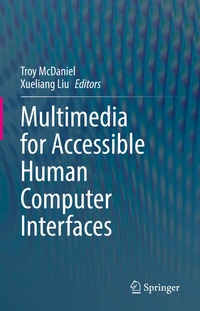
Multimedia for Accessible Human Computer Interfaces
Description

The book Multimedia for Accessible Human Computer Interfaces is to be the first resource to provide in-depth coverage on topical areas of multimedia computing (images, video, audio, speech, haptics, VR/AR, etc.) for accessible and inclusive human computer interfaces. Topics are grouped into thematic areas spanning the human senses: Vision, Hearing, Touch, as well as Multimodal applications. Each chapter is written by different multimedia researchers to provide complementary and multidisciplinary perspectives. Unlike other related books, which focus on guidelines for designing accessible interfaces, or are dated in their coverage of cutting edge multimedia technologies, Multimedia for Accessible Human Computer Interfaces takes an application-oriented approach to present a tour of how the field of multimedia is advancing access to human computer interfaces for individuals with disabilities.
Under Theme 1 "Vision-based Technologies for Accessible Human Computer Interfaces", multimedia technologies to enhance access to interfaces through vision will be presented including: "A Framework for Gaze-contingent Interfaces", "Sign Language Recognition", "Fusion-based Image Enhancement and its Applications in Mobile Devices", and "Open-domain Textual Question Answering Systems". Under Theme 2 "Auditory Technologies for Accessible Human Computer Interfaces", multimedia technologies to enhance access to interfaces through hearing will be presented including: "Speech Recognition for Individuals with Voice Disorders" and "Socially Assistive Robots for Storytelling and Other Activities to Support Aging in Place". Under Theme 3 "Haptic Technologies for Accessible Human Computer Interfaces", multimedia technologies to enhance access to interfaces through haptics will be presented including: "Accessible Smart Coaching Technologies Inspired by Elderly Requisites" and "Haptic Mediators for Remote Interpersonal Communication". Under Theme 4 "Multimodal Technologies for AccessibleHuman Computer Interfaces", multimedia technologies to enhance access to interfaces through multiple modalities will be presented including: "Human-Machine Interfaces for Socially Connected Devices: From Smart Households to Smart Cities" and "Enhancing Situational Awareness and Kinesthetic Assistance for Clinicians via Augmented-Reality and Haptic Shared-Control Technologies".
More details
Other editions
Additional editions
Persons
Xueliang Liu is a Professor in School of Computer Science and Information Engineering in Hefei University of Technology, China. His research interests include multimedia retrieval, social media analysis and object detection. He has authored over 40 journal and conference papers in these areas. He has served as the area chair of ACM Multimedia, and on technical program committees of numerous multimedia and information retrieval conferences including ACM Multimedia (MM), ACM SIGIR, International Conf. on Multimedia Retrieval (ICMR) and International Conf. on Multimedia and Expo (ICME). He has received the outstanding service award at PCM 2018, the best reviewer award at PCM 2013, and the best demo award at ACM MM 2007. He has also been the program chair of the ACM workshop on Multimedia for Accessible Human Computer Interfaces, and the organizing chair of ICIMCS 2013, MMM 2016, and PCM 2018. He received his Ph.D and MSc from EURECOM France and USTC China in 2013 and 2008 respectively.
