

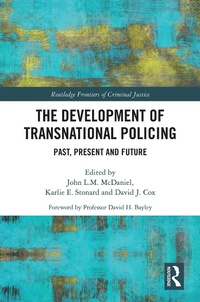
The Development of Transnational Policing
Past, Present and Future
1st Edition
Published on 10. October 2019
382 pages
978-1-351-03953-6 (ISBN)
Description

This book draws together the insights of eminent academics and specialists to present an overview of past and present approaches to transnational policing throughout the Anglophone world. It aims to revitalize the study of transnational policing by showing that past and present developments in this field remain poorly understood, while also suggesting future avenues of research.
Containing chapters on police history, police accountability, gendered hate crime in an increasingly online world, counter-radicalisation strategies being pursued around the world, internet-facilitated sex trafficking and changes in organised crime, amongst others, the authors adopt revisionist, orthodox and progressive views in order to challenge our understanding and appreciation of developments in transnational policing. All of the chapters in the book use policing models employed within the UK as either their focal point or as a point of comparison so that direct comparisons and contrasts can be examined.
The Development of Transnational Policing illustrates distinctive and separate aspects of what remains an undoubtedly complex and dynamic field, but also forms an overview of developments and the dearth of academic research which surround them, in order hopefully to inspire researchers, policymakers and practitioners alike.
Containing chapters on police history, police accountability, gendered hate crime in an increasingly online world, counter-radicalisation strategies being pursued around the world, internet-facilitated sex trafficking and changes in organised crime, amongst others, the authors adopt revisionist, orthodox and progressive views in order to challenge our understanding and appreciation of developments in transnational policing. All of the chapters in the book use policing models employed within the UK as either their focal point or as a point of comparison so that direct comparisons and contrasts can be examined.
The Development of Transnational Policing illustrates distinctive and separate aspects of what remains an undoubtedly complex and dynamic field, but also forms an overview of developments and the dearth of academic research which surround them, in order hopefully to inspire researchers, policymakers and practitioners alike.
More details
Series
Edition
1. Auflage
Language
English
Place of publication
London
United Kingdom
Publishing group
Taylor & Francis Ltd
Target group
College/higher education
Illustrations
2 Tables, black and white; 1 Line drawings, black and white; 1 Illustrations, black and white
ISBN-13
978-1-351-03953-6 (9781351039536)
Copyright in bibliographic data and cover images is held by Nielsen Book Services Limited or by the publishers or by their respective licensors: all rights reserved.
Schweitzer Classification
Other editions
Additional editions
John McDaniel | Karlie Stonard | David Cox
The Development of Transnational Policing
Past, Present and Future
Book
06/2021
1st Edition
Routledge
€66.30
Shipment within 10-20 days
John McDaniel | Karlie Stonard | David Cox
The Development of Transnational Policing
Past, Present and Future
Book
10/2019
1st Edition
Routledge
€207.40
Shipment within 10-20 days
Persons
John L.M. McDaniel is a Senior Lecturer in Policing and Criminal Justice and the Course Leader of the BSc Policing and the BSc Policing and Intelligence at the University of Wolverhampton. He teaches and researches in the area of police accountability from a sociolegal perspective. John completed his PhD on police accountability and cross-border police cooperation at the University of Kent law school in 2015. He has worked as a visiting researcher at the University of Copenhagen and Tilburg University law schools.
Karlie E. Stonard is a Senior Lecturer in Criminology at the University of Wolverhampton and a member of the Violence Against Women and Girls Research Cluster at the university. Her past and current research interests are in the area of domestic violence and its impact on children and young people, the role of technology in adolescent dating violence (PhD), and gender-based violence. She has published in the Journal of Interpersonal Violence, Aggression and Violent Behavior, Journal of Child and Family Studies, Current Psychology, and Advances in Developmental and Educational Psychology and presented at numerous national and international conferences. Her most recent publications include 'The Prevalence and Overlap of Technology-Assisted and Offline Adolescent Dating Violence', Current Psychology (2018); 'Technology-Assisted Adolescent Dating Violence and Abuse: A Factor Analysis of the Nature of Electronic Communication Technology Used Across Twelve Types of Abusive and Controlling Behaviour', Journal of Child and Family Studies (2018); and 'Explaining ADVA and TAADVA: Risk Factors and Correlates', Advances in Developmental and Educational Psychology (2019).
David J. Cox is Reader in Criminal Justice History at the University of Wolverhampton, specialising in early and pre-Metropolitan Police history, and is a Fellow of the Royal Historical Society. He has an extensive publication record, including Crime, Regulation and Control During The Blitz [co-authored with P. Adey and B. Godfrey] (2016), Public Indecency in England 1857-1960: 'A Serious and Growing Evil' [with K. Stevenson, J. Rowbotham and C. Harris] (Routledge/SOLON Explorations in Crime and Criminal Justice Histories series, Routledge, 2015), and Crime in England, 1688-1815 (History of Crime in the UK and Ireland series, Routledge, 2014). He also recently co-edited (with K. Stevenson and I. Channing) Leading the Police: A History of Chief Constables 1835-2017 (Routledge/SOLON Explorations in Crime and Criminal Justice Histories series, Routledge, 2018).
Karlie E. Stonard is a Senior Lecturer in Criminology at the University of Wolverhampton and a member of the Violence Against Women and Girls Research Cluster at the university. Her past and current research interests are in the area of domestic violence and its impact on children and young people, the role of technology in adolescent dating violence (PhD), and gender-based violence. She has published in the Journal of Interpersonal Violence, Aggression and Violent Behavior, Journal of Child and Family Studies, Current Psychology, and Advances in Developmental and Educational Psychology and presented at numerous national and international conferences. Her most recent publications include 'The Prevalence and Overlap of Technology-Assisted and Offline Adolescent Dating Violence', Current Psychology (2018); 'Technology-Assisted Adolescent Dating Violence and Abuse: A Factor Analysis of the Nature of Electronic Communication Technology Used Across Twelve Types of Abusive and Controlling Behaviour', Journal of Child and Family Studies (2018); and 'Explaining ADVA and TAADVA: Risk Factors and Correlates', Advances in Developmental and Educational Psychology (2019).
David J. Cox is Reader in Criminal Justice History at the University of Wolverhampton, specialising in early and pre-Metropolitan Police history, and is a Fellow of the Royal Historical Society. He has an extensive publication record, including Crime, Regulation and Control During The Blitz [co-authored with P. Adey and B. Godfrey] (2016), Public Indecency in England 1857-1960: 'A Serious and Growing Evil' [with K. Stevenson, J. Rowbotham and C. Harris] (Routledge/SOLON Explorations in Crime and Criminal Justice Histories series, Routledge, 2015), and Crime in England, 1688-1815 (History of Crime in the UK and Ireland series, Routledge, 2014). He also recently co-edited (with K. Stevenson and I. Channing) Leading the Police: A History of Chief Constables 1835-2017 (Routledge/SOLON Explorations in Crime and Criminal Justice Histories series, Routledge, 2018).
Content
Foreword Professor Emeritus David H. Bayley; Introduction John L.M. McDaniel, Karlie E. Stonard and David J. Cox; 1. The origins of transnational policing: the continental activities of the Bow Street 'Runners', 1749-1839 David J. Cox; 2. Policing with the enemy. British Military Police, Public Safety and German Police in post-war Germany 1945-1955 Bettina Blum; 3. West Midlands Police Service and the International Police Task Force in Bosnia, 1994-6 Michael Pearson; 4. Enhancing the accountability and transparency of transnational police cooperation within the European Union John L.M. McDaniel and Anita Lavorgna; 5. Nordic Police Cooperation Henrik Stevnsborg; 6. Policing Australasia: Challenges and successes of law enforcement cooperation in a diverse region Saskia Hufnagel; 7. Transnational policing in Southern Africa: moving towards a centralized European model of police cooperation? John L.M. McDaniel and Elrena van der Spuy; 8. Policing Online Hate Jo Smith and Jon Garland; 9. Exporting Preemption: The Transnational Diffusion of Counter-Radicalization Policing Strategies Derek M.D. Silva and Mathieu Deflem; 10. Transnational Policing and Organized Crime Neil Olley; 11. Transnational policing of online sex trafficking Karlie E. Stonard and Ana M. Fuentes Cano; 12. The new EU counter-terrorism directive: closing all the gaps in the EU legal framework? Maria O'Neill; 13. International asset recovery: perspectives from Ireland Colin King; 14. Restorative justice and transnational policing in the modern world Yasmin Devi-McGleish; Conclusion John L.M. McDaniel, Karlie E. Stonard and David J. Cox; Index
