

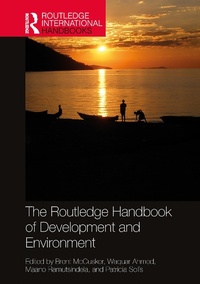
The Routledge Handbook of Development and Environment
1st Edition
Published on 29. November 2021
460 pages
978-0-429-83331-1 (ISBN)
Description

The handbook seeks to illuminate the key concepts in the study of development-environment through showcasing some of the Majoritarian (formerly "Developing") world's scholars in order to explore theoretical connections through critical/radical theory, "small" theory, various conceptual frameworks, and non-Western and subaltern viewpoints.
The volume examines the themes around the study of the relationship between economic and social development and the environment. Part 1 covers theoretical and conceptual approaches to the study of development and environment by examining the diverse ways in which people perceive, understand, and act upon the world around them. Cross-scalar topics such as neo-liberalism and globalization, human rights, climate change, sustainability, and technology are covered in Part 2. The book shifts to examinations of resources and production in Part 3, where authors with a focus on one or more environmental resources or types of economic production are presented. Topics range from water, agriculture, and food, to energy, bioeconomy, and mining. The fourth section presents chapters where people are at the center of the development-environment nexus through topics such as gender relations, children, health, and cities. Finally, policy and governance of development and environment are explored in Part 5. The section includes both academics and practitioners who have worked with policy makers and are policy makers themselves.
The book is primarily intended for scholars and graduate students in geography, environmental studies, and development studies for whom it will provide an invaluable and up-to-date guide to current thinking across the range of disciplines, which converge in the study of development and environment.
The volume examines the themes around the study of the relationship between economic and social development and the environment. Part 1 covers theoretical and conceptual approaches to the study of development and environment by examining the diverse ways in which people perceive, understand, and act upon the world around them. Cross-scalar topics such as neo-liberalism and globalization, human rights, climate change, sustainability, and technology are covered in Part 2. The book shifts to examinations of resources and production in Part 3, where authors with a focus on one or more environmental resources or types of economic production are presented. Topics range from water, agriculture, and food, to energy, bioeconomy, and mining. The fourth section presents chapters where people are at the center of the development-environment nexus through topics such as gender relations, children, health, and cities. Finally, policy and governance of development and environment are explored in Part 5. The section includes both academics and practitioners who have worked with policy makers and are policy makers themselves.
The book is primarily intended for scholars and graduate students in geography, environmental studies, and development studies for whom it will provide an invaluable and up-to-date guide to current thinking across the range of disciplines, which converge in the study of development and environment.
More details
Series
Edition
1. Auflage
Language
English
Place of publication
London
United Kingdom
Publishing group
Taylor & Francis Ltd
Target group
College/higher education
Illustrations
13 Tables, black and white; 33 Line drawings, black and white; 12 Halftones, black and white; 45 Illustrations, black and white
ISBN-13
978-0-429-83331-1 (9780429833311)
Copyright in bibliographic data and cover images is held by Nielsen Book Services Limited or by the publishers or by their respective licensors: all rights reserved.
Schweitzer Classification
Other editions
Additional editions
Brent McCusker | Waquar Ahmed | Maano Ramutsindela
The Routledge Handbook of Development and Environment
Book
10/2024
1st Edition
Routledge
€69.90
Shipment within 15-20 days
Brent McCusker | Waquar Ahmed | Maano Ramutsindela
The Routledge Handbook of Development and Environment
Book
11/2021
1st Edition
Routledge
€314.20
Shipment within 10-20 days
Persons
Brent McCusker is Professor of Geography and Department Chairperson in the Department of Geology and Geography at West Virginia University, USA. He has published extensively on land use and livelihoods systems in sub-Saharan Africa. He also works with USAID on livelihood vulnerability analysis and mapping across a range of countries in sub-Saharan Africa and south Asia.
Waquar Ahmed, a graduate of Clark University (Ph.D.) and Jawaharlal Nehru University (M. Phil.), is an associate professor of geography at the University of North Texas. He is the editor of the radical journal Human Geography. His research interests are in Capitalism, development-underdevelopment, state theory, foreign direct investments and social movements. His research has been published in the Annals of the Association of American Geographers, Antipode, Human Geography, ACME and several other journals and edited books.
Maano Ramutsindela is Professor in the Department of Environmental and Geographical Science at the University of Cape Town, South Africa. He has conducted research in Botswana, Namibia, Lesotho, South Africa, and Tanzania focusing on transfrontier conservation, land, and regions.
Patricia Solis is Associate Research Professor in the School of Geographical Sciences and Urban Planning at Arizona State University, USA. She is the executive director of the Knowledge Exchange for Resilience at Arizona State University, an interdisciplinary effort to link multi-sector community needs with research innovations around resilience.
Waquar Ahmed, a graduate of Clark University (Ph.D.) and Jawaharlal Nehru University (M. Phil.), is an associate professor of geography at the University of North Texas. He is the editor of the radical journal Human Geography. His research interests are in Capitalism, development-underdevelopment, state theory, foreign direct investments and social movements. His research has been published in the Annals of the Association of American Geographers, Antipode, Human Geography, ACME and several other journals and edited books.
Maano Ramutsindela is Professor in the Department of Environmental and Geographical Science at the University of Cape Town, South Africa. He has conducted research in Botswana, Namibia, Lesotho, South Africa, and Tanzania focusing on transfrontier conservation, land, and regions.
Patricia Solis is Associate Research Professor in the School of Geographical Sciences and Urban Planning at Arizona State University, USA. She is the executive director of the Knowledge Exchange for Resilience at Arizona State University, an interdisciplinary effort to link multi-sector community needs with research innovations around resilience.
Content
1. Introduction: Development and Environment in the 2020s Part 1: Theoretical Approaches and Syntheses 2. Defining and Transgressing Boundaries in Development and Environment Contexts 3. Framing Development through Environmentalism 4. The Financialization of Nature 5.Colonialism/post-colonialism nexus: an oxymoron of coloniality and globality 6. Ecosocialism: Historical Roots and Current Movements Part 2: Global Development, Environment, and Resources 7. Food, digital life, and new environment-development dynamics 8. Historic -Dialectical Aspect of Environment and Development: An Analysis 9. Nila nunanico, the threat to our lands 10. Is This Land Made for You and Me 11. Contesting Invisibility of Immigrant Detention Landscapes in Texas 12. Smallholder farmers' lived experiences of weather perturbation in Malawi 13. Terra sacer: water infrastructure and core-periphery reconfiguration in Dallas/Fort Worth 14. Sustainable Development: Quo Vadis Africa 15. Contrasting Climate Change Knowledges in Colombia 16. Spaces of Environmental (In)Justice and Accumulation by Dispossession in India 17. No Lifeboats Available: Hurricane Harvey and Emergency Management Part 3: People and Communities 18. Challenges of the Anthropocene for protected areas and conservation in Costa Rica 19. Archaeology and Tourism at Mesa Verde National Park: An Environmental Justice Heritage 20. Communities and conservation: Between two models of development 21. Circumscribing local development: the role of community-based conservation in Tanzania 22. Understanding the relationship among gender, space and the environment: the case of Waorani Women in Gareno, Ecuador 23. Upgrading the Shock Theory: Female Resilience in Reconstructing Puerto Rico After Hurricanes Irma and Maria 24. Gendered access to wetland gardens (dimba) in northern Malawi 25.The dialectic of places 26. From Species life to Nature's outside: New Town 'Green City,' Kolkata Part 4: Policy and Governance 27. Diaspora Within: Territoriality, Nationality and Justice for the Indigenous community in India 28. Rationalities of Government and Webs of Relations(hips) in the Funding and Implementation of Sea Defense Systems in the Volta River Delta of Ghana 29. Political ecology and policy: A case study in engagement 30. Spatial Policymaking: Using large, public datasets to illustrate spatial patterns of human vulnerability in Niger.
