

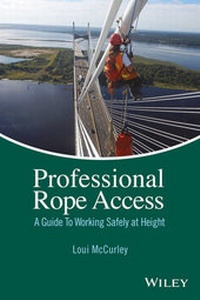
Professional Rope Access
Description

More details
Other editions
Additional editions
Person
Content
Notes on Contributors xiii
Foreword xix
Your Success xxiii
Preface xxv
How to use this book xxvii
Section 1 | Planning for Rope Access 1
Chapter 1 | What Is Rope Access? 3
1-1 Introduction 3
Why Choose Rope Access? 4
1-2 Foundation and Evolution of Rope Access 6
The Modern Rope Access System 6
Skills Required for Modern Rope Access Workers 7
1-3 Rope Access Compared/Contrasted with Other Disciplines 8
Rope Access Contrasted with Recreational Rappelling 8
Rope Access Contrasted with Controlled Descent 9
Rope Access Contrasted with Rope Descent Techniques 11
Rope Access Contrasted with Bosun's Chairs 11
Rope Access Backup Contrasted with Other Backup Systems 14
WhereModern Rope Access Has Landed - The Bus You Take to Work 14
1-4 Compatibility and Work Safety 15
Fall Restraint 15
Fall Arrest 15
Fall Containment Systems 17
Suspended Scaffolds 17
Aerial Platforms and Man Baskets 17
1-5 Special Techniques 18
Aid Climbing 18
Lead Climbing 19
1-6 Practical Application of Rope Access 19
1-7 Summary 20
Chapter 2 | Rope Access and the Comprehensive Managed Fall Protection Plan 21
2-1 Protecting Workers at Height 21
2-2 Comprehensive Managed Fall Protection 22
Policy Statement 22
Staff Responsibilities 23
Fall Hazard Survey 25
2-3 Hierarchy of Fall Protection 26
Types of Active Protection - Harness-Based Solutions 27
Choosing a System of Protection 28
2-4 Rope Access Work Plan 29
System Requirements 30
Safety in Rope Access Operations 31
Work Practices 32
2-5 Summary 34
Chapter 3 | Personnel Selection and Training 35
3-1 Introduction 35
3-2 Personnel Qualifications 35
Aptitude for Rope Access 37
3-3 Team Organization and Competencies 38
Technician Skills and Responsibilities 38
Supervisor Skills and Responsibilities 39
Program Manager Skills and Responsibilities 40
3-4 Training and Certification 40
Training Records 41
Training Outline 41
Advanced Levels of Certification 45
Rope Access Certification Bodies 46
3-5 Summary 47
Chapter 4 | Equipment for Rigging 49
4-1 Equipment for Rigging Rope Access Systems 49
4-2 How to Choose Equipment for Rigging in Life Safety Situations 50
4-3 The Difference Between Personal Equipment and Rigging Equipment 52
4-4 Rigging Equipment for Fall Arrest 52
4-5 Rigging Equipment for Cranes Versus Rigging Used in Rope Access 53
4-6 Rigging Equipment for Suspended Scaffolds 54
4-7 Rigging Equipment for Rescue 54
4-8 Rope 55
4-9 Connectors 59
4-10 Hardware 63
4-11 Mechanical Anchorage Connectors 65
4-12 Anchor Slings 67
4-13 Summary 69
Chapter 5 | Personal Equipment for Rope Access 71
5-1 Introduction 71
5-2 Essential Requirements 72
5-3 Harnesses 74
5-4 A Note About Comfort Seats (Seatboards) 76
5-5 Helmets 77
5-6 Lanyards 78
5-7 Connectors 79
5-8 Descending Devices 80
5-9 Rope Access Backup Devices 84
5-10 Ascenders 86
5-11 Gloves 88
5-12 Clothing and Personal Wear 89
5-13 OTHER PPE 89
5-14 Equipment Traceability and Recordkeeping 89
5-15 Summary 90
Section 2 | Skills for the Rope Access Technician 91
Chapter 6 | Rigging Concepts 93
6-1 Principles at Work in a System 94
Gravity 94
Friction 94
Angles 96
Vector Forces 99
6-2 Using the Principles 107
Mechanical Advantage 107
Load Ratios 111
Safety Factors 112
6-3 Summary 114
Chapter 7 | Rope Terminations and Anchorages 115
7-1 Rope and Knot Terminology 116
7-2 Rope Terminations 118
7-3 Manufactured Terminations 118
7-4 Knots 119
Stopper Knots 119
End-of-Line Knots 120
Midline Knots 124
Knots (Bends) That Join Two Ropes 125
Knot Safety 127
Hitches 128
7-5 Knots and Rope Strength 132
7-6 Anchorages 132
Classifications of Anchorages 133
Anchorage System Performance 134
Positioning the Anchorage System 135
Back-Ties 136
Direct Attachment 136
Load Sharing Anchor Systems 138
Angles in Anchor Systems 141
Change of Direction 142
7-7 Summary 143
Chapter 8 | Rope Access Systems 145
8-1 Compatibility 149
8-2 Access System 149
8-3 Backup System 151
8-4 Attachment to Technician's Harness 152
8-5 Pull-through Systems 153
Pull-Through with Ground Anchor 153
Top Anchor Pull-Through with Knot 153
8-6 Changing the Fall Line 155
Directional Deviation 155
Rebelay (Re-anchor) Systems 156
Well-Being of the Technician 157
8-7 Summary 159
Chapter 9 | Descending 161
9-1 Introduction 161
9-2 Choosing a Descender 162
9-3 Choosing a Rope for Descent 164
9-4 Rigging for Descent 165
9-5 Getting on Rope 167
9-6 Managing the Descent 168
9-7 Tending the Backup Device 170
9-8 Passing a Knot 170
9-9 Passing a Deviation Anchor 173
9-10 Passing a Rebelay 174
9-11 Landing 177
9-12 Summary 178
Chapter 10 | Ascending 179
10-1 Selecting Ascenders 180
Handled Ascenders 180
Chest Ascender 181
10-2 The Complete Ascending System 181
Rigging the Chest Ascender 182
Rigging the Handled Ascender 184
10-3 Managing the Ascent 184
10-4 Changeovers 186
Changeover from Ascending System to Descending System 187
Using a Descender for Ascent 187
Rope-to-Rope Transfer 188
Passing a Knot in the Ropes While on Ascent 189
Negotiating an Edge or Obstruction While on Ascent 190
Passing a Deviation 191
Passing a Re-anchor (Rebelay) on Ascent 192
Transitioning Off Rope from Ascent, Onto a Platform 196
10-5 Summary 196
Chapter 11 | Advanced Techniques 197
11-1 Belays 198
11-2 Aid Climbing 201
11-3 Lead Climbing 203
11-4 Climbing with Twin Lanyards 206
11-5 Raising and Lowering Systems 207
11-6 Systems for Lowering 208
11-7 Systems for Raising 209
11-8 Cross-haul 211
11-9 Tensioned Ropes 212
11-10 Multiple Simultaneous Systems 214
11-11 Powered Assist Systems 214
11-12 Summary 215
Chapter 12 | Use of Powered Rope Access Devices 217
12-1 Precautions 217
12-2 Configuring the Device into the System 219
12-3 Configuration 1 (Sit on Top) 221
12-4 Configuration (Suspend Beneath) 223
12-5 Using the Device from a Fixed Position 224
12-6 Additional Considerations 226
12-7 Care and Maintenance 226
12-8 Summary 227
Chapter 13 | Rescue 229
13-1 Rope Access and Rescue 229
13-2 The Rescue Preplan 232
13-3 Self-Rescue 233
13-4 Coworker-Assisted Rescue 235
13-5 Noncommittal Rescue and Prerigging for Rescue 236
13-6 Co-Worker Assisted Rescue from Descent 238
13-7 Rescue from Ascent 240
13-8 Challenging Rescues 241
13-9 Standby Rescue 242
13-10 Professional Versus Coworker-Assisted Rescue 243
13-11 Conclusion 244
Section 3 | Program Administration 245
Chapter 14 | Developing a Rope Access Plan 247
14-1 Working Safely at Heights 248
Harness-Based Works 248
Fall Arrest 250
Work Positioning 250
Rope Access 251
14-2 Necessary Elements of a Rope Access Program 251
Rescue 251
One Rope or Two? 252
Avoid the Fall 253
Team Works 253
Team Documentation 254
14-3 Work in a System 254
Supervisor 255
SuitableManagement 255
Summary 256
Chapter 15 | Developing a Policy Statement 257
15-1 Questions to Consider 257
15-2 Putting it all Together 262
15-3 Congratulations! 263
Chapter 16 | Writing a Work Order 265
Summary 268
Chapter 17 | Establishing a Work Plan 269
17-1 Summary 273
Chapter 18 | Performing a Job Hazard Analysis 275
18-1 The Process 275
18-2 Content 276
18-3 Using the JHA 278
18-4 Summary 279
Chapter 19 | Fall Hazard Survey/Assessment 281
19-1 Conducting the Survey 281
19-2 Survey Contents 283
19-3 Using the Survey 283
19-4 Fall Hazard Mitigation 284
19-5 Summary 284
Chapter 20 | Creating a Rescue Preplan 287
20-1 Emergency Response Planning 287
20-2 Fall Rescue Planning 289
20-3 Coordination with External Resources 293
20-4 Summary 293
Chapter 21 | Training Records 295
21-1 Certification Records 295
21-2 Technician Records 296
21-3 Employer Records 297
21-4 Program Administrator Training 298
Chapter 22 | Equipment Inspection and Care 301
22-1 Specifying Equipment 301
22-2 Placing Equipment into Service 302
22-3 Equipment Inspection 302
22-4 Cleaning 303
22-5 Retirement 304
Chapter 23 | Rope Access Program Audit 307
23-1 Components of an Audit 307
23-2 Management 308
23-3 Practices 309
23-4 Equipment Management 311
23-5 Recordkeeping 312
23-6 Summary 312
Knowledge Check 313
Glossary 339
Index 343
How To Use This Book
Whether you are an aspiring rope access technician, a technical safety manager, or an executive with workers at height, the information in this book will help you to be safer, more efficient, and better equipped to do your job.
Executives and safety managers will find this text a useful reference in establishing, overseeing, and maintaining a rope access program, focusing perhaps on Sections 1 and 3, while trainers and practitioners will find it beneficial as a training aid, with emphasis on Sections 1 and 2. While no textbook can ever be a replacement for hands-on, practical experience, this book provides supportive text to augment the training and continuous skills development of rope access technicians and others involved in the rope access safety chain.
Some users of this book will choose to read it cover-to-cover, while others may pick and choose chapters according to their respective needs. The book is organized into chapters, each of which addresses a particular area of rope access. While each chapter stands alone in the area of its content, concepts in some chapters do build and expand upon concepts introduced in other chapters.
For ease of reference, the 23 chapters are grouped into three different sections. Each of the three sections contains related topics.
SECTION 1 - PLANNING FOR ROPE ACCESS
This section is a must-read for Safety Professionals, Regulatory Authorities, and Supervisory Managers. It provides an overview of rope access as a work method, describes rope access within the context of a Comprehensive Managed Fall Protection Program, and provides guidance toward developing the rope access program. It contains five chapters:
CH 1 What Rope Access Is. and Isn't!
This chapter provides some historical context for rope access, differentiating it from other suspended rope methods and recreational uses of ropes. Reading this chapter will provide a greater understanding of where rope access concepts have originated, and an informed outlook toward the future.
CH 2 Rope Access and Your Comprehensive Managed Fall Protection Plan
Here we will explore how rope access fits into the Comprehensive Managed Fall Protection Plan, and further develop understanding of the differences between Rope Access and the conventional fall protection methods of Fall Arrest, Positioning, and Restraint.
CH 3 Personnel
In Chapter 3, the human element of rope access is explored, including a review of aptitude, abilities, training, certification, and how to help technicians maintain skills over time. The personnel side of selection and composition of work teams is also addressed, along with team organization and leadership.
CH 4 Equipment for Rigging
In this chapter, we explore the equipment that comprises the systems that rope access technicians use: Artificial Anchors, Rope, Slings and Webbing, Hardware (connectors, rope adjusters, etc.), and more. This encompasses the equipment usually provided by the jobsite or employer for use by a group or team of rope access technicians.
CH 5 Personal Equipment
This chapter provides an overview of personal equipment for rope access, including those items that would be considered Personal Protective Equipment (PPE). It also provides descriptions of each component's use. This includes equipment that is often based on the preference of an individual rope access technician, and that will most often be a part of his personal kit. Selection of equipment is addressed, and PPE for rope access is contrasted with PPE used for other purposes.
SECTION 2 SKILLS FOR THE ROPE ACCESS TECHNICIAN
Having established an understanding of regulations and equipment in Section 1, Section 2 delves into how the equipment is used in the field. Section 2 is a must-read for technicians, as it provides a basis for understanding skills and techniques that are best learned through hands-on training. Administrators and Supervisors will also find this section useful for gaining insight into the safe practices used by the technicians within their area of work.
CH 6 Rigging Concepts
Chapter 6 expands our understanding of the equipment by introducing the factors that affect equipment once it is rigged. Basic concepts of forces and friction are presented, and tips are provided for maximizing the efficiency and effectiveness of the rigging within rope-based systems.
CH 7 Terminations and Anchorages
Appropriately terminating ropes is foundational to every rope access system, as is the implementation within a rope access system of safe, effective anchorages. Because these topics are such an important part of the system, an entire chapter is dedicated to the understanding of termination types and limitations, anchorage terminology, and the types and uses of anchorages.
CH 8 Rope Access Systems
This chapter draws together the information in previous chapters to provide an understanding of how everything fits together as a system for rope access. It offers general guidelines for rigging the basic systems used for moving up and down, and working while being suspended from ropes. A solid understanding of equipment, forces, and rigging concepts is essential to using this chapter effectively.
CH 9 Descending
Chapter 9 begins the foray into the methods that a rope access technician uses as part of their daily work. This chapter discusses important rigging tips for descending systems, methods for managing equipment while descending, negotiating edges, maintaining control, and negotiating basic obstacles including knots, deviations, and re-anchors.
CH 10 Ascending
A companion chapter to Chapter 9, and embracing the idea that any technician who is able to descend down a rope should also be capable of ascending, here the concept of using equipment to ascend a rope is introduced. Rigging tips, equipment management, and special circumstances are all addressed, this time within the context of moving up rather than down.
CH 11 Advanced Techniques
Although much of rope access involves simple up and down movement, the fundamental principle behind the safety of the rope access technician depends upon the ability to perform more advanced techniques when necessary. This includes the safe use of horizontal traverse, lead climbing, aid climbing, twin lanyard climbing, highlines, and guideline systems.
CH 12 Powered Devices
In recent years, the efficiency and safety of rope access has been enhanced through the introduction of powered devices for rope access. Powered devices are not a replacement for skills and training in manual rope access techniques, but rather a tool to assist the technician reduce fatigue and increase efficiency.
CH 13 Rescue
Rope access technicians are capable of safely accessing some of the most remote and otherwise inaccessible work-at-height locations. In fact, rope access technicians are often able to get to locations that professional rescuers are not adequately prepared to reach! For this reason, the ability to perform self-rescue as well as coworker-assisted rescue is a mandatory requirement for all rope access workers. This chapter delves into some detail on this subject.
SECTION 3 PROGRAM ADMINISTRATION
The third and final section of the book is designed to guide the safety manager and/or rope access supervisor through the process of effectively administering a rope access program. Each chapter delves into a different planning tool, some of which are applicable program-wide while others are job-specific. These chapters provide step-by-step guidance to assist administrators through the planning process. Field technicians should also be aware of this information so that they better understand the resources available to them, and how to reference essential job information.
CH 14 Management and Planning for Rope Access
In this chapter, the reader will be reminded of the framework necessary for an effective rope access program and how to establish and adhere to basic principles for a rope access program.
CH 15 Policy Statement (Document Guide)
The employer's policy statement forms the foundation for the comprehensively managed fall protection program, setting the tone for the overall approach to work at height. This chapter will help guide the employer in writing a policy statement.
CH 16 Work Orders (Document Guide)
A work order may be used to help define the scope of work between an organization and a contractor, or between departments within an organization. This chapter provides guidance toward the effective writing and use of work orders.
CH 17 Rope Access Work Plan (Document Guide)
Also sometimes called a "Rope Access Permit," the work plan outlines specific details regarding how a rope access job will be performed, what methods and equipment will be used, personnel responsibilities, and other essential information. This chapter offers insight and assistance toward developing such a document.
CH 18 Job Hazard Analysis (Document Guide)
Where conditions or circumstances exist that might expose a worker to potential hazards in the workplace, a job hazard analysis should be performed to identify and seek mitigation of foreseeable hazards. While not specific to rope access, a JHA is essential in any work at height program. A process for approaching and writing a JHA is offered in this chapter.
CH 19 Fall Hazard Survey (Document Guide)
Every fall protection program begins with a fall hazard survey. While the mission of the...
