

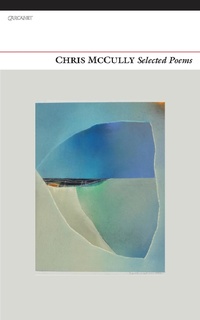
Selected Poems
Chris McCully
Published on 25. August 2011
116 pages
978-1-84777-807-9 (ISBN)
Description

Chris McCully's Selected Poems includes work from 1993 to 2009, a representative selection which reveals his precise craft of language and poetic form. The book opens with the prose-poem 'Dust' from his 2009 collection Polder, a meditation on extinction: 'dust again the voices of the pages and the voices of the lovers'. Other voices follow, conversations in which civility, memories of friendship, art and literature respond to the desolation of dust, asserting what can be created out of it.
In translations from Old English, sonnets, villanelles and ballads, McCully's supple, sparing verse celebrates the fragile areas in which we live, 'between space and space - / and both are dark'.
In translations from Old English, sonnets, villanelles and ballads, McCully's supple, sparing verse celebrates the fragile areas in which we live, 'between space and space - / and both are dark'.
Reviews / Votes
[...] In his brief introduction, McCully defines his criteria for the selection and inclusion of work by quoting Coleridge's 'homely definition': 'the best words, in the best order'; and McCully's skill at ordering words is everywhere apparent in this selection, whichincludes work from five previous volumes. McCully is a skilled - one might well say an obsessed - prosodist, and in the mix one finds a villanelle, a pantoum, various sonnets, and even a composition in headless amphibrachs. There is a fine translation of 'The Seafarer' from his 2008 collection Old English Poems and Riddles:Truth? I can seal it in song's reckoning,
tell its stories: in times of hardship
I owned often, unease and toil;
how I've borne both bitterness and breast-care
known sorrow's surges in the surging keel,
wave-roiling terror -they wore me, saw
the narrow night-watch nailed to the boat-prow
as the cliffs unsteadied. (p.69)
The effect is salty and muscular, and McCully's preservation of the half-lines gives an exhilarating flavour of the original. In this regard he can perhaps be forgiven the amusingly prissy incredulity of his note on the text, in which he explains his decision to revise the formerly justified leftmost edges of the right-hand half-lines: 'I couldn't believe that anyone would be so ignorant of the originals... so to read, or to wish to read.' McCully's 'ideal reader' is rather better-educated, clearly, than most of his critics.
The instinct to control in McCully's verse is very great, and a poem like 'Icarus' (from The Country of Perhaps, 2002) betrays an acute awareness of the tensions inherent in such a drive:
He was mad with it -
the whole beautiful engineering.
But turning westwards, higher,
becoming pressure, becoming weight,
he had forgotten the sun.
And strange that when there was
that endless sense of falling,
he was glad of it. (p.51)
It is probably instructive to note that McCully is a recovering alcoholic (this is a matter of record; he has written about this experience in an autobiography entitled Goodbye, My Wonderful); and it is therefore not entirely fanciful to read into poems like the lovely 'Polder' (p.87) a kind of shadowy autobiography of reclamation: 'How, then, to sustain / water-tight Holland, guilty but ingenious, / against the nails of the north wind / and the narrows of the night-watch / or inundations of the day?' Nor perhaps, to see something deeply personal and necessary in the passionate adherence to the strictures of metre and verse form. McCully's work is saved from dry formalism by its aghast understanding; a continuous dark undertow throwing his instinctive Augustanism into sharp relief. The inclusions from his most recent volume, Polder (2009), show that he is still committed, whether in Horatian or ekphrastic mood, to poetry that tries to make sense of the world. N.S. Thompson in Stand finds Chris McCully 'very reminiscent of Auden'.
Chris McCully is a poet who evidently relishes the attempt - like Hardy - to set his formally rhymed verse in the true lyric tradition of song; thus as well as the precision of sonnets, villanelles, and ballads selected here, along with several experimental pieces and a good selection of his translations from Old English, we have the very unfashionable use of repetition and refrain that Auden once used to good effect. An example from his second collection is the aptly-titled 'Song' where the last line in the quatrain is repeated throughout, bar variation on the last word:
All summer's unsafe,
The north wind and leaf,
Its green turned like grief
On willow, white willow.
In general, if McCully's titles also show a preference for by now traditional subjects ('Pastoral', 'Finding a Fossil', 'Ave Atque Vale', 'Icarus', 'Demeter', 'Ithaka'), he always tried to show the unsettling elements behind the scenes. I find his technique very reminiscent of Auden, who was similarly unsettling in his lyrics and McCully joins him in adopting dactylic and anapaestic measures: 'Undo the rope from the rafter, young lover' ('Witness'), 'He asked for a passage to Ithaka' ('Ithaka'), obviously with variations. By contrast, the collection opens with a long prose poem 'Dust' from his latest collection Polder and ends with a selection of ekphrastic poems from mainly seventeenth-century paintings houses in Amsterdam's Rijksmuseum in McCully's newly-adopted Netherlands.
More details
Language
English
Place of publication
Chicago
United Kingdom
Publishing group
Carcanet Press Ltd
File size
0,52 MB
ISBN-13
978-1-84777-807-9 (9781847778079)
Copyright in bibliographic data and cover images is held by Nielsen Book Services Limited or by the publishers or by their respective licensors: all rights reserved.
Schweitzer Classification
Other editions
Additional editions
Book
03/2011
Carcanet Poetry
€21.00
Shipment within 3-4 weeks
Person
Chris McCully, born in Bradford, Yorkshire in 1958, worked as a full-time academic, specialising in the history of the English language and on English sound-structure as well as on verse and verse-form, at the University of Manchester (1985-2003). From 2003-13 he worked part-time at various universities in the Netherlands (Vrije Universiteit, Amsterdam; Rijksuniversiteit Groningen) while writing books for several publishers. His Selected Poems (Carcanet) was published in 2012. He is currently a Senior Lecturer in the Department of Literature, Film and Theatre Studies at the University of Essex.
Content
McCully is a keen fly-fisher, a translator of Old English poetry and an expert prosodist; and these skills have miraculously combined so that almost every poem slights on the surface of the reader's mind with absolute integrity, judgement, and a profound allure - Adam Thorpe, The Observer
