

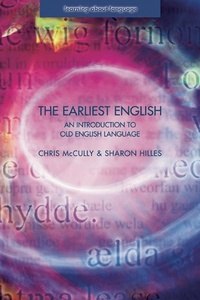
The Earliest English
An Introduction to Old English Language
Published on 28. January 2016
328 pages
978-1-317-87698-4 (ISBN)
Description

The Earliest English provides a student-friendly introduction to Old English and the earliest periods of the history of the English Language as it evolved before 1215. Using non-technical language, the book covers basic terminology, the linguistic and cultural backgrounds to the emergence and development of OE, and the OE vocabulary that students studying this phase of the English language need to know.
In eight carefully structured units, the authors show how the vocabulary of Old English contains many items familiar to us today; how its characteristic poetic form is based on a beautiful and intricate simplicity; how its patterns of word building and inflectional structure are paralleled in several present day languages and how and why the English language and its literature continued to change so that by the mid-12th century the English language looks more like the 'English' that we are familiar with in the 21st century. Features of the book include:
the provision of accessible guides to some important 'problem topics' of classical OE
stimulating cross-linguistic comparisons, e.g. the pronoun system of OE as compared with the pronoun system of present day Dutch
cleverly laid out translation exercises, with structural help in the form of selective glossaries
careful division into eight units, designed for both classroom use and self-study
Written in a clear and accessible manner, The Earliest English provides a comprehensive introduction to the evolution of Old English language and literature, and will be an invaluable textbook for students of English Language and Linguistics.
In eight carefully structured units, the authors show how the vocabulary of Old English contains many items familiar to us today; how its characteristic poetic form is based on a beautiful and intricate simplicity; how its patterns of word building and inflectional structure are paralleled in several present day languages and how and why the English language and its literature continued to change so that by the mid-12th century the English language looks more like the 'English' that we are familiar with in the 21st century. Features of the book include:
the provision of accessible guides to some important 'problem topics' of classical OE
stimulating cross-linguistic comparisons, e.g. the pronoun system of OE as compared with the pronoun system of present day Dutch
cleverly laid out translation exercises, with structural help in the form of selective glossaries
careful division into eight units, designed for both classroom use and self-study
Written in a clear and accessible manner, The Earliest English provides a comprehensive introduction to the evolution of Old English language and literature, and will be an invaluable textbook for students of English Language and Linguistics.
Reviews / Votes
'...a new textbook that makes intricate changes in the language comprehensible to students and provides new perspectives on language evolution.'...this account of the development of the English language is a true asset to it's study.'
Biljana Cubrovic, The European English Messenger, 14.1, 2005.
'...nicely bound, well presented and with earnest claims on the back cover to provide students with everything they could possibly need to become expert in the subject.'
Tim Connell, The Times Higher, Dec 2nd 2005.
More details
Series
Language
English
Place of publication
London
United Kingdom
Publishing group
Taylor & Francis Ltd
Target group
College/higher education
File size
4,09 MB
ISBN-13
978-1-317-87698-4 (9781317876984)
Copyright in bibliographic data and cover images is held by Nielsen Book Services Limited or by the publishers or by their respective licensors: all rights reserved.
Schweitzer Classification
Other editions
Additional editions
Book
09/2018
1st Edition
Routledge
€215.41
Shipment within 10-20 days
Book
09/2004
1st Edition
Longman
€77.00
Shipment within 10-20 days
Persons
Chris McCully is a freelance writer and academic. He has published widely in the fields of English historical linguistics, Old English and English phonology.
Sharon Hilles is Professor of English at California State Polytechnic University where she teaches Linguistics, grammar, first and second language acquisition and the development of modern English.
Sharon Hilles is Professor of English at California State Polytechnic University where she teaches Linguistics, grammar, first and second language acquisition and the development of modern English.
Content
Acknowledgements
List of symbols
Abbreviations
Using this book
1. Thinking about the earliest English
2. History, culture, language origins
3. Nouns
4. Verbs
Interlude. Working with dictionaries
5. OE Metric
6. Standards and Crosses
7. Twilight
8. Rebuilding English
At-a-glance guide to inflections (1): classical Old English, nouns
At-a-glance guide to inflections (2): classical old English, verbs
References
List of symbols
Abbreviations
Using this book
1. Thinking about the earliest English
2. History, culture, language origins
3. Nouns
4. Verbs
Interlude. Working with dictionaries
5. OE Metric
6. Standards and Crosses
7. Twilight
8. Rebuilding English
At-a-glance guide to inflections (1): classical Old English, nouns
At-a-glance guide to inflections (2): classical old English, verbs
References
