

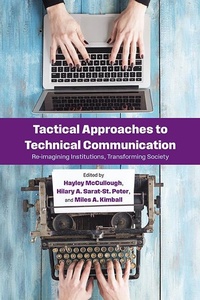
Tactical Approaches to Technical Communication
Description

Delves into how individuals tactically exist within communicative systems, carving out spaces for themselves in places they don't necessarily fit.
In 1984, Michel de Certeau described the terms "strategies" as how institutions communicate their wants/demands/desires and "tactics" as how individuals navigate these potentially hostile, unwelcoming systems. A little over two decades later, Miles A. Kimball solidified the idea of tactical technical communication, laying the foundations for a new area of inquiry and scholarship. Today, many academics and researchers have imbued the concept of tactical technical communication with their own ideas and perspectives. This essay collection spotlights a meaningful diversity of tactical technical communication scholarship, exploring topics like the feminist punk magazine BIKINI KILL, the phenomenon of copwatching, the usage of fictional narratives in technical writing courses, and the challenges of LBGTQ+ visibility in local libraries. In many ways, the contributors are partaking in their own forms of tactical communication as they carve out spaces for themselves and their ideas within the academic discourse.
More details
Other editions
Additional editions
Persons
Hayley McCullough is Assistant Professor of Technical Communication and Digital Media at New Mexico Tech. Hilary A. Sarat-St. Peter is Associate Professor of Technical Communication and Rhetoric at Columbia College in Chicago. Miles A. Kimball is a recently retired Professor from Rensselaer Polytechnic Institute. He is the coauthor, with Derek G. Ross, of Document Design, Second Edition: From Process to Product in Professional Communication, also published by SUNY Press.
Content
- Intro
- Contents
- Introduction
- Establishing Technical Communication
- Technical Communication and Michel de Certeau
- The Tactical in Technical Communication
- Part One: Reimagining Institutions
- Part Two: Transforming Society
- Acknowledgments
- References
- Part 1: Reimagining Institutions
- Chapter 1: In-Plain-Sight Tactics: One-to-One Advocacy in the Workplace
- Beyond Communal Tactical Technical Communication
- Tactical Moves in Strategic Documentation
- Case: Legal Administrative Specialist, Department of Veteran Affairs
- Case: Physician Assistant, Neurosurgery, Large Urban Hospital
- Driven by Empathy: In-Plain-Sight Advocacy
- Studying In-Plain-Sight Tactics to Better Serve Vulnerable Populations
- References
- Chapter 2: LGBTQ+ Programming at the Local Library: Tactical Technical Communication as a Way of Addressing Gaps in Community Resources and Representation
- Literature Review
- Methods
- Case Study
- Discussion and Implications
- Conclusion
- References
- Chapter 3: Exposing the "Actively Enforced" Policy: Tactical Technical Disruptake for Rhetorical Deinstitutionalization
- Church Clarity as Tactical Technical Communication
- "I'm Just Like, What Are You Hiding?": How Users Interact With Church Websites
- "Like a Mining Process": How Users Interact with Church Clarity Disruptakes
- Jill's Relief (City Church, Oklahoma)
- Sarah's Revelation (Eagle Brook Church, Minnesota)
- Conclusion
- References
- Chapter 4: #WearAMaskNY Public Service Announcements: Tactical Technical Communication During a Global Pandemic
- Tactical Technical Communication in Post-Postmodern Life
- Strategies and Tactics
- Using Tactics During the Social-Justice Turn
- PSA Videos as Tactical Technical Communication
- New York's PSA Video Contest
- We &3 NY
- We Are Compassion. We Are NY
- That Guy
- Do the Right Thing
- You Can Still Smile
- Implications
- Promoting User Agency Within Power Dynamics
- Blending Strategies and Tactics Through Cocreation
- Promoting Beneficence with Tactical Technical Communication
- Conclusion
- References
- Chapter 5: Grassroots Activism and Tactical Communities: Examining the Poor People's Corporation in Mississippi in the 1960s and 1970s
- The Poor People's Corporation: Its History and Structure
- The Poor People's Corporation in Brief
- The PPC and TTC
- The PPC Member Documents
- The Mississippi Brick Co-op Brochure
- The PPC as a Tactical Community
- Conclusion
- References
- Chapter 6: The Streets Have Eyes: "Copwatching" as Tactical Citizen Engagement with Police Policy
- History of Policing: Establishing Strategy, Occasioning Tactics
- Use of Force and Institutional Strategy
- Copwatching and Tactical Citizen Actions
- Brief History
- Observed Practices and Interviews
- Sousveillance
- Know-Your-Rights Training
- Agonistic Involvement in Police-Citizen Interaction
- Database Development
- Copwatching as Tactical Technical Communication: Operating in the Gaps Between Strategies
- References
- Chapter 7: Tactical Tech Comm and Failures in Crowdsourcing Mass Production
- Craftivism as Tactical Technical Communication
- The Pussyhat Project
- Mass Customization
- User Investment in Customization
- Principles for User Design of Customized Products
- Consistent Visual Identity Through Diverse Hats
- To Wear or Not to Wear Versus Which to Wear
- References
- Chapter 8: Tactical User Research: How UX Can (Re)Shape Organizations
- A Brief Introduction to SeaMe
- Toward a User-Positive Framework for UX
- A Mini Case Study in Tactical User Research
- Step 1: Identify Key Actors Within Organizational Workflows
- Interview Questions for Recreational Boaters
- Interview Questions for BLAs
- Step 2: Understand How These Actors Stabilize Existing Network Configurations
- Step 3: Use This Knowledge to Create Opportunities to Destabilize Existing Configurations in Favor of New Ones
- Conclusions, Limitations, and Opportunities for Further Work
- Acknowledgments
- Notes
- References
- Chapter 9: The Motivations of the Marginalized: Identifying and Navigating Hegemonic Factors in Petroleum Risk Communication
- Background
- Doing Versus Becoming
- Offshore, Tactically Speaking
- A Quick Portrait of an Oil-Rig Disaster
- Intercultural Issues Offshore
- Dynamics of a Petroleum (Re-)training Session
- My Analysis of (Re-)training Session
- Conclusion
- References
- Part 2: Transforming Society
- Chapter 10: Engaging Eurocentric Legacies in de Certeau's Thinking Through a Self-Reflection on "Queering Tactical Technical Communication"
- The Eurocentric Roots of de Certeau's Thinking
- Layer 1: Eurocentric Legacies Within de Certeau's Writing
- Layer 2: Eurocentricity in TC/Rhetoric/the West
- New Lines of Research: What Are BIPOC Trans Community's Specific Terms for Circumventing Strategies?
- Conclusion: Revisions Toward Future Trans-BIPOC Scholarship in TC
- Note
- References
- Chapter 11: DIY Instructions in BIKINI KILL: A Feminist Historiographical Approach to Tactical Technical Communication
- Feminist Historiography and Technical Communication
- Zines, BIKINI KILL, and the Riot Grrrl Movement
- BIKINI KILL's Technical Function and Tactical Identity
- DIY Practices of Composition and Circulation
- Partial and Provocative Forms of Instruction
- Embrace of Personal Experience as Knowledge Production
- Rejection of Cultural and Professional Norms
- Implications for the Histories of TTC
- Notes
- References
- Chapter 12: Our Bodies, Ourselves: A Case for Metical Technical Communication
- Strategies, Tactics, and Technical Communication
- TTC and Bodies
- Metis Defined
- Our Bodies, Ourselves as Metical Technical Communication
- Conclusion
- References
- Chapter 13: Armed Propaganda and the Ethics of Horrorism: Tactical Communiques from the Weather Underground
- Active Equality, Radical Sharing, and Alienation
- Citizen Engineering: Days of Rage and the Weathermyth
- Mirroring Wargasm, Weaponizing Whiteness
- Explosive Revelations and Armed Propaganda
- References
- Chapter 14: Hospitality at the End of the World: An Ideological Rhetorical Criticism of Tactical Technical Communication in The Prepper Journal
- Apocalyptic Rhetoric and the Ideology of Prepperism
- The Apocalyptic Hospitality of Prepper TTC
- An Ideological Criticism of TPJ
- Whom Does Apocalyptic Hospitality Include, and Whom Does It Exclude from the Postapocalyptic Imaginary?
- What Are the Ideologies Circulating in TTC-Focused Doomsday Prepper Communities?
- How Does TTC Contribute to Apocalypticism?
- Conclusion
- References
- Chapter 15: Marx in the Digital Age: The Critical Role of Tactical Technical Communication in Contemporary Humanism
- Challenging a Manufactured Identity: Consumption as Secondary Production
- Reuniting with Species-Being: Tertiary Production and Its Challenge to the Dominant Economic Order
- Implications
- References
- Chapter 16: The Narrative Construction of Social Justice in Technical Communication Pedagogy
- Terrarium in the Classroom
- Revised Scenario
- Positionality, Privilege, and Power: A Self-Reflexive Exercise
- Technical Communication Pedagogy and Social Justice
- Narrative and Technical Communication Pedagogy
- Journey of Transformation to Social Justice
- Conclusion
- References
- Chapter 17: Finding Agency Through Tactical Technical Communication: Privacy and Data Surveillance
- Tactical Communication, Surveillance, Privacy, Resistance, and Agency
- Methods
- Results
- Act
- Target
- Agent
- Site
- Consequences
- What-to-Do Tactics
- Implications
- Conclusion
- References
- Contributors
- Editors
- Index
