

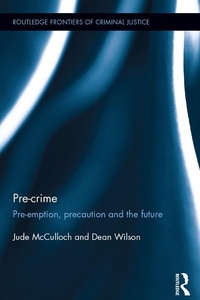
Pre-crime
Pre-emption, precaution and the future
Published on 24. July 2015
170 pages
978-1-317-67024-7 (ISBN)
Description

Pre-crime aims to pre-empt 'would-be-criminals' and predict future crime. Although the term is borrowed from science ?ction, the drive to predict and pre-empt crime is a present-day reality. This book critically explores this major twenty-first century development in crime and justice.
This first in-depth study of pre-crime defines and describes different types of pre-crime and compares it to traditional post-crime and crime risk approaches. It analyses the rationales that underpin pre-crime as a response to threats, particularly terrorism, and shows how it is spreading to other areas. It also underlines the historical continuities that prefigure the emergence of pre-crime, as well as exploring the new technologies and forms of surveillance that claim the ability to predict crime and identify future criminals. Through the use of examples and case studies it provides insights into how pre-crime generates the crimes it purports to counter, providing compelling evidence of the problems that arise when we act as if we know the future and aim to control it through punishing, disrupting or incapacitating those we predict might commit future crimes.
Drawing on literature from criminology, law, international relations, security and globalization studies, this book sets out a coherent framework for the continued study of pre-crime and addresses key issues such as terminology, its links to past practises, its likely future trajectories and its impact on security, crime and justice. It is essential reading for academics and students in security studies, criminology, counter-terrorism, surveillance, policing and law, as well as practitioners and professionals in these fields.
This first in-depth study of pre-crime defines and describes different types of pre-crime and compares it to traditional post-crime and crime risk approaches. It analyses the rationales that underpin pre-crime as a response to threats, particularly terrorism, and shows how it is spreading to other areas. It also underlines the historical continuities that prefigure the emergence of pre-crime, as well as exploring the new technologies and forms of surveillance that claim the ability to predict crime and identify future criminals. Through the use of examples and case studies it provides insights into how pre-crime generates the crimes it purports to counter, providing compelling evidence of the problems that arise when we act as if we know the future and aim to control it through punishing, disrupting or incapacitating those we predict might commit future crimes.
Drawing on literature from criminology, law, international relations, security and globalization studies, this book sets out a coherent framework for the continued study of pre-crime and addresses key issues such as terminology, its links to past practises, its likely future trajectories and its impact on security, crime and justice. It is essential reading for academics and students in security studies, criminology, counter-terrorism, surveillance, policing and law, as well as practitioners and professionals in these fields.
Reviews / Votes
'Welcome to the terrifying universe of pre-crime - the world of today, the past and the future all rolled up into one fantastical display of pre-emptive state power. This book provides the first ever systematic examination of the nature, dynamics and interventions of pre-crime. The line between fiction and reality has never been more tenuous or disturbing, as threats of insecurity and terror are mobilised in ways directly undermining individual and collective rights, freedom and justice. This is an essential book for interpreting the exercise of unbridled coercive force in uncertain times.' - Rob White, Professor of Criminology, School of Social Sciences, University of Tasmania, Australia'In this exceptionally original book on the dangers of "a pre-crime society that jumps at shadows," McCulloch and Wilson brilliantly examine how the speculative fiction of pre-crime utilizes logics of security, risk, and pre-emption to justify coercive and secretive state interventions against groups and identities viewed as threats. Absolutely essential reading for criminologists, legal scholars, social scientists, policy experts, and, indeed, anyone committed to the future of justice.' - Nancy A. Wonders, Professor of Criminology and Criminal Justice, Northern Arizona University, Arizona, USA
'Officials are re-calibrating their understanding of the relationship between the past and the future as it pertains to policing, security, and punishment. This volume offers cutting-edge insights into this important development, and cautions us about the ethical dilemmas presented by a brave new world of "pre-crime".' - Kevin D. Haggerty, Killam Laureate, University of Alberta, Canada
'This is an authoritative, critical and wide-ranging account of the emergence of pre-crime. It is elegantly written, accessible and historically nuanced, taking the reader through a fascinating journey from the past, to the present and, thereafter, into the future.
The central concepts associated with pre-crime - such as risk, pre-emption, precaution and futurity - are deftly unpacked and scrutinized with rigor. The book makes both a substantial theoretical contribution to debates about the utility and the morals underpinning pre-crime, whilst simultaneously offering a commanding overview of key debates in the area for social science students and researchers. The definitive work on pre-crime.' - Gabe Mythen, Professor of Criminology, University of Liverpool, UK
"A clearly written, accessible and indeed the most incisive deconstruction to date of the phenomenon of pre-crime, how it has partially displaced other adjacent crime control strategies and what it portends for the likely character of the security state in the coming period." - John Lea, Honorary Professor of Criminology, University of Roehampton, UK, British Journal of Criminology
"Pre-crime is an urgent and important piece of socio-legal scholarship. McCulloch and Wilson's book breaks new ground in the criminological literature on risk and challenges its readers to confront hard realities about the growing convergence between national security and criminal justice." - James Oleson, Associate Professor, University of Auckland, New Zealand, Australian and New Zealand Journal of Criminology
"Over little more than 150 pages, the authors provide a strong conceptual framework that should become a key resource in our understanding of pre-crime laws, security and counter-extremism. To those who are looking for a rich definition and theoretical advancement of the concept of pre-crime, this is the kind of scholarship that offers some clarity." - Raphael Schlembach, University of Brighton, UK, Criminology and Criminal Justice
More details
Series
Language
English
Place of publication
London
United Kingdom
Publishing group
Taylor & Francis Ltd
Target group
College/higher education
Illustrations
1 s/w Tabelle
1 Tables, black and white
File size
1,72 MB
ISBN-13
978-1-317-67024-7 (9781317670247)
Copyright in bibliographic data and cover images is held by Nielsen Book Services Limited or by the publishers or by their respective licensors: all rights reserved.
Schweitzer Classification
Other editions
Additional editions
Book
04/2017
1st Edition
Routledge
€64.00
Shipment within 10-20 days
Book
08/2015
1st Edition
Routledge
€217.50
Shipment within 10-20 days
Persons
Jude McCulloch is Professor of Criminology at Monash University. Her research focuses on the growing integration of crime and war and the impacts of this on justice, politics and society. Jude is on the editorial and advisory boards of leading national and international criminology and interdisciplinary journals. Her research spans counter terrorism laws and policing, police use of force and (in)security politics. She has published widely in scholarly journals as well as in the media and magazines. Jude's books include Blue Army: Paramilitary Policing in Australia, State Crime and Resistance (eds. Elizabeth Stanley and Jude McCulloch) and Borders and Crime (eds. Jude McCulloch and Sharon Pickering).
Dean Wilson is Professor of Criminology, School of Law, Politics and Sociology, University of Sussex, UK. He has published widely in the areas of surveillance, border control, technology and security and the history of policing and criminal justice. He is a Director of the international Surveillance Studies Network and an Associate Editor of the journal Surveillance & Society.
Dean Wilson is Professor of Criminology, School of Law, Politics and Sociology, University of Sussex, UK. He has published widely in the areas of surveillance, border control, technology and security and the history of policing and criminal justice. He is a Director of the international Surveillance Studies Network and an Associate Editor of the journal Surveillance & Society.
Content
1. Introduction: pre-crime: pre-emption, precaution and the future 2. Before pre-crime 3. Risking the future: pre-emption, precaution and uncertainty 4. Pre-empting justice: pre-crime, precaution and counterterrorism 5. Pre-crime science, technology and surveillance 6. Evidence to intelligence: justice through the crystal ball 7. Creating terror: pre-crime, undercover agents and informants 8. Pre-crime: securing a just future.
