

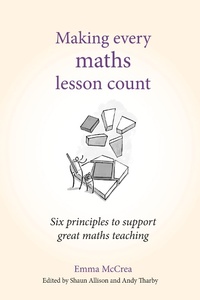
Making Every Maths Lesson Count
Six principles to support great maths teaching
Published on 1. May 2019
192 pages
978-1-78583-421-9 (ISBN)
Description

In Making Every Maths Lesson Count: Six principles to support great maths teaching, experienced maths teacher and lecturer Emma McCrea takes away the guesswork as she sums up the key components of effective maths teaching.
Maths classrooms are incredibly complex places. At any given time, the factors influencing the effectiveness of your teaching are boundless and this can lead to relying on intuition as to what might work best.
This book aims to signpost a route through this complexity.
Writing in the practical, engaging style of the award-winning Making Every Lesson Count, Emma McCrea helps teachers to move beyond trial and error by sharing evidence-informed tips and suggestions on how they can nudge the impact of their teaching in the right direction.
Making Every Maths Lesson Count is underpinned by six pedagogical principles challenge, explanation, modelling, practice, feedback and questioning and presents 52 high-impact strategies designed to streamline teacher workload and ramp up the level of challenge in the maths classroom.
The book draws out the key findings from the latest research on memory, learning and motivation and each chapter features numerous worked examples to demonstrate the theory in action, together with a concluding series of questions that will help maths practitioners relate the content to their own classroom practice. Furthermore, Emma's writing offers clarity around the language of maths teaching and learning, and also delves into the finer points of how to identify and address any misconceptions that students may hold.
Written for new and experienced practitioners alike, this gimmick-free guide provides sensible solutions to perennial problems and inspires a rich, challenging and evidence-based approach to the teaching of maths.
Suitable for maths teachers of students aged 11 to 18 years, and for primary school maths specialists.
Maths classrooms are incredibly complex places. At any given time, the factors influencing the effectiveness of your teaching are boundless and this can lead to relying on intuition as to what might work best.
This book aims to signpost a route through this complexity.
Writing in the practical, engaging style of the award-winning Making Every Lesson Count, Emma McCrea helps teachers to move beyond trial and error by sharing evidence-informed tips and suggestions on how they can nudge the impact of their teaching in the right direction.
Making Every Maths Lesson Count is underpinned by six pedagogical principles challenge, explanation, modelling, practice, feedback and questioning and presents 52 high-impact strategies designed to streamline teacher workload and ramp up the level of challenge in the maths classroom.
The book draws out the key findings from the latest research on memory, learning and motivation and each chapter features numerous worked examples to demonstrate the theory in action, together with a concluding series of questions that will help maths practitioners relate the content to their own classroom practice. Furthermore, Emma's writing offers clarity around the language of maths teaching and learning, and also delves into the finer points of how to identify and address any misconceptions that students may hold.
Written for new and experienced practitioners alike, this gimmick-free guide provides sensible solutions to perennial problems and inspires a rich, challenging and evidence-based approach to the teaching of maths.
Suitable for maths teachers of students aged 11 to 18 years, and for primary school maths specialists.
More details
Series
Language
English
Place of publication
Carmarthen
United Kingdom
Target group
Young adult
College/higher education
Professional and scholarly
File size
6,86 MB
ISBN-13
978-1-78583-421-9 (9781785834219)
Copyright in bibliographic data and cover images is held by Nielsen Book Services Limited or by the publishers or by their respective licensors: all rights reserved.
Schweitzer Classification
Other editions
Additional editions
Emma McCrea | Andy Tharby | Shaun Allison
Making Every Maths Lesson Count
Six principles to support great maths teaching
Book
05/2019
Crown House Publishing
€24.00
Shipment within 3-4 weeks
Persons
Andy Tharby is a practising English teacher with over a decade's classroom experience at a secondary school in West Sussex. He is co-author of the award winning Making Every Lesson Count and the author of Making Every English Lesson Count. Andy is also interested in helping fellow teachers enhance their practice through engagement with research evidence. Shaun Allison leads on CPD in his school and is interested in supporting teachers to grow and develop their classroom practice. He is the author of the widely acclaimed Perfect Teacher-Led CPD and a popular speaker. Shaun's background is in science teaching and he is currently deputy head teacher at Durrington High School.Andy Tharby, a practising English teacher, is a research lead with an interest in helping ordinary classroom teachers enhance their practice through engagement with a wider evidence base. His well-regarded blog, Reflecting English, covers a range of subjects from improving student writing to finding solutions to the problems and dilemmas faced by busy teachers.
Content
- Cover
- Praise
- Title Page
- Copyright
- Acknowledgements
- Contents
- Introduction
- 1 Challenge
- 2 Explanation and Modelling
- 3 Practice
- 4 Questioning
- 5 Feedback
- Final Thoughts
- Appendix: Index of Strategies
- Bibliography
