

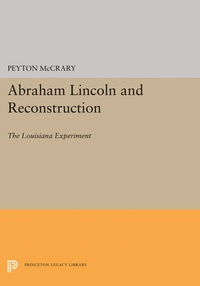
Abraham Lincoln and Reconstruction
The Louisiana Experiment
1st Edition
Published on 19. May 2015
444 pages
978-1-4008-7019-6 (ISBN)
Description

After victorious federal troops swept through southern Louisiana in 1862, the state became the testing ground for Abraham Lincoln's approach to reconstruction, and thus the focal point for the debate over post-war policy in Washington. Peyton McCrary offers a comprehensive account of the social and political upheavals in Louisiana, set against the background of a new interpretation of the revolutionary dimensions of the Civil War party system. He compares the moderate Republican regime set up by Lincoln with the antebellum social and political system, and contrasts it with the reactionary government established in 1865 under the aegis of Andrew Johnson and the Democratic Party. The author also explores the social history of the contract labor system, the evolution of the Freedmen's Bureau, and the growing participation of blacks in the Louisiana Republican movement.
Drawing on extensive research in unpublished manuscripts, party records, and newspapers, and using sophisticated quantitative analysis of electoral and legislative behavior, Professor McCrary suggests a significant revision of earlier interpretations of Lincoln's reconstruction policies. He finds that the real architect of the gradualist approach with which the President was publicly identified was his commanding general in Louisiana, Nathaniel P. Banks, who was less open to the idea of Negro suffrage than was Lincoln himself.
Originally published in 1979.
The Princeton Legacy Library uses the latest print-on-demand technology to again make available previously out-of-print books from the distinguished backlist of Princeton University Press. These editions preserve the original texts of these important books while presenting them in durable paperback and hardcover editions. The goal of the Princeton Legacy Library is to vastly increase access to the rich scholarly heritage found in the thousands of books published by Princeton University Press since its founding in 1905.
Drawing on extensive research in unpublished manuscripts, party records, and newspapers, and using sophisticated quantitative analysis of electoral and legislative behavior, Professor McCrary suggests a significant revision of earlier interpretations of Lincoln's reconstruction policies. He finds that the real architect of the gradualist approach with which the President was publicly identified was his commanding general in Louisiana, Nathaniel P. Banks, who was less open to the idea of Negro suffrage than was Lincoln himself.
Originally published in 1979.
The Princeton Legacy Library uses the latest print-on-demand technology to again make available previously out-of-print books from the distinguished backlist of Princeton University Press. These editions preserve the original texts of these important books while presenting them in durable paperback and hardcover editions. The goal of the Princeton Legacy Library is to vastly increase access to the rich scholarly heritage found in the thousands of books published by Princeton University Press since its founding in 1905.
More details
Other editions
Additional editions
Book
04/2016
Princeton University Press
€145.30
Article not available at the moment
Book
03/2015
Princeton University Press
€53.00
Shipment within 10-20 days
Book
02/1979
Princeton University Press
€71.80
Article exhausted; check different version
Person
Peyton McCrary
Content
Frontmatter, pg. i
Contents, pg. vii
Tables, pg. ix
Preface, pg. xi
Abbreviations, pg. xvii
Prologue "Mr. Lincoln's Model Of Reconstruction", pg. 1
I. The Old Regime: Society And Politics In Antebellum Louisiana, pg. 19
II. War And Social Change: Benjamin F. Butler And The Assertion Of Federal Power, pg. 66
III. The Failure Of Conciliation: Nathaniel P. Banks And The Planters, pg. 110
IV. Between Slavery And Freedom: The Labor System Of General Banks, pg. 135
V. Reconstruction As A Problem In Party Building: Thomas J. Durant And The Free State Movement, pg. 159
VI. The Suffrage Issue: General Banks Takes Command, pg. 186
VII. Radicals Vs. Moderates: The Ideological Dimension Of Unionist Politics, pg. 212
VIII. The Moderates In Power: The Constitutional Convention Of 1864, pg. 237
IX. Lincoln Vs. Sumner: The Louisiana Question In National Politics, pg. 271
X. Counterrevolution: The Return Of The Confederates, pg. 305
Epilogue. The Politics Of Revolution, pg. 342
Appendix A. Regression Analysis Of Electoral Behavior In Antebellum Louisiana, 1840-1861, pg. 357
Appendix B. The Occupational Background Of Delegates To The Louisiana Constitutional Convention Of 1864, pg. 370
Appendix C. A Scale Analysis Of Voting Behavior In The Louisiana Constitutional Convention, 1864, pg. 373
Bibliographical Essay, pg. 381
Index, pg. 401
Contents, pg. vii
Tables, pg. ix
Preface, pg. xi
Abbreviations, pg. xvii
Prologue "Mr. Lincoln's Model Of Reconstruction", pg. 1
I. The Old Regime: Society And Politics In Antebellum Louisiana, pg. 19
II. War And Social Change: Benjamin F. Butler And The Assertion Of Federal Power, pg. 66
III. The Failure Of Conciliation: Nathaniel P. Banks And The Planters, pg. 110
IV. Between Slavery And Freedom: The Labor System Of General Banks, pg. 135
V. Reconstruction As A Problem In Party Building: Thomas J. Durant And The Free State Movement, pg. 159
VI. The Suffrage Issue: General Banks Takes Command, pg. 186
VII. Radicals Vs. Moderates: The Ideological Dimension Of Unionist Politics, pg. 212
VIII. The Moderates In Power: The Constitutional Convention Of 1864, pg. 237
IX. Lincoln Vs. Sumner: The Louisiana Question In National Politics, pg. 271
X. Counterrevolution: The Return Of The Confederates, pg. 305
Epilogue. The Politics Of Revolution, pg. 342
Appendix A. Regression Analysis Of Electoral Behavior In Antebellum Louisiana, 1840-1861, pg. 357
Appendix B. The Occupational Background Of Delegates To The Louisiana Constitutional Convention Of 1864, pg. 370
Appendix C. A Scale Analysis Of Voting Behavior In The Louisiana Constitutional Convention, 1864, pg. 373
Bibliographical Essay, pg. 381
Index, pg. 401
