

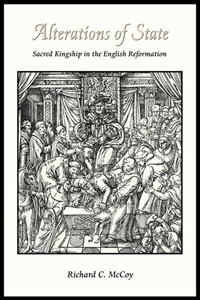
Alterations of State
Sacred Kingship in the English Reformation
1st Edition
Published on 25. September 2015
192 pages
978-0-231-50107-1 (ISBN)
Description

Traditional notions of sacred kingship became both more grandiose and more problematic during England's turbulent sixteenth and seventeenth centuries. The reformation launched by Henry VIII and his claims for royal supremacy and divine right rule led to the suppression of the Mass, as the host and crucifix were overshadowed by royal iconography and pageantry. These changes began a religious controversy in England that would lead to civil war, regicide, restoration, and ultimately revolution.
Richard McCoy shows that, amid these sometimes cataclysmic Alterations of State, writers like John Skelton, Shakespeare, John Milton, and Andrew Marvell grappled with the idea of kingship and its symbolic and substantive power. Their artistic representations of the crown reveal the passion and ambivalence with which the English viewed their royal leaders. While these writers differed on the fundamental questions of the day-Skelton was a staunch defender of the English monarchy and traditional religion, Milton was a radical opponent of both, and Shakespeare and Marvell were more equivocal-they shared an abiding fascination with the royal presence or, sometimes more tellingly, the royal absence.
Ranging from regicides real and imagined-with the very real specter of the slain King Charles I haunting the country like a revenant of the king's ghost in Shakespeare's Hamlet-from the royal sepulcher at Westminster Abbey to Peter Paul Reubens's Apotheosis of King James at Whitehall, and from the Elizabethan compromise to the Glorious Revolution, McCoy plumbs the depths of English attitudes toward the king, the state, and the very idea of holiness. He reveals how older notions of sacred kingship expanded during the political and religious crises that transformed the English nation, and helps us understand why the conflicting emotions engendered by this expansion have proven so persistent.
Richard McCoy shows that, amid these sometimes cataclysmic Alterations of State, writers like John Skelton, Shakespeare, John Milton, and Andrew Marvell grappled with the idea of kingship and its symbolic and substantive power. Their artistic representations of the crown reveal the passion and ambivalence with which the English viewed their royal leaders. While these writers differed on the fundamental questions of the day-Skelton was a staunch defender of the English monarchy and traditional religion, Milton was a radical opponent of both, and Shakespeare and Marvell were more equivocal-they shared an abiding fascination with the royal presence or, sometimes more tellingly, the royal absence.
Ranging from regicides real and imagined-with the very real specter of the slain King Charles I haunting the country like a revenant of the king's ghost in Shakespeare's Hamlet-from the royal sepulcher at Westminster Abbey to Peter Paul Reubens's Apotheosis of King James at Whitehall, and from the Elizabethan compromise to the Glorious Revolution, McCoy plumbs the depths of English attitudes toward the king, the state, and the very idea of holiness. He reveals how older notions of sacred kingship expanded during the political and religious crises that transformed the English nation, and helps us understand why the conflicting emotions engendered by this expansion have proven so persistent.
More details
Other editions
Additional editions
Book
07/2002
Columbia University Press
€68.20
Article not available at the moment
Person
Richard McCoy is professor of English at the Graduate Center of the City University of New York, and at Queens College. He is the author of The Rites of Knighthood: The Literature and Politics of Elizabethan Chivalry, and Sir Philip Sidney: Rebellion in Arcadia.
Content
Preface
Acknowledgments
List of Illustrations
1. Real Presence to Royal Presence
2. Sacred Space: John Skelton and Westminster's Royal Sepulcher
3. Rites of Memory: Shakespeare and the Elizabethan Compromise
4. Idolizing Kings: John Milton and Stuart Rule
5. Sacramental to Sentimental: Andrew Marvell and the Restoration
Notes
Index
Acknowledgments
List of Illustrations
1. Real Presence to Royal Presence
2. Sacred Space: John Skelton and Westminster's Royal Sepulcher
3. Rites of Memory: Shakespeare and the Elizabethan Compromise
4. Idolizing Kings: John Milton and Stuart Rule
5. Sacramental to Sentimental: Andrew Marvell and the Restoration
Notes
Index
