

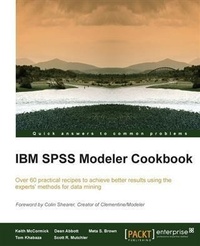
IBM SPSS Modeler Cookbook
If you've already had some experience with IBM SPSS Modeler this cookbook will help you delve deeper and exploit the incredible potential of this data mining workbench. The recipes come from some of the best brains in the business.
1st Edition
Published on 13. January 2025
382 pages
978-1-84968-547-4 (ISBN)
Description

If you ve already had some experience with IBM SPSS Modeler this cookbook will help you delve deeper and exploit the incredible potential of this data mining workbench. The recipes come from some of the best brains in the business.Key Features - Go beyond mere insight and build models than you can deploy in the day to day running of your business
- Save time and effort while getting more value from your data than ever before
- Loaded with detailed step-by-step examples that show you exactly how it's done by the best in the business
Book DescriptionIBM SPSS Modeler is a data mining workbench that enables you to explore data, identify important relationships that you can leverage, and build predictive models quickly allowing your organization to base its decisions on hard data not hunches or guesswork. IBM SPSS Modeler Cookbook takes you beyond the basics and shares the tips, the timesavers, and the workarounds that experts use to increase productivity and extract maximum value from data. The authors of this book are among the very best of these exponents, gurus who, in their brilliant and imaginative use of the tool, have pushed back the boundaries of applied analytics. By reading this book, you are learning from practitioners who have helped define the state of the art. Follow the industry standard data mining process, gaining new skills at each stage, from loading data to integrating results into everyday business practices. Get a handle on the most efficient ways of extracting data from your own sources, preparing it for exploration and modeling. Master the best methods for building models that will perform well in the workplace. Go beyond the basics and get the full power of your data mining workbench with this practical guide.What you will learn - Use and understand the industry standard CRISP_DM process for data mining.
- Assemble data simply, quickly, and correctly using the full power of extraction, transformation, and loading (ETL) tools.
- Control the amount of time you spend organizing and formatting your data.
- Develop predictive models that stand up to the demands of real-life applications.
- Take your modeling to the next level beyond default settings and learn the tips that the experts use.
- Learn why the best model is not always the most accurate one.
- Master deployment techniques that put your discoveries to work making the most of your business most critical resources.
- Challenge yourself with scripting for ultimate control and automation - it s easier than you think!
Who this book is forIf you have had some hands-on experience with IBM SPSS Modeler and now want to go deeper and take more control over your data mining process, this is the guide for you. It is ideal for practitioners who want to break into advanced analytics.
- Save time and effort while getting more value from your data than ever before
- Loaded with detailed step-by-step examples that show you exactly how it's done by the best in the business
Book DescriptionIBM SPSS Modeler is a data mining workbench that enables you to explore data, identify important relationships that you can leverage, and build predictive models quickly allowing your organization to base its decisions on hard data not hunches or guesswork. IBM SPSS Modeler Cookbook takes you beyond the basics and shares the tips, the timesavers, and the workarounds that experts use to increase productivity and extract maximum value from data. The authors of this book are among the very best of these exponents, gurus who, in their brilliant and imaginative use of the tool, have pushed back the boundaries of applied analytics. By reading this book, you are learning from practitioners who have helped define the state of the art. Follow the industry standard data mining process, gaining new skills at each stage, from loading data to integrating results into everyday business practices. Get a handle on the most efficient ways of extracting data from your own sources, preparing it for exploration and modeling. Master the best methods for building models that will perform well in the workplace. Go beyond the basics and get the full power of your data mining workbench with this practical guide.What you will learn - Use and understand the industry standard CRISP_DM process for data mining.
- Assemble data simply, quickly, and correctly using the full power of extraction, transformation, and loading (ETL) tools.
- Control the amount of time you spend organizing and formatting your data.
- Develop predictive models that stand up to the demands of real-life applications.
- Take your modeling to the next level beyond default settings and learn the tips that the experts use.
- Learn why the best model is not always the most accurate one.
- Master deployment techniques that put your discoveries to work making the most of your business most critical resources.
- Challenge yourself with scripting for ultimate control and automation - it s easier than you think!
Who this book is forIf you have had some hands-on experience with IBM SPSS Modeler and now want to go deeper and take more control over your data mining process, this is the guide for you. It is ideal for practitioners who want to break into advanced analytics.
More details
Other editions
Additional editions
Keith McCormick | Dean Abbott
IBM SPSS Modeler Cookbook
If you've already had some experience with IBM SPSS Modeler this cookbook will help you delve deeper and exploit the incredible potential of this data mining workbench. The recipes come from some of the best brains in the business.
Book
10/2013
Packt Publishing
€80.40
Shipment within 3-4 weeks
Content
- Cover
- Copyright
- Credits
- Foreword
- About the Authors
- About the Reviewers
- www.PacktPub.com
- Table of Contents
- Preface
- Chapter 1: Data Understanding
- Introduction
- Using an empty aggregate to evaluate sample size
- Evaluating the need to sample from the initial data
- Using CHAID stumps when interviewing an SME
- Using a single cluster K-means as an alternative to anomaly detection
- Using an @NULL multiple Derive to explore missing data
- Creating an outlier report to give to SMEs
- Detecting potential model instability early using the Partition node and Feature Selection
- Chapter 2: Data Preparation - Select
- Introduction
- Using the Feature Selection node creatively to remove, or decapitate, perfect predictors
- Running a Statistics node on anti-join to evaluate potential missing data
- Evaluating the use of sampling for speed
- Removing redundant variables using correlation matrices
- Selecting variable using the CHAID modeling node
- Selecting variables using the Means node
- Selecting variables using single-antecedent association rules
- Chapter 3: Data Preparation - Clean
- Introduction
- Binning scale variables to address missing data
- Using a full data model/partial data model approach to address missing data
- Imputing in-stream mean or median
- Imputing missing values randomly from uniform or normal distributions
- Using random imputation to match a variable's distribution
- Searching for similar records using a neural network for inexact matching
- Using neuro-fuzzy searching to find similar names
- Producing longer Soundex codes
- Chapter 4: Data Preparation - Construct
- Introduction
- Building transformations with multiple Derive nodes
- Calculating and comparing conversion rates
- Grouping categorical values
- Transforming high skew and kurtosis variables with a multiple Derive node
- Creating flag variables for aggregation
- Using Association Rules for interaction detection/feature creation
- Creating time-aligned cohorts
- Chapter 5: Data Preparation - Integrate and Format
- Introduction
- Speeding up merge with caching and optimization settings
- Merging a look-up table
- Shuffle-down (nonstandard aggregation)
- Cartesian product merge using key-less merge by key
- Multiplying out using Cartesian product merge, user source, and derive dummy
- Changing large numbers of variable names without scripting
- Parsing nonstandard dates
- Parsing and performing a conversion on a complex stream
- Sequence processing
- Chapter 6: Selecting and Building a Model
- Introduction
- Evaluating balancing with the Auto Classifier
- Building models with and without outliers
- Neural Network Feature Selection
- Creating a bootstrap sample
- Creating bagged logistic regression models
- Using KNN to match similar cases
- Using Auto Classifier to tune models
- Next-Best-Offer for large datasets
- Chapter 7: Modeling - Assessment, Evaluation, Deployment, and Monitoring
- Introduction
- How (and why) to validate as well as test
- Using classification trees to explore the predictions of a Neural Net
- Correcting a confusion matrix for an imbalanced target variable by incorporating priors
- Using aggregate to write cluster centers to Excel for conditional formatting
- Creating a classification tree financial summary using aggregate and an Excel Export node
- Reformatting data for reporting with a Transpose node
- Changing formatting of fields in a Table node
- Combining generated filters
- Chapter 8: CLEM Scripting
- Introduction
- Building iterative Neural Network forecasts
- Quantifying variable importance with Monte Carlo Simulation
- Implementing champion/challenger model management
- Detecting Outliers with the jackknife method
- Optimizing K-means cluster solutions
- Automating time series forecasts
- Automating HTML reports and graphs
- Rolling your own modeling algorithm: Weibull analysis
- Appendix: Business Understanding
- Introduction
- Define business objectives by Tom Khabaza
- Assessing the situation by Meta Brown
- Translating your business objective into a data mining objective by Dean Abbott
- Produce a project plan - ensuring a realistic timeline by Keith McCormick
- Index
