

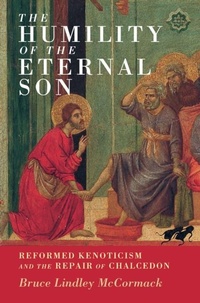
The Humility of the Eternal Son
Reformed Kenoticism and the Repair of Chalcedon
Published on 24. November 2021
978-1-009-00328-5 (ISBN)
Description

The Chalcedonian Definition of 451 never completely resolved one of the critical issues at the heart of Christianity: the unity of the 'person' of Christ. In this eagerly-awaited volume - the result of deep and sustained reflection - distinguished theologian Bruce Lindley McCormack examines the reasons for this philosophical and theological failure. His book serves as a critical history that traces modern attempts at resolution of this problem, from the nineteenth-century Lutheran emphasis on Kenoticism (or the 'self-emptying' of the Son in order to be receptive to the will of the Father) to post-Barthian efforts that evade the issue by collapsing the second person of the Trinity into the human Jesus - thereby rejecting altogether the logic of the classical 'two-natures' Christology. McCormack shows how New Testament Christologies both limit and authorize ontological reflection, and in so doing offers a distinctively Reformed version of Kenoticism. Proposing a new and bold divine ontology, with a convincing basis in Christology, he persuasively argues that the unity of the 'person' is in fact guaranteed by the Son's act of taking into his 'being' the lived existence of Jesus.
Reviews / Votes
'Based on a lucidly presented history of Chalcedonian Christology and firmly grounded in biblical exegesis, Bruce McCormack advances a novel thesis: The shortcomings of Chalcedonian Christology can be repaired, if one maintains a precise understanding of kenosis as the 'ontological receptivity' of the eternal Son to the fate of the human Jesus. McCormack's view that divine passibility can be squared with divine immutability makes his readers hungry for the second volume of the promised trilogy.' Christoph Schwoebel, University of St Andrews 'McCormack's The Humility of the Eternal Son is constructive theology at its very best. He aims not only to solve theological periphera but those at the very heart of millennia old Christological debates. What is more, he realises this ambition informed by a breathtakingly mature knowledge of the Tradition and its aporias. As anyone familiar with McCormack's previous works would expect, his solutions emerge from a gospel-animated account of that which is central, namely God's lived relation to the world in Christ. And to this is added a sharply Protestant - in the best sense of that term - sensibility: to sift all things in light of the witness of Scripture to that centre. Hence, he simply refuses to allow biblical scholarship and theological reflection to run on alternative tracks but brings them both into dynamic, fruitful and sophisticated conversation. Here is constructive theology that takes seriously the advances and insights of New Testament scholarship to heart. McCormack's proposals relating to 'ontological receptivity' - and more besides - are also disarmingly beautiful. Reading his work led me to ponder again the breadth and length and height and depth of the love of Christ. What an astonishing start to the planned trilogy of books from the premier theologian of our age.' Chris Tilling, St. Mellitus College 'It is safe to say that no one today knows Karl Barth's theology better than Bruce McCormack, and even more certain that no one has thought more about its striking implications. We have accustomed ourselves to thinking that Barth is a fairly mainstream Reformed theologian. But, of course, he is not, and never really was. He was too original (e.g., his novel application of the doctrine of justification to theological epistemology), and even something of a rebel (e.g., his overturning of the Reformed doctrine of election). But, as McCormack shows in this book, the first of three projected volumes, we have still not grasped just how original Barth was. We can be sure that McCormack's conclusions will provoke much discussion, and we can be grateful for this, especially if it helps us to see something that has been revealed but not yet seen: the eternal - and not merely accidental - humility of the Son of God.' John Betz, University of Notre Dame ... this book will be epoch-making in the field of Christology. It is a masterful work of constructive theology.' SDMorrison.org 'This book is the ripe fruit of decades of high-level theological thought ... McCormack's argumentative style is insightful and clear. He honestly admits in which respects he has changed his mind over recent years.' A. Huijgen, Theologia Reformata (from Dutch) 'Refreshingly ... Bruce McCormack only publishes his work when he has something significant to say. His latest book, The Humility of the Eternal Son, the first of a promised three- volume trilogy, gives every indication that he has a lot left to say in his retirement.' Zack Kahler, The Heythrop Journal '... this book is a groundbreaking work of postmetaphysical christological reflection, and as such it is essential reading for any student or scholar of Christology.' Thomas Haviland-Pabst, Journal of Reformed TheologyMore details
Series
Language
English
Place of publication
Cambridge
United Kingdom
Target group
Professional and scholarly
Illustrations
Worked examples or Exercises
File size
3,14 MB
ISBN-13
978-1-009-00328-5 (9781009003285)
Copyright in bibliographic data and cover images is held by Nielsen Book Services Limited or by the publishers or by their respective licensors: all rights reserved.
Schweitzer Classification
Other editions
Additional editions
Bruce Lindley McCormack
The Humility of the Eternal Son
Reformed Kenoticism and the Repair of Chalcedon
Book
11/2023
Cambridge University Press
€30.00
Shipment within 15-20 days
Bruce Lindley McCormack
The Humility of the Eternal Son
Reformed Kenoticism and the Repair of Chalcedon
Book
09/2021
Cambridge University Press
€51.30
Shipment within 15-20 days
Person
Content
I. A Critical History of Kenotic Christologies and their Antecedents: An Overview: 1. Chalcedon and its legacy; 2. Self-emptying: as either depotentiation or divestment: the failure of nineteenth centure Kenoticism to repair Chalcedon; 3. Divine Kenosis as proper to the Eternal Son: Barth, Bulgakov and von Balthasar; 4. The Post-Barthian temptation: collapse of the Eternal Son into Jesus and surrender of an immanent trinity in protology; II. Returning to Holy Scripture: 5. The self-humiliating God in Paul's theology (and in Hebrews); 6. The Christological subject in the synoptics and in John; III. Repairing Chalcedon: 7. Towards a reformed version of Kenotic Christology; 8. Looking forward.
