

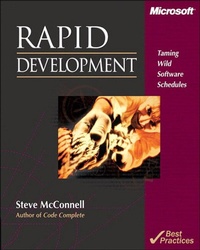
Rapid Development
Rapid Devment _p1
1st Edition
Published on 2. July 1996
672 pages
978-0-7356-4723-7 (ISBN)
Description

Corporate and commercial software-development teams all want solutions for one important problem-how to get their high-pressure development schedules under control. In RAPID DEVELOPMENT, author Steve McConnell addresses that concern head-on with overall strategies, specific best practices, and valuable tips that help shrink and control development schedules and keep projects moving. Inside, you'll find:
A rapid-development strategy that can be applied to any project and the best practices to make that strategy work
Candid discussions of great and not-so-great rapid-development practices-estimation, prototyping, forced overtime, motivation, teamwork, rapid-development languages, risk management, and many others
A list of classic mistakes to avoid for rapid-development projects, including creeping requirements, shortchanged quality, and silver-bullet syndrome
Case studies that vividly illustrate what can go wrong, what can go right, and how to tell which direction your project is going
RAPID DEVELOPMENT is the real-world guide to more efficient applications development.
A rapid-development strategy that can be applied to any project and the best practices to make that strategy work
Candid discussions of great and not-so-great rapid-development practices-estimation, prototyping, forced overtime, motivation, teamwork, rapid-development languages, risk management, and many others
A list of classic mistakes to avoid for rapid-development projects, including creeping requirements, shortchanged quality, and silver-bullet syndrome
Case studies that vividly illustrate what can go wrong, what can go right, and how to tell which direction your project is going
RAPID DEVELOPMENT is the real-world guide to more efficient applications development.
More details
Series
Edition
1. Auflage
Language
English
Place of publication
Redmond
United States
Target group
College/higher education
File size
4,81 MB
ISBN-13
978-0-7356-4723-7 (9780735647237)
Copyright in bibliographic data and cover images is held by Nielsen Book Services Limited or by the publishers or by their respective licensors: all rights reserved.
Schweitzer Classification
Other editions
Additional editions
Person
Steve McConnell is recognized as one of the premier authors and voices in the development community. He is Chief Software Engineer of Construx Software and was the lead developer of Construx Estimate and of SPC Estimate Professional, winner of Software Development magazine's Productivity Award. He is the author of several books, including Code Complete and Rapid Development, both honored with Software Development magazine's Jolt Award.
Content
Preface
Part I: EFFICIENT DEVELOPMENT
Chapter 1: Welcome to Rapid Development
Chapter 2: Rapid-Development Strategy
Chapter 3: Classic Mistakes
Chapter 4: Software-Development Fundamentals
Chapter 5: Risk Management
Part II: RAPID DEVELOPMENT
Chapter 6: Core Issues in Rapid Development
Chapter 7: Lifecycle Planning
Chapter 8: Estimation
Chapter 9: Scheduling
Chapter 10: Customer-Oriented Development
Chapter 11: Motivation
Chapter 12: Teamwork
Chapter 13: Team Structure
Chapter 14: Feature-Set Control
Chapter 15: Productivity Tools
Chapter 16: Project Recovery
Part III: BEST PRACTICES
Introduction to Best Practices
Chapter 17: Change Board
Chapter 18: Daily Build and Smoke Test
Chapter 19: Designing for Change
Chapter 20: Evolutionary Delivery
Chapter 21: Evolutionary Prototyping
Chapter 22: Goal Setting
Chapter 23: Inspections
Chapter 24: Joint Application Development (JAD)
Chapter 25: Lifecycle Model Selection
Chapter 26: Measurement
Chapter 27: Miniature Milestones
Chapter 28: Outsourcing
Chapter 29: Principled Negotiation
Chapter 30: Productivity Environments
Chapter 31: Rapid-Development Languages (RDLs)
Chapter 32: Requirements Scrubbing
Chapter 33: Reuse
Chapter 34: Signing Up
Chapter 35: Spiral Lifecycle Model
Chapter 36: Staged Delivery
Chapter 37: Theory-W Management
Chapter 38: Throwaway Prototyping
Chapter 39: Timebox Development
Chapter 40: Tools Group
Chapter 41: Top-10 Risks List
Chapter 42: User-Interface Prototyping
Chapter 43: Voluntary Overtime
Bibliography
Part I: EFFICIENT DEVELOPMENT
Chapter 1: Welcome to Rapid Development
Chapter 2: Rapid-Development Strategy
Chapter 3: Classic Mistakes
Chapter 4: Software-Development Fundamentals
Chapter 5: Risk Management
Part II: RAPID DEVELOPMENT
Chapter 6: Core Issues in Rapid Development
Chapter 7: Lifecycle Planning
Chapter 8: Estimation
Chapter 9: Scheduling
Chapter 10: Customer-Oriented Development
Chapter 11: Motivation
Chapter 12: Teamwork
Chapter 13: Team Structure
Chapter 14: Feature-Set Control
Chapter 15: Productivity Tools
Chapter 16: Project Recovery
Part III: BEST PRACTICES
Introduction to Best Practices
Chapter 17: Change Board
Chapter 18: Daily Build and Smoke Test
Chapter 19: Designing for Change
Chapter 20: Evolutionary Delivery
Chapter 21: Evolutionary Prototyping
Chapter 22: Goal Setting
Chapter 23: Inspections
Chapter 24: Joint Application Development (JAD)
Chapter 25: Lifecycle Model Selection
Chapter 26: Measurement
Chapter 27: Miniature Milestones
Chapter 28: Outsourcing
Chapter 29: Principled Negotiation
Chapter 30: Productivity Environments
Chapter 31: Rapid-Development Languages (RDLs)
Chapter 32: Requirements Scrubbing
Chapter 33: Reuse
Chapter 34: Signing Up
Chapter 35: Spiral Lifecycle Model
Chapter 36: Staged Delivery
Chapter 37: Theory-W Management
Chapter 38: Throwaway Prototyping
Chapter 39: Timebox Development
Chapter 40: Tools Group
Chapter 41: Top-10 Risks List
Chapter 42: User-Interface Prototyping
Chapter 43: Voluntary Overtime
Bibliography
