

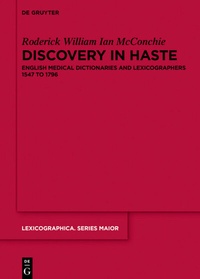
Discovery in Haste
Description

Discovery in Haste is the first book to survey the English printed medical dictionary, a greatly under-researched area, from Andrew Boorde's Breviary of Helthe of 1547 to Benjamin Lara's surgical dictionary of 1796. The book begins with Andrew Boorde's Breviary of Helthe of 1547, moves on to medical glossaries, which were produced through the whole period, the 'physical dictionaries' of the mid-seventeenth century which first employed 'dictionary' in the title, the translation into English of Steven Blancard's dictionary, Latin medical dictionaries of the late seventeenth century by Thomas Burnet and John Cruso, the influential dictionary by John Quincy which dominated the eighteenth century, surgical dictionaries through to that by Benjamin Lara, Robert James's massive encyclopaedic dictionary and the work derived from it by John Barrow, as well as George Motherby's dictionary of 1775. The characteristics of each are discussed and their inter-relationships explored. Attention is also paid to the printing history and the way the publishers influenced the works and, where appropriate, to the influence each had on succeeding dictionaries. This book is the first to locate medical dictionaries within the history of lexicography.
More details
Other editions
Additional editions
Person
Content
- Intro
- Acknowledgments
- Contents
- 1. Introduction
- 2. Andrew Boorde (1490?-1549) and The breuiary of helthe 1547
- 3. Medical glossaries
- 4. The physical dictionaries of 1655-1678
- 5. Latin medical dictionaries: Thomas Burnet and John Cruso
- 6. Steven Blancard (1650-1704)
- 7. John Quincy (1683?-1723) and the Lexicon physico-medicum
- 8. Aids to memory: Surgical dictionaries
- 9. Robert James (1703-1776) and A medicinal dictionary (1742-1745)
- 10. "Careful" John Barrow (fl. 1735-1773?)
- 11. George Motherby (1731-1793)
- 12. Epilogue
- Bibliography
- Index
