

Theoretical Basis of Occupational Therapy
4th Edition
Published on 27. November 2024
236 pages
978-1-040-16489-1 (ISBN)
Description

The fourth edition of this popular student-friendly textbook provides a thorough and detailed exploration of the key theoretical approaches that inform occupational therapy in the 21st century. It provides a comprehensive overview of how occupation can be used therapeutically, and of both the determinants and consequences of occupation.
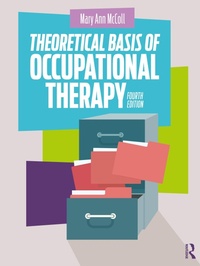
The book uses the familiar filing cabinet metaphor to offer an easily digestible classification system for theoretical ideas in occupation therapy. It also includes historical perspectives on how these key theories evolved, as well as enlightening commentary of the latest theoretical developments. Links to practice are highlighted throughout with extensive examples and case studies. Fully updated with key occupation-focused models, the fourth edition also features a new chapter on the most influential theorists in the field.
Including illustrative figures and student activities to help develop a fuller understanding, this is an essential textbook for anyone studying occupational therapy or occupational science.
The book uses the familiar filing cabinet metaphor to offer an easily digestible classification system for theoretical ideas in occupation therapy. It also includes historical perspectives on how these key theories evolved, as well as enlightening commentary of the latest theoretical developments. Links to practice are highlighted throughout with extensive examples and case studies. Fully updated with key occupation-focused models, the fourth edition also features a new chapter on the most influential theorists in the field.
Including illustrative figures and student activities to help develop a fuller understanding, this is an essential textbook for anyone studying occupational therapy or occupational science.
More details
Edition
4th edition
Language
English
Place of publication
London
United Kingdom
Publishing group
Taylor & Francis Ltd
Target group
College/higher education
Illustrations
14 Illustrations, black and white
ISBN-13
978-1-040-16489-1 (9781040164891)
Copyright in bibliographic data and cover images is held by Nielsen Book Services Limited or by the publishers or by their respective licensors: all rights reserved.
Schweitzer Classification
Other editions
Additional editions
Mary Ann McColl
Theoretical Basis of Occupational Therapy
Book
11/2024
4th Edition
SLACK Incorporated
€89.20
Shipment within 3-4 weeks
Mary Ann McColl
Theoretical Basis of Occupational Therapy
Book
11/2024
4th Edition
Routledge
€200.89
Shipment within 10-20 days
Person
Mary Ann McColl, PhD, MTS, is a Professor in the School of Rehabilitation Therapy and Health Services and the Policy Research Institute at Queen's University, Kingston, Ontario.
Content
I. INTRODUCTION 1. What is theory? 2. Knowledge needed to be an occupational therapist 3. Occupation and occupational performance problems 4. The complexity of occupation 5. The consequences of occupation 6. The occupational therapy filing cabinet 7. Conceptual models in the filing cabinet 8. Models of practice in the filing cabinet 9. The filing cabinet in action II. THE DETERMINANTS OF OCCUPATION 10. The socio-cultural determinants of occupation 11. The psychological-emotional determinants of occupation (with Terry Krupa) 12. The physical determinants of occupation (with Briano DiRezze and Tara Packham) 13. The cognitive-neurological determinants of occupation (with Setareh Ghahari) 14. The environmental determinants of occupation (with Mary Law) 15. Review of determinants of occupation III. OCCUPATION-FOCUSED MODELS 16. Model of Human Occupation 17. Occupational Adaptation 18. Ecology of Human Performance 19. Six descriptive models of occupation, person, and environment 20. Review of occupation-focused models IV. LIVES AND TIMES IN OCCUPATIONAL THERAPY THEORY 21. LIVES - Eight people who changed how we think about occupation 22. TIMES - Occupation in the 20th century and beyond (with Penny Bryden) 23. Conclusion
