

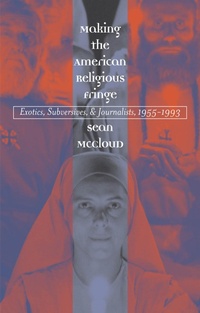
Making the American Religious Fringe
Description

In an examination of religion coverage in Time, Newsweek, Life, The Saturday Evening Post, Ebony, Christianity Today, National Review, and other news and special interest magazines, Sean McCloud combines religious history and social theory to analyze how and why mass-market magazines depicted religions as “mainstream” or “fringe” in the post–World War II United States. McCloud argues that in assuming an American mainstream that was white, middle class, and religiously liberal, journalists in the largest magazines, under the guise of objective reporting, offered a spiritual apologetics for the dominant social order. McCloud analyzes articles on a wide range of religious movements from the 1950s through the early 1990s, including Pentecostalism, the Nation of Islam, California cults, the Jesus movement, South Asian gurus, and occult spirituality. He shows that, in portraying certain beliefs as “fringe,” magazines evoked long-standing debates in American religious history about emotional versus rational religion, exotic versus familiar spirituality, and normal versus abnormal levels of piety. He also traces the shifting line between mainstream and fringe, showing how such boundary shifts coincided with larger changes in society, culture, and the magazine industry. McCloud’s astute analysis helps us understand both broad conceptions of religion in the United States and the role of mass media in American society.
More details
Other editions
Additional editions
Person
Content
- Intro
- Contents
- Illustrations
- Acknowledgments
- Introduction
- Argument One: From Mass Movements, Exoticism, and Subversion to Individuals, Brainwashing, and Coercion
- Argument Two: Societal Change, Identity Construction, and the Journalistic Habitus
- Methods
- Sources
- Caveats
- Organization
- Notes
- Part I. Monitoring the Marginal Masses: Exoticism, Zealotry, and Subversion during the Cold War, 1955-1965
- 1. Exoticism and the Dangers of Religious Zeal: Differentiating Fringe from Mainstream, 1955-1965
- Expanding the Center, Imagining Consensus: The 1950s Religious Revival and the Triple Melting Pot
- Identifying the Fringe by Regionalizing It: California Cults and Exoticism
- The Dangers of Religious Zeal: Neurotic Religion and Cold War Containment
- Alternative Representations: Evangelicals and Catholics Depict the Fringe
- Notes
- 2. Race, Class, and the Subversive Cold War Other: Depicting the Nation of Islam, 1959-1965
- The Birth of the Nation
- The Nation of Islam as Subversive Threat, 1959-1963
- Journalists, the Nation of Islam, and ''True Religion''
- The Nation of Islam as Social Mirror: Social Criticism and the Limits of Representational Contestation
- Just an Overblown Splinter Group: Representational Change and the Cessation of Coverage, 1964-1965
- Newsweek and the ''Negro in America'' Poll
- A Nation Apostate Speaks to the Nation
- Notes
- Part II. Reconstructing an American Religious Fringe, 1966-1993
- 3. The Buddha, the Hobbit, and the Christ: Depicting the Middle-Class Fringe, 1966-1972
- Making the Cult Explosion
- Gurus, Witches, and Asian Religion: Banal Exoticism and Authentic Religion, 1966-1969
- Satan Returns: Banal Exotics and Dangerous Deviants in Occult Coverage, 1968-1972
- Social Mirror and Genuine Realm of Magic: Journalists Interpret the Occult
- The Jesus Movement Is upon Us: The Generation Gap and Religion, 1971-1972
- Jesus Freaks and Anti-Cultists: Controversy at the Darkening Margins
- Notes
- 4. Making the Cult Menace: Brainwashing, Deprogramming, Mass Suicide, and Other Heresies, 1973-1979
- Cults, Brainwashing, and the Business of Journalism
- Deprogramming
- Heresy
- Atrocity Tales: ''Moonies,'' Broken Families, and Print Media, 1976-1979
- Alternatives to Atrocity Tales
- Jonestown and the Cult Menace
- Notes
- 5. Essentializing the Margins: The American Religious Fringe into the Nineties
- Marginalizing the Mainstream?: Professionalizing the ''Religion Beat'' and Reporting Clerical Scandals
- ''More K-Mart Than Cartier'': ''Lowbrow'' Religion and the Televangelism Scandal
- Essentializing the Fringe: From Cultic Groups to Cultic Activities
- Depicting the Waco Branch Davidians: Explaining the Ambiguous through Motifs of the Essentialized Margin
- Branch Davidian Coverage, ''True Crime'' Narratives, and Cult Menace Motifs
- Conclusion
- Notes
- Epilogue
- Notes
- Notes
- Bibliography
- Index
- A-B
- C
- D-G
- H-J
- K-M
- N
- O-S
- T
- U-Z
