

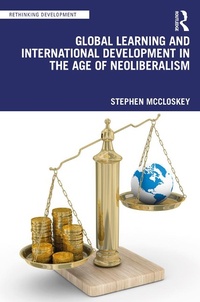
Global Learning and International Development in the Age of Neoliberalism
1st Edition
Published on 13. October 2021
200 pages
978-1-000-45912-8 (ISBN)
Description

This book argues that the international development sector is in crisis which can be mostly sourced to its side-stepping the dominant development question of our age, the neoliberal growth paradigm. It argues that this crisis can be addressed, at least in part, by the sector's re-engagement with the radical development education process that it helped to foster and sustain for over two decades.
The recent safeguarding scandal is symptomatic of a sector that is becoming overly hierarchical, brand conscious and disconnected from its base. This book argues that many of the problems the sector is facing can be sourced to its failings in grappling with the question of neoliberalism and formulating a coherent critique of how market orthodoxy has accelerated poverty in the global North and South. This book recommends re-embracing the radical origins of global learning, situated in the participative methodology and praxis (reflection and action) of Paulo Freire, both as internal capacity-building and external public engagement. The book proposes a new development paradigm, focusing on bottomup, participative approaches to policy-making based on the needs of those NGOs claim to represent - the poor, marginalised and voiceless - rather than constantly following the agenda of donors and governments.
The recommendations made by this book will serve as an important resource for researchers and students of international development and global learning, as well as to NGOs, civil society activists and education practitioners looking for solutions to the problems within the sector.
The recent safeguarding scandal is symptomatic of a sector that is becoming overly hierarchical, brand conscious and disconnected from its base. This book argues that many of the problems the sector is facing can be sourced to its failings in grappling with the question of neoliberalism and formulating a coherent critique of how market orthodoxy has accelerated poverty in the global North and South. This book recommends re-embracing the radical origins of global learning, situated in the participative methodology and praxis (reflection and action) of Paulo Freire, both as internal capacity-building and external public engagement. The book proposes a new development paradigm, focusing on bottomup, participative approaches to policy-making based on the needs of those NGOs claim to represent - the poor, marginalised and voiceless - rather than constantly following the agenda of donors and governments.
The recommendations made by this book will serve as an important resource for researchers and students of international development and global learning, as well as to NGOs, civil society activists and education practitioners looking for solutions to the problems within the sector.
Reviews / Votes
"In Global Learning and International Development in the Age of Neoliberalism, McCloskey explores these problems presented to the sector through the contextual lens of global learning. He argues that neoliberalism, specifically the pro-growth neoliberal model of development, is the core reason why the international development sector is in crisis. Thus, for McCloskey, re-embracing radical development education practice can help to build capacity to challenge the extreme levels of inequality created by neoliberalism ... the book offers a different perspective on today's debates about the main challenges within the field of international development and the development education sector. It engages with a wide range of cases and actors to support the critical discussion, and it raises important concerns and questions within the development sector."Natalya Hanley, Associate Research Fellow, University of Sussex, UK in International Journal of Development Education and Global Learning
"The book Global Learning and International Development in the Age of Neoliberalism by Stephen McCloskey, published in 2022 by Routledge, appears to be a crucial work to accompany the critical debate on cooperation for development and education for development/ global citizenship education (ED/ECG). Following the tradition of critical pedagogy that is based on the work of Paulo Freire, in particular his seminal text from 1968, Pedagogy of the Oppressed (Freire, 2005), McCloskey guides us along the paths of the crisis that the sector of cooperation for development is experiencing the neoliberal growth paradigm as the main driver of this crisis ... This book, by the approach that follows, is an excellent guide for researchers, students and activists, since it does not limit itself to taking the reader along the paths of this crisis, pointing out, throughout the book, alternatives that can contribute to mitigate this crisis, indicating critical ED/ECG as an essential point ... Stephen McCloskey's book is a must-read for activists and students interested in the area of development cooperation and ED/ECG as it provides a comprehensive reflection on the field and allows questioning the NGOization of the sector under analysis."
Rui da Silva, Center for African Studies at the University of Porto and La Salete Coelho, Center for African Studies at the University of Porto and Higher School of Education at the Polytechnic Institute of Viana do Castelo in Sinergias ed
More details
Series
Edition
1. Auflage
Language
English
Place of publication
London
United Kingdom
Publishing group
Taylor & Francis Ltd
Target group
College/higher education
Professional and scholarly
Illustrations
1 Tables, black and white; 3 Line drawings, black and white; 3 Illustrations, black and white
ISBN-13
978-1-000-45912-8 (9781000459128)
Copyright in bibliographic data and cover images is held by Nielsen Book Services Limited or by the publishers or by their respective licensors: all rights reserved.
Schweitzer Classification
Other editions
Additional editions
Book
10/2021
1st Edition
Routledge
€60.00
Shipment within 15-20 days
Book
10/2021
1st Edition
Routledge
€206.10
Shipment within 15-20 days
Person
Stephen McCloskey is the Director of the Centre for Global Education (CGE), a development non-governmental organisation in Belfast that provides training and resources on international development issues. He is the editor of Policy and Practice: A Development Education Review, a bi-annual peer reviewed, open-access journal. He regularly writes in both Policy and Practice and openDemocracy on development, the Middle-East, social justice and poverty. He is the co-editor of From the Local to the Global: Key Issues in Development Studies. He also edited Development Education in Policy and Practice. He manages education projects in the Gaza Strip, Palestine, and Beirut, Lebanon, and is currently undertaking research on Palestinian refugees across the Middle East.
Content
Chapter 1 Introduction: Fairy Tales of Development: Climate Change, COVID-19 and Neoliberalism Part 1: Development Education and Transformation Chapter 2 The Freirean Pedagogy of Development Education Chapter 3 Development Education and Social Change Chapter 4 Development Education and "Adjectival" Sectors Chapter 5 Development Education in Practice Part Two: Development Education, International Development and Neoliberalism Chapter 6 Neoliberalism and Inequality: Our Development Model is Broken Chapter 7 Resisting the Rise of Populist Nationalism: The Role of Development Education and International Development Chapter 8 Alternatives to Neoliberalism Chapter 9 COVID-19 and the Climate Crisis: Two Sides of the Same Neoliberal Coin Part Three: The Policy Environment for Development Education and International Development Chapter 10 Development NGOs and the Aid Fetish Chapter 11 The Sustainable Development Goals: Are they Fit for Purpose? Chapter 12 Racism and Development Chapter 13 Conclusion: Creating a New Development Paradigm
