

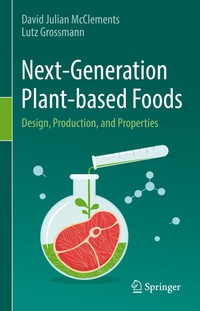
Next-Generation Plant-based Foods
Description

The creation of plant-based foods is one of the most rapidly advancing areas in the modern food industry. Many consumers are adopting more plant-based foods in their diets because of concerns about global warming and its devastating impacts on the environment and biodiversity. In addition, consumers are adopting plant-based diets for ethical and health reasons. As a result, many food companies are developing plant-based analogs of animal-based foods like dairy, egg, meat, and seafood products. This is extremely challenging because of the complex structure and composition of these animal-based foods.
Next-Generation Plant-based Foods: Design, Production and Properties presents the science and technology behind the design, production, and utilization of plant-based foods. Readers will find a review of ingredients, processing operations, nutrition, quality attributes, and specific plant-based food categories such as milk and dairy products, egg and egg products, meat and seafood products, providing the fundamental knowledge required to create the next generation of healthier and more sustainable plant-based food alternatives.More details
Other editions
Additional editions
Persons
David Julian McClements was born in the north of England but has lived in California, Ireland, France, and Massachusetts since then. He is currently a Distinguished Professor at the Department of Food Science at the University of Massachusetts where he specializes in the areas of food design and nanotechnology. He has written numerous books, published over 1200 scientific articles, been granted several patents, and presented his work at invited talks around the world. He is currently the most highly cited author in the food and agricultural sciences. He has received awards from numerous scientific organizations in recognition of his achievements and is a fellow of the Royal Society of Chemistry, American Chemical Society, and Institute of Food Technologists. His research has been funded by the United States Department of Agriculture, National Science Foundation, NASA, and the food industry.
Lutz Grossmann is currently an Assistant Professor at the Food Science Department at the University of Massachusetts Amherst. He was born in the southwest of Germany and graduated from the University of Hohenheim in Stuttgart (Germany) with several degrees in food science. His research focuses on facilitating a sustainable food system transition by designing holistic approaches to increase the consumption of plant- and microbial protein-rich foods. He is especially interested in combining downstream processing technology with molecular, physicochemical, and engineering concepts to create food textures that are nutritious, sustainable, and tasty. His research has been funded by the United States Department of Agriculture and The Good Food Institute
