

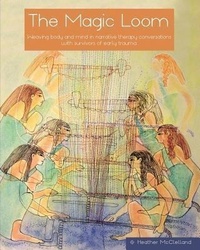
The Magic Loom
Description

In 'The Magic Loom' the author, Heather McClelland, invites adults who survived trauma in their childhood to become more aware of their sensations. She helps them interweave the narratives and wisdom of both body and mind as they safely explore and make meaning of the past and put it behind them. This is a text for therapists primarily, teaching with metaphor and case-study. Therapists will discover why and how weaving the body and mind together in interpersonal narrative style conversations meets the needs that contemporary scientific research is uncovering.
It is the author's hope that survivors themselves may find they can identify with the stories of trauma recovery as they unfold and engage with the Magic Loom's conversational style and translation of the languages of therapy and of science.
Neuroscientists inform us that unresolved aspects of early trauma become hidden within a person's somatic memory (van der Kolk, 2006). Memories are not cognitively or narratively retrievable because at the time of the original trauma, the hormonal impacts on the traumatised child's brain prevented vital neural signals from reaching the brain's higher, sense-making parts (Perry, 1997; van der Kolk, 2006). The trauma is remembered, not by her rational mind but by her body.
Raising a person's awareness of her body means that key threads can be woven together with the full range of narrative therapy approaches that enable her to explore what her mind presents. The body-focused narrative therapist is learning to listen to an added voice and a different suite of narratives. She is helping to make explicit and visible to the survivor what has long remained implicit and hidden. It's as if the person's body gives her back her voice and her mind.
Body-focused narrative therapy owes its transformative power to the synthesis of a range of somatic and narrative approaches.
More details
Persons
Content
Table of Contents
Part One consists of the Introduction and Chapters 1-4
The introduction sets out to engage the reader about the new therapy model as the author explains how the book will unfold.
Chapter 1 introduces narrative approaches to therapy.
Chapter 2 introduces contemporary somatic therapy.
Chapter 3 describes current scientific understandings of developmental trauma and emphasises the importance of including the body to ensure therapy is effective.
Chapter 4 introduces the model, 'body focused narrative therapy in conversations with survivors of developmental trauma' and explains how it evolved. It describes how the therapy conversations are scaffolded and provides a metaphorical map to help the therapist better understand and negotiate the therapy conversations.
Part Two consists of Chapters 5-13
Chapter 5 is an in depth case-study of developmental trauma and one person's uptake of the therapy model.
Chapter 6 makes sense of the Chapter 5 case-study with scientific and therapeutic explanation.
Chapter 7 features the impacts of isolation on the childhood trauma of three individuals.
Chapter 8 provides three case-studies that demonstrate how the body-focused narrative model can help transform emotions.
Chapter 9 engages the reader with the help of three conversational participants. Subtle body aspects in their lives are explored and woven together with a number of narrative approaches.
Chapter 10 shares the experiences of two individuals and introduces the body resource of rocking.
Chapter 11 takes the model into couple therapy showcasing the way aspects of early trauma can harm relationships. Three couples reveal their responses to the new therapy model.
Chapter 12 consists of case-studies with adolescents, children and their families demonstrating a variety of ways the body can be engaged.
At the end of each of the case-studies in Chapters 7-12, the conversation is re-described utilising the metaphor of weaving as introduced in Chapter 4. This helps the reader/student to reflect usefully on what has just been described.
Chapter 13 brings the book to a conclusion describing the main therapeutic and scientific features of the body-focused narrative model. It gives a final participant the opportunity to proffer his commendation of it.
