

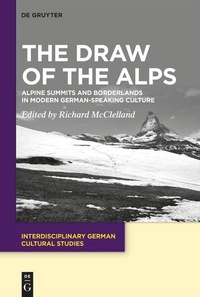
The Draw of the Alps
Description

The Alps have exerted a hold over the German cultural imagination throughout the modern period, enthralling writers, artists, philosophers, scientists, and tourists alike. The Draw of the Alps interrogates the dynamics of this fascination. Though philosophical and aesthetic responses to Alpine space have shifted over time, the Alps continue to captivate at an individual and collective level. This has resulted in myriad cultural engagements with Alpine space, as this interdisciplinary volume attests. Literature, photography, and philosophy continue to engage with the Alps as a place in which humans pursue their cognitive and aesthetic limits. At the same time, individuals engage physically with the alpine environment, whether as visitors through the well-established leisure industry, as enthusiasts of extreme sports, or as residents who feel the acute end of social and environmental change. Taking a transnational view of Alpine space, the volume demonstrates that the Alps are not geographically peripheral to the nation-state but are a vibrant locus of modern cultural production. As The Draw of the Alps attests, the Alps are nothing less than a crucible in which understandings of what it means to be human have been forged.
More details
Other editions
Additional editions
Person
Content
- Intro
- Contents
- The Draw of the Alps
- Part 1: Constructing the Alps
- Connecting Transnationalization and the Mnemotope of "the Pariah": The Alps as Border and Contact Zone in Ferdinand von Saar's Die Steinklopfer (The Stone Breakers, 1873)
- Setting the Scene: Tourist Infrastructure, Landscape, and Literature in the Swiss Alps from the 1880s to 1930s
- Constructing the Alps: Perspectives on the Perception of the Alps by the Tyrolean Anti-Transit Movement
- Shifting Perspectives: Alpine Scenarios in the Work Complex Nach der Natur (Beyond Nature) by Austrian Architectural Photographer Margherita Spiluttini
- Part 2: Desire and the Alps
- After the Mountain Sublime: Erosion and Catastrophe in Max Frisch's Der Mensch erscheint im Holozän (Man in the Holocene, 1979)
- God da Tamangur: An Alpine Landscape of Longing and Loss
- Walking Away, Going Astray in Alpine Spaces: Homeric Wanderings in Peter Stamm's Weit über das Land (To the Back of Beyond, 2016)
- Part 3: Into the Alps
- Crevasses and Magic Mountains: Alpine Discourse in Vicki Baum's Marion lebt (Marion Alive, 1942)
- Dream, Nightmare and Alpine Fortifications in Christian Kracht's Alternate History Novel Ich werde hier sein im Sonnenschein und im Schatten (2008)
- More than Romantic Scenery: The Contested Alpine Landscape in Raphaela Edelbauer's Das flüssige Land (The Liquid Land, 2019)
- Part 4: Boundaries and the Alps
- The Alps as a Site of Boundary Suspension? Wilhelmine von Hillern's Die Geier-Wally (The Vulture Maiden, 1875) in Deutsche Rundschau
- At the Limit: Edgework, Ethics and Environment in Paul Preuss' Theory and Practice of Climbing
- Bibliography
- About the Authors
- Index
