


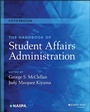
The Handbook of Student Affairs Administration
Description

Professionals in student affairs administration need practical, timely, and applied information on the myriad issues they encounter in supporting the success of the students and the institutions they serve. In the Handbook of Student Affairs Administration, the top scholars in the field share the latest information, methods, and advice on addressing these issues. The book is sponsored by NASPA, the leading professional organization for student affairs in higher education.
This fifth edition has been updated to reflect current and effective techniques in student affairs administration including new chapters on anti-oppressive frameworks and equity in praxis, access for students with disabilities, men and masculinities, support for students' mental health and well-being, and student employment as learning-integrated work. There is also an emphasis throughout on adult learners, online learners, part-time students, and transfer students. Chapter authors of diverse gender, ethnicity, sexual orientation, experiential background, and type of institution offer broader perspectives.
* Learn about the dominant organization and administration models in student affairs
* Stay up to date on core competencies and professional development models
* Discover research-based strategies for addressing both emerging and lasting issues in student affairs
* Instructor resources available
The Handbook of Student Affairs Administration is a comprehensive and thoughtful resource, with expert insight on the issues facing student affairs. This is one handbook students and professionals in the field won't want to go without.
More details
Other editions
Additional editions
Persons
Judy Marquez Kiyama is Professor in the Center for the Study of Higher Education, Department of Educational Policy Studies and Practice at the University of Arizona. Her research examines the structures that shape access to educational opportunities.
Content
NASPA--Student Affairs Administrators in Higher Education
Preface
Acknowledgments
The Authors
PART ONE: CONTEXTS OF PROFESSIONAL PRACTICE
1 A Concise and Critical History of Student Affairs
Michael S. Hevel and Amy E. Wells Dolan
2 Institutional Types and Missions
Claire K. Robbins and Sharrika D. Adams
3 Campus Environments and Student Affairs
Jillian Kinzie
4 The Office of the President: Pathways and Perspectives
Lori White and Sarah Steinkamp
5 Accountability: What It Is and Why It Matters
Sherry L. Mallory
PART TWO: FRAMEWORKS FOR PROFESSIONAL PRACTICE
6 An Overview of Student Development Theories
Symphony D. Oxendine and Deborah J. Taub
7 Centering Anti-Oppressive Frameworks as Student Affairs Educators
Antonio Duran and Angie Kim
8 Emerging Models of Practice
Michele A. Tyson
9 Contextualizing Everyday Ethics in Student Affairs
David Eberhardt and Aurélio Manuel Valente
10 Applying Professional Standards in Student Affairs
Stephanie A. Gordon
PART THREE: PURPOSES OF PROFESSIONAL PRACTICE
11 Diversity of Student Populations and How We Serve Them
Elena Sandoval-Lucero, Ignacio Hernandez, and Gillian McKnight-Tutein
12 Beyond Diversity and Multiculturalism: Advancing Equity in
Student Affairs Praxis
Sam Museus and Varaxy Yi
13 Persistence, Retention, Completion, and Student Success
Frank Fernandez and Cassandra Butcher
14 Helping Students Lead Lives of Purpose
Matthew Hartley, Laura E. Sponsler, and Cecilia M. Orphan
15 Disability in Higher Education: Shifting Concepts of
Access from Individual to Systemic
Amanda Kraus
16 Masculine Role Socialization and Performance
Jason A. Laker
17 Supporting Students' Mental Health and Well-Being
John Dunkle and Qianhui Zhang
PART FOUR: HUMAN RESOURCES IN PROFESSIONAL PRACTICE
18 Cultivating Critical Practice: Reflections on
Organization and Administration in Higher Education
Felecia Commodore and Leonard Taylor, Jr.
19 Hiring, Developing, and Retaining Professional Staff
Jason L. Meriwether
20 Student Employment as Learning-Integrated Work
Marianna Savoca and Krissy Creager
PART FIVE: INTERPERSONAL DYNAMICS IN PROFESSIONAL PRACTICE
21 Supporting and Enhancing Student Learning
Through Partnerships with Academic Colleagues
Kristan M. Venegas and Rebecca Cepeda
22 Politics, Power, Persuasion, and Shared Governance
George S. McClellan
23 Constellations of Love: Cultivating Intentional Campus and
Community Relations
Amanda R. Tachine and Kaiwipunikauikawe¯kiu Lipe
PART SIX: SKILLS AND COMPETENCIES FOR THE PROFESSION
24 Planning and Budgeting
Lori E. Varlotta
25 The Law on Campus and in Student Affairs Practice
Neal H. Hutchens and Daniel Hill
26 Analytics, Assessment, Research, and the Scholarship of Practice
Darby M. Roberts
27 Technology and Student Affairs
Ed Cabellon, Kevin R. Guidry, and T.J. Logan
28 Campus Crisis Management
Eugene L. Zdziarski, II
PART SEVEN: THE PROFESSION AND THE FUTURE
29 Student Affairs in the Moment and in the Future
George S. McClellan and Judy Marquez Kiyama
Index
THE AUTHORS
Sharrika D. Adams (she/her/hers) is an assistant professor of practice of higher education at Virginia Tech. She has over 15 years of experience as a student affairs and higher education administrator. Her research interests include crisis management in higher education.
Cassandra Butcher is a resident director at the University of California, Riverside. Her scholarly interests focus on the mental and emotional wellness of first-generation Black and Brown college students. She previously worked as a graduate assistant at the University of Houston while obtaining her M.Ed. in higher education.
Edmund T. Cabellon has worked in higher education for 24 years as an executive and senior administrator in student affairs and enrollment management and as an adjunct professor primarily in Massachusetts institutions. He currently serves as vice president of enrollment management at Curry College (MA). His research addresses digital technology and organizational change, and he has served as a co-editor and author for New Directions for Student Services.
Rebecca Cepeda is a doctoral student in the Higher Education and Student Affairs Program at The Ohio State University. Her research interests include centering and uplifting the experiences of People of Color in higher education.
Felecia Commodore is an assistant professor of higher education in the Darden College of Education and Professional Studies at Old Dominion University in Norfolk, Virginia. Felecia's research focus area is leadership, governance, and administrative practices with a particular focus on HBCUs and MSIs. Felecia's research interests also lie in how leadership is exercised, constructed, and viewed in various communities, and the relationship of Black women and leadership. She is the lead author of Black Women College Students: A Guide to Success in Higher Education with D.J. Baker and A.T. Arroyo (Routledge).
Krissy Creager has held several student affairs roles over the last 12 years and currently serves as the vice chancellor for enrollment management and the student experience at Purdue University, Fort Wayne. Her work focuses on the impact on-campus student employment has on retention, success, satisfaction, and emotional intelligence.
Antonio Duran (he/him) is an assistant professor of higher and postsecondary education at Arizona State University. Antonio's research interests involve understanding how historical and contemporary legacies of oppression influence college student development, experiences, and success.
John Dunkle is the senior clinical director, higher education, at The Jed Foundation (JED), a nonprofit organization that focuses on protecting the emotional health and preventing suicide among youth and young adults. Prior to joining JED, John had a 25-year career at the Counseling and Psychological Services (CAPS) at Northwestern University (NU).
David Eberhardt has over 25 years of experience in numerous student affairs roles and currently serves as the vice president for student development at Birmingham-Southern College. His scholarly interests focus on the ethical and spiritual development of college students, and he has written for and serves as an editor for the Journal of College and Character.
Stephanie A. Gordon serves as the vice president for professional development at NASPA-Student Affairs Administrators in Higher Education. Her scholarly research includes the education and competencies of chief student affairs officers, persistence of first-generation and historically excluded student populations, and mental health and well-being within the context of student learning and success.
Kevin R. Guidry is the associate director of educational assessment in the University of Delaware's Center for Teaching & Assessment of Learning. He previously co-chaired NASPA's Technology Knowledge Community and has written about the history of technology in student affairs.
Frank Fernandez is assistant professor of higher education administration and policy at the University of Florida. He previously worked as a director of institutional research, administered NSSE and HERI surveys, and helped lead assessment and accreditation projects. He has published in the Journal of College Student Development, Leadership Exchange, and is on the editorial board of the Journal of Student Affairs Research and Practice. He has been a guest on NASPA's SA: Voices from the Field podcast.
Matthew Hartley is professor of education and associated dean at the University of Pennsylvania's Graduate School of Education. His research and writing examines how colleges and universities define and seek to live out their educational purposes.
Ignacio Hernández is an associate professor of educational leadership and director of the doctoral program at California State University, Fresno. His research seeks to highlight the experiences and lessons learned by Latina/o leaders in community colleges that may serve to reimagine normative definitions of community college leadership and the social practice of leadership in higher education.
Michael Hevel is an associate professor of higher education and department head at the University of Arkansas. His research focuses on the history of college students and student affairs.
Daniel Hill currently serves as the coordinator of aquatics at the University of Mississippi. He is pursuing his PhD in higher education at the University of Mississippi.
Neal Hutchens is professor of higher education at the University of Kentucky. His scholarship centers on intersections of law, policy, and practice in higher education.
Angie Kim (she/her) is an associate director of the Office of Inclusive Engagement and Student Life at New York University Silver School of Social Work. Angie's research interests include examining institutional equity initiatives through racial capitalism and neoliberalism.
Jillian Kinzie is associate director, Center for Postsecondary Research and the National Survey of Student Engagement (NSSE) Institute, Indiana University School of Education. She conducts research and leads project activities on effective use of data to improve educational quality and issues of teaching and learning.
Judy Marquez Kiyama (she/her/hers) serves as the associate vice provost for faculty development and is a professor in the Center for the Study of Higher Education, Department of Educational Policy Studies and Practice at the University of Arizona. As a community-engaged scholar, her research examines the structures that shape educational opportunities for minoritized groups to better understand the collective knowledge drawn upon to confront, negotiate, and (re)shape such structures.
Amanda Kraus has nearly 20 years of professional experience in student affairs and disability resources. She is currently assistant vice president for campus life and associate professor of practice in higher education at the University of Arizona. She is also president for the Association on Higher Education and Disability. Across her research, teaching, and practice, she draws upon disability studies, universal design, and social justice principles to challenge the deficit or tragedy narrative on disability to increase equity in higher education and ultimately reframe concepts of difference.
Jason Laker is currently a professor in the Department of Counselor Education (where he previously served as vice president for student affairs) at San José State University and affiliated research faculty with the Center for Research and Education on Gender and Sexuality at San Francisco State University. His scholarship focuses on gender and masculinities, citizenship and democratic education, and comparative higher education.
Kaiwipunikauikawekiu Lipe is Native Hawaiian and lives on the island of O'ahu. She is the University of Hawai'i at Manoa's Native Hawaiian Affairs program officer and director of the campus's Truth, Racial Healing, and Transformation Center. Her praxis focuses on utilizing Native Hawaiian wisdom to create sustainable, abundant, and loving futures for her children and grandchildren.
T.J. Logan has over 20 years of experience in higher education administration, and currently serves as the associate vice president for student life at The Ohio State University. In addition to his work on a variety of campuses, he has presented internationally on the topics of social media in higher education, innovation in student affairs administration, and business operations.
Sherry Mallory serves as dean of student affairs for Revelle College at the University of California, San Diego, and is a lecturer in the Master's Program in Postsecondary Educational Leadership - Student Affairs at San Diego State University. An active member of NASPA, she has served on the Board of Directors, as chair of the Public Policy Division; as a member of the Region IV-W, V, and VI Advisory Boards; on numerous conference planning committees; and on the editorial board for the Journal of Student Affairs Research and Practice.
George S. McClellan (he/him/his) is professor of higher education at the University of Mississippi. Prior to joining students and colleagues there, he served students for 35 years in a variety of student affairs professional positions including service as senior student affairs officer at both Indiana University-Purdue University Fort Wayne...
