

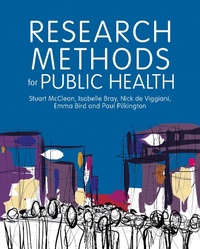
Research Methods for Public Health
1st Edition
Published on 30. September 2019
296 pages
978-1-5264-8552-6 (ISBN)
Description

Research Methods for Public Health offers an in-depth introduction to the theories, concepts, approaches and practices, relevant to research methods in a public health setting. Informed by a socio-ecological model of public health, the book uses real world research examples and contemporary social, political and environmental themes of public health that reflect UK and international contexts.
The book provides a straightforward approach to developing a research project and applying methods in practical and realistic ways, using an innovative, integrative approach that combines methodologies. The authors have moved away from traditional approaches to research methods, and include chapters on primary quantitative, qualitative and mixed methods research, evidence synthesis approaches, critical appraisal, research governance and ethics, and dissemination.
Essential reading for postgraduate students, researchers and public health practitioners, or individuals preparing for the UK Faculty of Public Health Part A examination.
The book provides a straightforward approach to developing a research project and applying methods in practical and realistic ways, using an innovative, integrative approach that combines methodologies. The authors have moved away from traditional approaches to research methods, and include chapters on primary quantitative, qualitative and mixed methods research, evidence synthesis approaches, critical appraisal, research governance and ethics, and dissemination.
Essential reading for postgraduate students, researchers and public health practitioners, or individuals preparing for the UK Faculty of Public Health Part A examination.
Reviews / Votes
This text is easy to read and makes good use of examples, which are clear and directed at an appropriate level for Post Graduate Public Health students. The use of applied examples and case studies from a range of contexts make this book relevant to a wide audience. Chapters cover core aspects needed for the teaching of Public Health Research methods, in particular, the focus on mixed methods, which is becoming a more prominent methodology in Public Health research.-- Jacques Oosthuizen Research Methods for Public Health is an excellent resource covering a broad range of research methodologies, as well as being a welcome source of inspiration for integrating these methods. I highly recommend this book as an introductory text for students of Public Health, as well as a companion book for any researcher working in the field. -- Fredrik Saboonchi
More details
Edition
1. Auflage
Language
English
Place of publication
London
United Kingdom
Target group
College/higher education
Product notice
Reflowable
ISBN-13
978-1-5264-8552-6 (9781526485526)
Copyright in bibliographic data and cover images is held by Nielsen Book Services Limited or by the publishers or by their respective licensors: all rights reserved.
Schweitzer Classification
Other editions
Additional editions
Stuart McClean | Isabelle Bray | Nick de Viggiani
Research Methods for Public Health
Book
10/2019
1st Edition
SAGE Publications Ltd
€86.10
Shipment within 15-20 days
Stuart McClean | Isabelle Bray | Nick de Viggiani
Research Methods for Public Health
Book
10/2019
1st Edition
SAGE Publications Ltd
€172.70
Shipment within 15-20 days
Persons
Dr Stuart McClean is a social anthropologist and social scientist working at UWE, Bristol as a Public Health academic. He is leader of the MSc Public Health Programme, a successful and internationally recognised Masters. He is also a research theme leader in the Public Health and Wellbeing Research Group on 'Inequality, Disadvantage and Public Policy'. Stuart is a fellow of the Royal Society of Public Health, the Royal Anthropological Institute and the Higher Education Academy, and is the Book Review Editor for the international journal 'Health', the co-editor of Folk Healing and Health Care Practices in Britain and Ireland (Berghahn, 2010), and more recently the co-author of Thinking About the Lifecourse (Palgrave, 2014). He holds a number of professional roles at the University, including Vice Chair of the Faculty Board and a member of the University Academic Board. He is also Pathway Lead (Health and Wellbeing) for the ESRC South West Doctoral Training Partnership. Having graduated in Geography from the University of Sheffield in 1987, Nick firstly trained as a Registered General Nurse in London, and subsequently completed his MSc degree in Health Promotion at the University of Manchester in 1991. His growing interest in health inequalities led him into a career in health promotion, working with Wigan Area Health Authority as a Health Promotion Officer for HIV and AIDS. In 1993, he was appointed as a Lecturer in Health Promotion at Liverpool John Moores University, and since 1998 has worked at UWE Bristol as a Senior Lecturer in Public Health. In 2003, Nick completed his PhD with the University of Bristol, having completed an ethnography involving men in prison, exploring prison masculinities as determinants of health. This led to various funded research projects involving people in the criminal and youth justice systems, including a Big Lottery funded three-year study involving young offenders, undertaken in partnership with a music charity. Much of Nick's research in the criminal justice health sector has involved developing relations with regional and national stakeholders across public, private and third sector agencies, and with colleagues at other UK universities. He is particularly interested in working with hard-to-reach groups, sometimes described as 'challenging' or 'vulnerable', including male and female young offenders, older prisoners, sex offenders and foreign national prisoners, across different provider organisations. A key objective of Nick's work has been to explore, explain and tackle health and social inequality. His current research is seeking to involve people in the criminal and youth justice systems in peer led research mentoring and advocacy.? Emma Bird is a Senior Lecturer in Public Health at the University of the West of England (UWE), Bristol. Emma obtained a BSc in Psychology (University of Liverpool, 2008) and was awarded an MSc in Health Psychology, with Distinction, from UWE in 2010. Emma joined the Faculty of Health and Life Sciences at UWE in 2010 as a researcher and was appointed as Senior Lecturer in 2014.
Emma's research interests are wide-ranging, although she is particularly interested in how the environment may influence health behaviour and health behaviour change. Recent and current research projects include:
iConnect (Impact of COnstructing Non-motorised Networks and Evaluating Changes in Travel) - A UK-wide project examining the impact of newly constructed infrastructure on walking and cycling, overall physical activity and carbon emissions (www.iconnect.ac.uk);
CARS (Coroners' records for Action on Road Safety) - An examination of coroners' records to better understand the factors involved in fatal road traffic collisions among young people;
Bristol Girls Dance Project - A cluster-randomised controlled trial of an after-school dance programme to increase physical activity among 11-12 your old girls (www.bristol.ac.uk/sps/research/).
Facts4Life - A controlled evaluation of a school-based health education intervention with pre-adolescent children.
Emma contributes to teaching across the University, including MSc Public Health and BSc/PGDip Specialist Community Public Health Nursing (SCPHN) programmes. She leads two modules: Health Promotion (MSc Public Health) and Principles of Evidence Based Public Health (SCPHN).
Emma is a professional member of the International Society for Physical Activity and Health.
Paul Pilkington is a Senior Lecturer in Public Health in the Department of Health and Social Sciences, Faculty of Health and Applied Sciences. He leads the Environment and Sustainability for Health Improvement research theme, based in the Public Health and Wellbeing Research Group. The theme advances research across the university on issues relating to healthy and sustainable environments, bringing together researchers from public health with those across the university and beyond. Taking a socio-ecological approach to public health, Paul's research interests centre on how the promotion of healthy and sustainable environments can impact on population level health and wellbeing. Paul has a particular interest in the relationship between the built environment and health, particularly issues relating to road safety (measures to reduce danger in the road environment) and spatial planning (the better consideration of health in the planning process). Paul is an experienced teacher, and contributes to teaching on the highly successful MSc Public Health, and the Specialist Community Public Health Nursing programme, as well as other courses at both undergraduate and postgraduate levels across the university. Paul is a Specialty Tutor on the Public Health Specialty Training Programme in the South West, leading the development and management of specialty training provision at UWE. He is also an Academic Supervisor, member of the Regional Training Committee, and an Assessor on the National Public Health Specialty Training Assessment Centre. Paul is a Fellow of the Faculty of Public Health and has completed NHS higher specialist training in public health, being registered on the UK Register for Public Health Specialists. Paul is a reviewer for several international peer-reviewed journals, including Public Health, Journal of Public Health, Journal of Transport and Health, and Injury Prevention. Paul is also a member of the SHINE Health Integration Team in Bristol. Paul is Co-Primary Investigator in a major new project, funded by the Wellcome Trust, entitled Moving health and sustainability upstream into strategic urban development decision making.
Emma's research interests are wide-ranging, although she is particularly interested in how the environment may influence health behaviour and health behaviour change. Recent and current research projects include:
iConnect (Impact of COnstructing Non-motorised Networks and Evaluating Changes in Travel) - A UK-wide project examining the impact of newly constructed infrastructure on walking and cycling, overall physical activity and carbon emissions (www.iconnect.ac.uk);
CARS (Coroners' records for Action on Road Safety) - An examination of coroners' records to better understand the factors involved in fatal road traffic collisions among young people;
Bristol Girls Dance Project - A cluster-randomised controlled trial of an after-school dance programme to increase physical activity among 11-12 your old girls (www.bristol.ac.uk/sps/research/).
Facts4Life - A controlled evaluation of a school-based health education intervention with pre-adolescent children.
Emma contributes to teaching across the University, including MSc Public Health and BSc/PGDip Specialist Community Public Health Nursing (SCPHN) programmes. She leads two modules: Health Promotion (MSc Public Health) and Principles of Evidence Based Public Health (SCPHN).
Emma is a professional member of the International Society for Physical Activity and Health.
Paul Pilkington is a Senior Lecturer in Public Health in the Department of Health and Social Sciences, Faculty of Health and Applied Sciences. He leads the Environment and Sustainability for Health Improvement research theme, based in the Public Health and Wellbeing Research Group. The theme advances research across the university on issues relating to healthy and sustainable environments, bringing together researchers from public health with those across the university and beyond. Taking a socio-ecological approach to public health, Paul's research interests centre on how the promotion of healthy and sustainable environments can impact on population level health and wellbeing. Paul has a particular interest in the relationship between the built environment and health, particularly issues relating to road safety (measures to reduce danger in the road environment) and spatial planning (the better consideration of health in the planning process). Paul is an experienced teacher, and contributes to teaching on the highly successful MSc Public Health, and the Specialist Community Public Health Nursing programme, as well as other courses at both undergraduate and postgraduate levels across the university. Paul is a Specialty Tutor on the Public Health Specialty Training Programme in the South West, leading the development and management of specialty training provision at UWE. He is also an Academic Supervisor, member of the Regional Training Committee, and an Assessor on the National Public Health Specialty Training Assessment Centre. Paul is a Fellow of the Faculty of Public Health and has completed NHS higher specialist training in public health, being registered on the UK Register for Public Health Specialists. Paul is a reviewer for several international peer-reviewed journals, including Public Health, Journal of Public Health, Journal of Transport and Health, and Injury Prevention. Paul is also a member of the SHINE Health Integration Team in Bristol. Paul is Co-Primary Investigator in a major new project, funded by the Wellcome Trust, entitled Moving health and sustainability upstream into strategic urban development decision making.
Content
Part 1: Quantitative Methods for Public Health
Chapter 1: Epidemiology
Chapter 2: Sampling
Chapter 3: Collecting Quantitative Data
Chapter 4: Quantitative Data Analysis
Chapter 5: Quality and Rigour in Quantitative Research
Part 2: Qualitative Methods for Public Health
Chapter 6: Methodological Approaches and Basic Principles
Chapter 7: Accessing and Selecting Cases in Qualitative Research
Chapter 8: Collecting Qualitative Data
Chapter 9: Qualitative Data Analysis
Chapter 10: Quality and Rigour in Qualitative Research
Part 3: Mixing it Up: Combining Methods and Evidence Synthesis in Public Health
Chapter 11: Mixed methods research and evaluation design
Chapter 12: Evidence synthesis approaches: Systematic reviews
Chapter 13: Evidence synthesis approaches: Meta-ethnography and realist synthesis
Part 4: Applying Research to Public Health Practice
Chapter 14: The Ethics of Public Health Research
Chapter 15: Writing up, Dissemination and Publication
Chapter 1: Epidemiology
Chapter 2: Sampling
Chapter 3: Collecting Quantitative Data
Chapter 4: Quantitative Data Analysis
Chapter 5: Quality and Rigour in Quantitative Research
Part 2: Qualitative Methods for Public Health
Chapter 6: Methodological Approaches and Basic Principles
Chapter 7: Accessing and Selecting Cases in Qualitative Research
Chapter 8: Collecting Qualitative Data
Chapter 9: Qualitative Data Analysis
Chapter 10: Quality and Rigour in Qualitative Research
Part 3: Mixing it Up: Combining Methods and Evidence Synthesis in Public Health
Chapter 11: Mixed methods research and evaluation design
Chapter 12: Evidence synthesis approaches: Systematic reviews
Chapter 13: Evidence synthesis approaches: Meta-ethnography and realist synthesis
Part 4: Applying Research to Public Health Practice
Chapter 14: The Ethics of Public Health Research
Chapter 15: Writing up, Dissemination and Publication
