

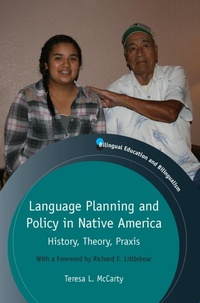
Language Planning and Policy in Native America
History, Theory, Praxis
Published on 19. February 2013
280 pages
978-1-84769-865-0 (ISBN)
Description

Comprehensive in scope and rich in detail, this book explores language planning, language education, and language policy for diverse Native American peoples across time, space, and place. Based on long-term collaborative and ethnographic work with Native American communities and schools, the book examines the imposition of colonial language policies against the fluorescence of contemporary community-driven efforts to revitalize threatened mother tongues. Here, readers will meet those who are on the frontlines of Native American language revitalization every day. As their efforts show, even languages whose last native speaker is gone can be reclaimed through family-, community-, and school-based language planning. Offering a critical-theory view of language policy, and emphasizing Indigenous sovereignties and the perspectives of revitalizers themselves, the book shows how language regenesis is undertaken in social practice, the role of youth in language reclamation, the challenges posed by dominant language policies, and the prospects for Indigenous language and culture continuance current revitalization efforts hold.
Reviews / Votes
In terms of both the breadth and depth of scholarship Teresa L. McCarty's Language Planning and Policy in Native America is an extraordinary contribution. The work of those in Native language revitalization, the perspectives of a number of academic disciplines as well as education and Native language policy development are uniquely and artfully brought together in this volume by a scholar whose career has had significant involvement and contribution in each area. -- David Beaulieu, Electa Quinney Institute for American Indian Education, University of Wisconsin-Milwaukee, USA Grounding her position in the principles of tribal sovereignty, McCarty provides an insightful, thoroughly investigated, and critical examination of the complexities of Native American language rights and change. She deconstructs commonly held perceptions and theoretical positions of language change and re-introduces us to the multifaceted and resilient qualities of Native peoples and their languages in our contemporary world. -- Tiffany S. Lee, Native American Studies, University of New Mexico, USA McCarty's Language Planning and Policy in Native America is a beautiful testimonial to this historic time when Native American communities are taking control of their own linguistic futures. In contrast to the view of language policy as primarily a top-down set of regulations from various levels of government and authorities, McCarty recognizes the primacy of tribal sovereignity, and puts together a new and exciting approach to LPP in Native America as indigenous and community-driven. This inspired and hopeful volume provides a theoretical analysis of the history of oppression and subsequent reclamation of Native American languages, combined with current case studies and a view to the future through the eyes of indigenous youth. A must-read for community language activists and all those interested in language revitalization. -- Leanne Hinton, University of California at Berkeley, USA Language Planning and Policy will serve as a valuable resource for scholars interested in establishing research agendas in language policy and planning, education policy, or work with Indigenous communities. McCarty's theoretical framework provides a resource for understanding how language policy shapes and is shaped by Indigenous communities. Teresa L. McCarty, as a professor and researcher, successfully presents her argument in an attempt to better understand the inequities facing Native communities. -- Idalia Nunez, University of Texas at Austin * Education Review, March 2014 *More details
Series
Language
English
Place of publication
Bristol
United Kingdom
Publishing group
Channel View Publications Ltd
Target group
Professional and scholarly
ISBN-13
978-1-84769-865-0 (9781847698650)
Copyright in bibliographic data and cover images is held by Nielsen Book Services Limited or by the publishers or by their respective licensors: all rights reserved.
Schweitzer Classification
Other editions
Additional editions
Book
02/2013
Multilingual Matters
€48.70
Shipment within 10-20 days
Person
Teresa L. McCarty is the George F. Kneller Chair in Education and Anthropology at the University of California, Los Angeles, and the Alice Wiley Snell Professor Emerita of Education Policy Studies at Arizona State University. An educational anthropologist and applied linguist, she has worked with Indigenous education programs throughout North America. Her books include A Place To Be Navajoa??Rough Rock and the Struggle for Self-Determination in Indigenous Schooling (2002); Language, Literacy, and Power in Schooling (2005); 'To Remain an Indian'??: Lessons in Democracy from a Century of Native American Education (with K. T. Lomawaima, 2006), and Ethnography and Language Policy (Routledge, 2011).
Content
Dedication
Statement by Miami Tribe of Oklahoma Chief Thomas Gamble
Foreword by Richard E. Littlebear
Acknowledgements
Preface
1. Contextualizing Native American LPP: Legal-Political, Demographic, and Sociolinguistic Foundations
2. Conceptualizing Native American LPP: Critical Sociocultural Foundations
3. Native American Languages In and Out of the Safety Zone, 1492-2012
4.Indigenous Literacies, Bilingual Education, and Community Empowerment: The Case of Navajo
5. Language Regenesis in Practice
6. Language in the Lives of Indigenous Youth
7. Planning Language for the Seventh Generation
Appendix
References
Index
Statement by Miami Tribe of Oklahoma Chief Thomas Gamble
Foreword by Richard E. Littlebear
Acknowledgements
Preface
1. Contextualizing Native American LPP: Legal-Political, Demographic, and Sociolinguistic Foundations
2. Conceptualizing Native American LPP: Critical Sociocultural Foundations
3. Native American Languages In and Out of the Safety Zone, 1492-2012
4.Indigenous Literacies, Bilingual Education, and Community Empowerment: The Case of Navajo
5. Language Regenesis in Practice
6. Language in the Lives of Indigenous Youth
7. Planning Language for the Seventh Generation
Appendix
References
Index
